In 2003, Michael Lewis published Moneyball, a New York Times best seller which explored how the Oakland Athletics used statistical analysis to build a competitive baseball team despite limited financial resources (Chang and Zenilman 2013). Forecasting has since played an increasingly important role in professional sports, as teams turn to data-driven insights to gain a competitive advantage. Today, nearly every major professional sports organization employs analytic experts who study player statistics and historical performance data to predict future games and optimize their roster (Wang 2018). Even the National Hockey League (NHL), which has historically lagged behind other major professional leagues in adopting analytics, has seen a marked increase in analytics personnel, as demonstrated in Figure 1 (Goldman 2022).
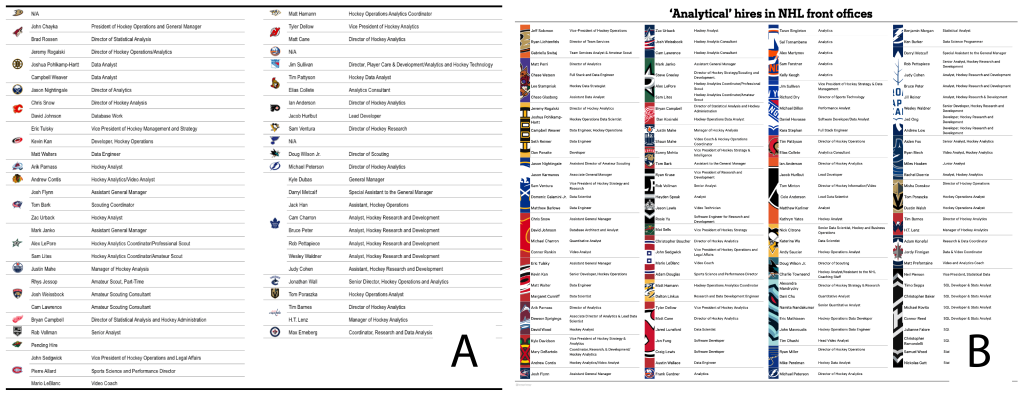
Figure 1: Comparison of analytics personnel employed by NHL organizations in a) 2019 and b) 2022. The number of identified analytics personnel increased from 51 to 95 in 2022, an increase of approximately 86% (Goldman 2022)
The success of analytics is reflected by the success of Sunny Mehta and Eric Tulsky, who rose from independent hockey analysts to NHL executives and contributed significantly to their respective organizations Stanley Cup winning teams. Their achievements illustrate how statistical analysis can contribute directly to competitive success.
The applications of predictive analytics extend beyond traditional sports. Broadly defined as competitive video gaming (Wollesen et al. 2025), esports has rapidly gained substantial global popularity, as reflected in its viewership. For instance, the League of Legends 2025 World Championship reached a peak viewership of 6 million viewers during the grand final (ESPORTS charts n.d). As esports continues to grow in popularity and competitive parity, there is increasing potential to apply the same data-driven approach used in traditional sports to evaluate player performance, optimize team strategies, and predict match outcome (Wang 2018).
Hitar-García et al. (2023) investigated the potential of machine learning to predict professional League of Legends (LoL) match outcomes using only pregame statistics. LoL is a multiplayer online battle arena game where two teams, composed of five players each, face off with the objective of the opposing team’s base by eliminating enemies and capturing objectives across the map (Junior and Campelo 2023). Hitar-García et al. (2023) analyzed 7,583 professional matches, collecting information about participating teams, players, champion selections, and match results. Using historical win rates, they developed new statistical variables to capture relationships between individual players, champion selections, role performance, team compositions, and historical matchups. They identified the 28 most informative variables for predicting variables, which were then used to train several machine learning algorithms, including a stacking-based meta-model which combined predictions from multiple algorithms to produce a more accurate final prediction. When evaluated on 757 previously unseen matches, the stacking-based model achieved the highest prediction accuracy of over 70%.
Beyond predicting match outcomes, Hitar-García et al. (2023) also examined which variables contributed most strongly to the model’s predictions (Figure 2).
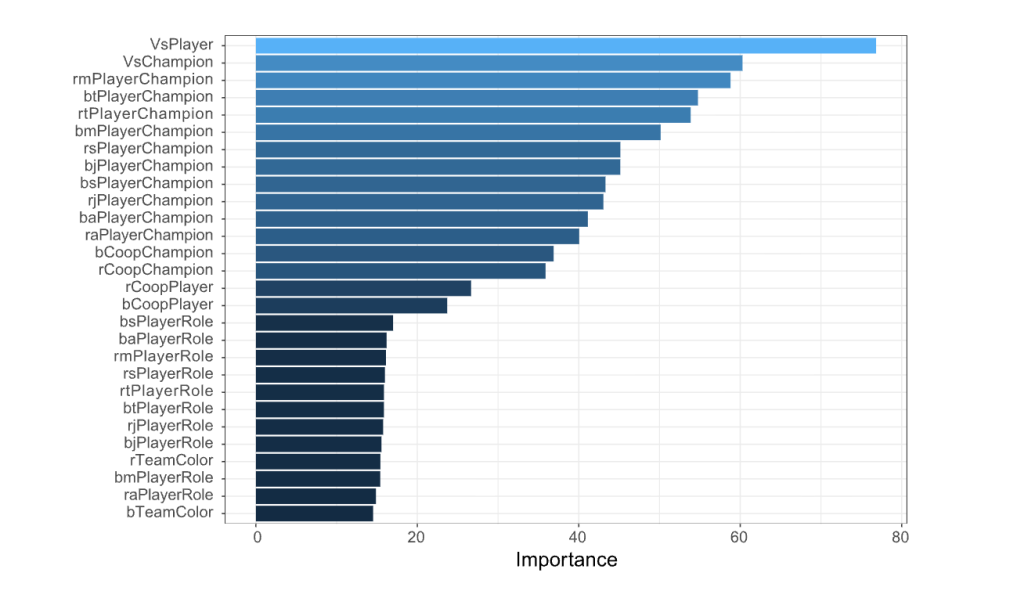
Figure 2: Bar graph charting which factors were most important when predicting the winning team in a game of League of Legends. Each bar represents a factor used to predict the winner, with longer bars indicating greater importance to the model’s predictions. The variables capture historical win rates between opposing players (VsPlayer), opposing champions (VsChampion), individual players using specific champion (PlayerChampion), champion combinations within a team (CoopChampion), players competing together (CoopPlayer), players in specific roles (PlayerRole), and teams playing on the blue or red side of the map (TeamColor). For player-specific variables, the first letter indicates the team (b = blue, r = red), and the second letter indicates the player’s role in the game (t = top, j = jungle, m = mid, a = ADC, s = support) (Hitar-García et al. 2023).
As illustrated in Figure 1, the most influential predictors were historical player-versus-player matchups (VsPlayer), which measures how often players have won against specific opposing players, and champion-versus-champion matchups (VsChampion), which measure how often specific champions have won against opposing champions. Contrastingly, variables which describe how well players and champions performed together on the same team (CoopPlayer; CoopChampion), player-role performance (PlayerRole), and a team’s starting position (TeamColor) had lower importance. By identifying influential factors, predictive analytics could help professional esports teams make more informed decisions on optimizing player selection and team composition relative to the configuration of the opposing team. Such advancements highlight the potential for data-driven approaches to support strategic decision making in professional esports.
References
2025 World Championship [Worlds 2025]—LoL – Viewership, Overview, Prize Pool | Esports Charts. (2026, October 15). https://escharts.com/tournaments/lol/2025-world-championship-worlds-2025
Chang, J., & Zenilman, J. (2013). A Study of Sabermetrics in Major League Baseball:The Impact of Moneyball on Free Agent Salaries. https://www.semanticscholar.org/paper/A-Study-of-Sabermetrics-in-Major-League-Baseball-%3A-Chang-Zenilman/e7900907fcadfa4ae1652dcbaf2d53b5a38eaa86
Goldman, S. (2022, June 24). Analytics in the NHL: Where it’s at and where it’s going next. The New York Times. https://www.nytimes.com/athletic/3381342/2022/06/24/nhl-analytics-stats/
Hitar-García, J. A., Morán-Fernández, L., & Bolón-Canedo, V. (2023). Machine Learning Methods for Predicting League of Legends Game Outcome. IEEE Transactions on Games, 15(2), 171–181. https://doi.org/10.1109/TG.2022.3153086
Junior, J. B. S., & Campelo, C. E. C. (2023). League of Legends: Real-Time Result Prediction. Anais Do XVI Congresso Brasileiro de Inteligência Computacional, 1–8. https://doi.org/10.21528/CBIC2023-161
Machine Learning Methods for Predicting League of Legends Game Outcome. (n.d.). Retrieved November 11, 2026, from https://ieeexplore.ieee.org/document/9720122
Wang, T. (2018). Predictive Analysis on eSports Games: A Case Study on League of Legends (LoL) eSports Tournaments. https://doi.org/10.17615/ez9n-t517
Wollesen, B., Tholl, C., & Thiel, A. (2025). Esports: Scientific significance, and the debate on its status as sport. German Journal of Exercise and Sport Research, 55(3), 313–318. https://doi.org/10.1007/s12662-025-01054-9


Leave a Reply
You must be logged in to post a comment.