Like many of you reading this, I did not know much or care much about curling. It seemed odd, easy to play, and, worst of all, boring. However, I quickly discovered that curling is a far more interesting sport than it may seem, and beneath its seemingly simple gameplay, it may even hold the physics answer to saving humanity.
Now, the stones used for curling are no ordinary stones. Curling stones are exclusively made on one tiny island off the coast of Scotland called Ailsa Craig. Approximately 60 million years ago, a granitic intrusion occurred as magma rose from beneath the surface. It cooled and solidified underground to form a granite plug. As a result of erosion, the granite plug is now exposed as Ailsa Craig. This microgranite has tightly interlocking mineral structures that make it very durable and water-resistant, making it ideal for curling stones. (Leung and McDonald 2022). Furthermore, the ice is also unusual. In preparation, purified water is sprayed onto the ice courts and allowed to freeze, creating a surface called “pebbled ice.” The pebbles reduce the contact area between the stone and the ice, allowing it to travel farther (See Figure 1) (Jensen and Shegelski 2021).
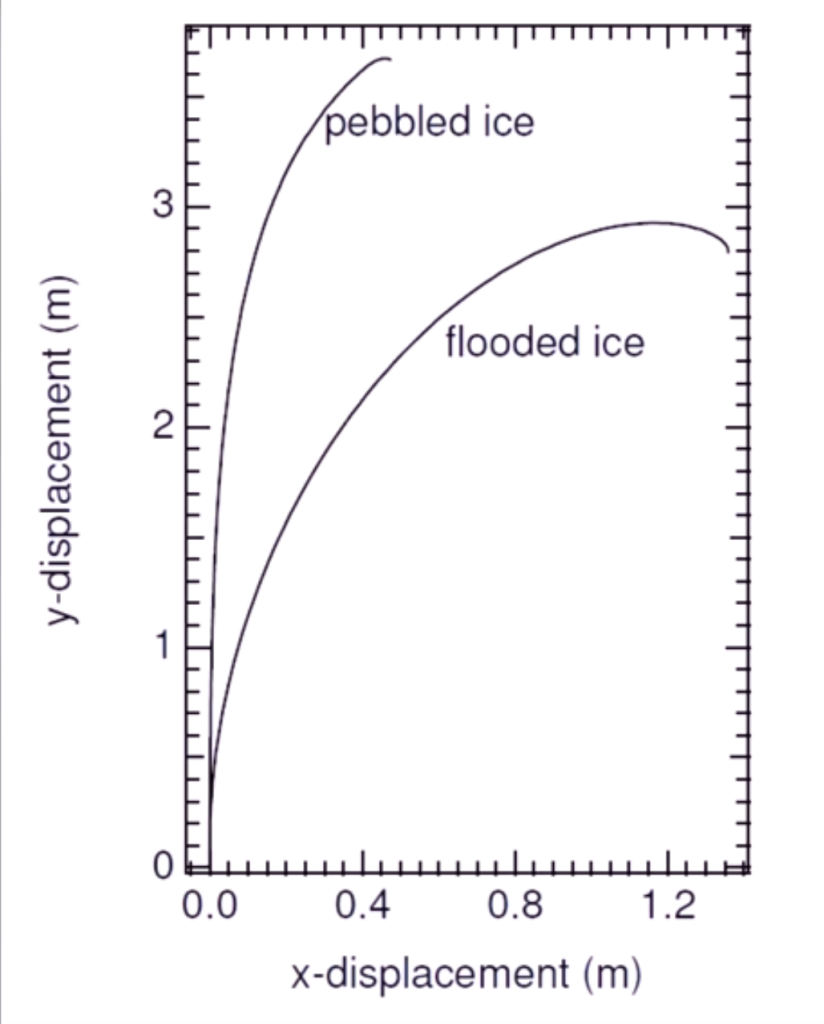
Figure 4. Trajectories of two rapidly rotating, slowly sliding curling rocks, one on pebbled ice and the other on flooded ice. The rock on pebbled ice follows a much straighter path compared to the one on flooded ice, which curls farther sideways (Jensen and Shegelski 2021).
However, what’s really mind-boggling is that, in everyday life, if an object is spun forward, for example, to the right, it will curl to the left (you can try this at home with a cup). Because of friction, as the cup moves forward, its top tends to tip forward. This shifts more weight toward the front, resulting in greater kinetic friction. Since frictional forces act in the direction opposite to motion, spinning the cup to the right causes the friction to act toward the left, slowing down the rotation at the front. The back of the cup now rotates faster, causing it to take the path of least resistance and curve to the left (See Video 1). However, curling stones do the opposite: they curl in the same direction they spin (Keating 2022).
Video 1. Explanation of the curved trajectory of a cup sliding and spinning to the right (Abram 2026).
This anomaly is particularly important because Europa, Jupiter’s moon, and Enceladus, Saturn’s moon, are considered among the most promising places to search for extraterrestrial life, particularly within their subsurface oceans. However, both oceans are covered by thick, 15–30 km layers of ice (NASA Science 2026). Scientists are developing cryobots equipped with drills that rotate and bore through these thick ice sheets. However, the friction between the two surfaces would influence their traction, direction, and overall efficiency when penetrating the ice (NASA Science 2023). Understanding the unusual physics behind curling stones could provide scientists with insight into how rotating objects interact with ice and design more reliable cryobots. The unique composition of microgranite could be a key component of the cryobots’ outer material, and how it interacts with pebbled ice could guide us in determining how the surrounding ice should be modified, rather than focusing solely on the machine.
Curling’s mechanics may seem like an unlikely connection to solutions to extraterrestrial exploration. However, all of the greatest scientific discoveries begin with a seemingly small observation. Gravity was famously inspired by a falling apple, just as the principles of flight were informed by birds. Science is interconnected, and ideas from seemingly unrelated fields can provide unexpected insights into some of humanity’s greatest challenges. And this time, it might just be curling.
References
Murata, Jiro. 2022. “Study of Curling Mechanism by Precision Kinematic Measurements of Curling Stone’s Motion.” Scientific Reports 12 (2022): 15047. September 3 https://doi.org/10.1038/s41598-022-19303-4 .
Grant, Alastair. 2025. “Photo Essay: Scottish Island Ailsa Craig Is the Granite Source for Olympic Curling Stones.” AP News, December 18 https://apnews.com/photo-essay/olympics-curling-island-ailsa-craig-scotland-photos-90cc3742fe35b63b87755ad126942c42 .
Keating, Shane. 2022. “The Slippery Science of Olympic Curling: We Still Don’t Know How It Works.” UNSW Newsroom, February 15. https://www.unsw.edu.au/newsroom/news/2022/02/the-slippery-science-of-olympic-curling–we-still-dont-know-how- .
NASA Science. 2023. “Digging Deeper to Find Life on Ocean Worlds.” December 5, https://science.nasa.gov/science-research/science-enabling-technology/digging-deeper-to-find-life-on-ocean-worlds/.
NASA Science. 2026 “Europa Up Close.” September 10 https://science.nasa.gov/mission/europa-clipper/why-europa-europa-up-close/
Leung, Derek D. V., and Andrew M. McDonald. 2022 . “Taking Rocks for Granite: An Integrated Geological, Mineralogical, and Textural Study of Curling Stones Used in International Competition.” Canadian Mineralogist 60, no. 1 (2022): 171–99. https://doi.org/10.3749/canmin.2100052.
Abram, Cleo. “Why This Olympic Sport Bothers Physicists. 2026. ” YouTube video, February 5, 2026. https://youtu.be/p60I9LNHNxg.
Jensen, E. T., and Mark R. A. Shegelski. 2021. “The Motion of Curling Rocks: Experimental Investigation and Semi-phenomenological Description.” Preprint, arXiv, December 18, 2021. https://arxiv.org/abs/2112.09835.


Leave a Reply
You must be logged in to post a comment.