A bowl of soup comes out of the microwave too hot to touch. The bowl and soup itself is hot, but the inside of the microwave is still all cold. There is no flame burning. Nothing gets warm before the food does like in a traditional oven. After about two minutes the food starts to steam. Turns out, the heat does not come from the oven at all and instead, energy goes into the water inside the food, heating it up.
Radiation moves energy through photons. The energy of each photon depends on its frequency. Higher frequency means more energy and lower frequency means less energy. The same idea applies to the photoelectric effect. Only light above a certain frequency can knock electrons off a metal. Light below that frequency cannot, even if it is very bright (Squires 2026).
Microwaves sit low on the spectrum, at 2.45 gigahertz. Each microwave photon has very little energy, hundreds of thousands of times less than a photon of visible light (Vollmer 2004). This kind of energy is too weak to break chemical bonds. And it certainly cannot make food radioactive (FDA n.d.). So heating also has to happen in a much gentler way.
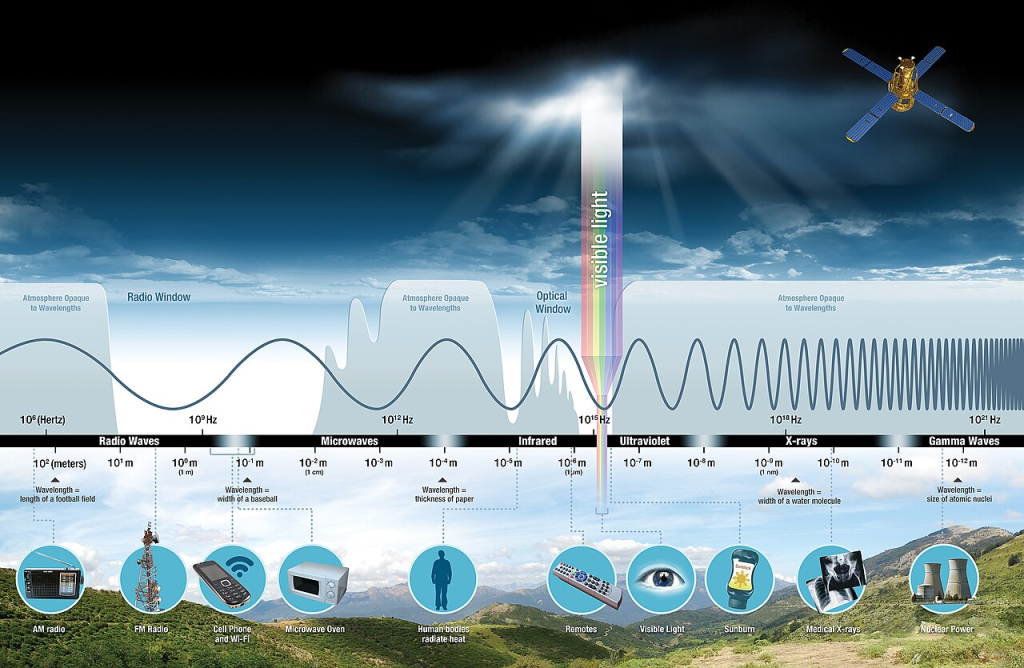
Figure 1. The electromagnetic spectrum. Frequency increases and wavelength decreases from left to right. Microwaves sit between radio waves and infrared, well below visible light and the ionising part of the spectrum, and a microwave oven is shown in that band. (NASA n.d., public domain, via Wikimedia Commons)
That gentler way uses water. Water molecules are polar, with each having a positive and a negative end. This is of course because electrons are not shared equally, because oxygen pulls them harder than hydrogen does. This causes the oxygen end to have a slight negative charge and the hydrogen end to have slight positive charges. This uneven charge also explains why water molecules form hydrogen bonds with each other (Khan Academy n.d.).
Inside a microwave oven the electric field changes direction billions of times every second. Water molecules rotate to match it. As they rotate they rub against their hydrogen bonds (Vollmer 2004). This rubbing causes friction at the molecular level, and friction turns movement into heat.
The waves also only go a few centimetres into the food. This means that the centre of a thick item warms by conduction from the outer layers (Vollmer 2004; FDA n.d.). This is why the centre can stay much colder than outer layers which is super frustrating. Standing waves also form inside the oven, making some parts hot and others cold. That is what the rotating plate inside the microwave counters (Vollmer 2004).
As we see, a microwave oven connects physics and chemistry concepts. Physics explains why the photons are too weak to break chemical bonds or damage food. Chemistry shows how polar water molecules turn that weak energy into heat, through their hydrogen bonds. They come together really nicely to quickly warm our food.
References
“Microwave Ovens.” 2024. FDA, January 11. https://www.fda.gov/radiation-emitting-products/resources-you-radiation-emitting-products/microwave-ovens.
Khan Academy. n.d. “Hydrogen Bonding in Water (Video).” Accessed November 12, 2026. https://www.khanacademy.org/hydrogen-bonding-in-water/v/hydrogen-bonding-in-water.
NASA. n.d. Electromagnetic spectrum diagram. Public domain, via Wikimedia Commons. Adapted by Inductiveload. https://commons.wikimedia.org/wiki/File:EM_Spectrum_Properties_reflected.svg
Squires, Gordon L. 2026. “Quantum Mechanics – Photoelectric Effect, Wave-Particle Duality, Einstein | Britannica.” November 12. https://www.britannica.com/science/quantum-mechanics-physics/Einstein-and-the-photoelectric-effect.
Vollmer, Michael. 2004. “Physics of the Microwave Oven.” Physics Education 39 (1): 74–81. https://doi.org/10.1088/0031-9120/39/1/006.


Leave a Reply
You must be logged in to post a comment.