Consider this: a man suffers a life-changing injury, subjecting him to severe amnesia. He cannot retain any new memories, and cannot or can rather vaguely remember his past life, including his childhood, his wife, and his kids. Yet somehow, when sat in front of a musical instrument he once played, could still effectively sight-read and perform.
This is the exact case of Clive Wearing, a renowned musicologist and conductor who underwent severe amnesia due to damage in the bilateral medial temporal lobe from herpes simplex encephalitis. Despite this, Clive retained his ability to sight-read, understand the significance of a metronome mark, and play and improvise the piano and organ (Cavaco et al. 2012). A similar case was observed in Patient H.M., later identified as Henry Molaison, who suffered from retrograde amnesia after an experimental neurosurgery to control his epileptic seizures. Like Clive, he could not retain any new memories, however, was able to trace the outline of a star reflected in a mirror during 10 trials across 3 days despite having no recollection of performing the task before (Squire 2009).
A 2004 study also investigated 10 amnesic patients’ acquisition and retention performance on five experimental tasks: weaving, tracing geometric figures, tracking a visual target using a joystick, pouring water into graduated cylinders, and pushing five spatially distributed buttons. Despite their damaged memory, the patients retained all of the five skills, demonstrating that preserved learning of complex motor skills is applicable across a variety of conditions and perceptual-motor demands (Cavaco 2004).
These findings point to the fundamental idea that memory is not a single system, but rather an amalgamation of several entities that depend on different brain systems (Squire and Zola 1996). This can be further explained by the concept of declarative vs non-declarative or procedural memory. Declarative memory refers to conscious knowledge of facts and events, which was impaired in both Clive Wearing and Patient H.M.. Conversely, Clive and H.M. preserved their procedural memory, known as the skill-based knowledge that develops gradually and unconsciously (Squire 2009). The distinction and complexities of these systems is illustrated in Figure 1.
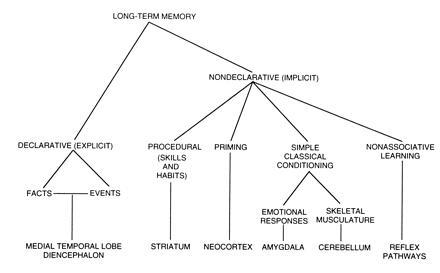
Areas adjacent to the hippocampal formation are essential to the medial temporal lobe memory system that supports declarative memory. Thus, bilateral damage to the hippocampal formation is sufficient enough to induce severe anterograde amnesia and temporally graded retrograde amnesia whilst leaving non-declarative memory systems intact (Squire and Zola 1996).
The cases of Clive and H.M. exhibit that memory works as a set of systems with its own brain regions rather than a single entity. These findings are crucial to the future of the neurological treatment of amnesia, as the ability to retain certain aspects of information can both comfort and shape a patient’s life, ultimately aiding people with severe memory loss.
References
Cavaco, S. 2004. “The Scope of Preserved Procedural Memory in Amnesia.” Brain 127 (8): 1853–67. https://doi.org/10.1093/brain/awh208.
Cavaco, Sara, Justin S. Feinstein, Henk van Twillert, and Daniel Tranel. 2012. “Musical Memory in a Patient With Severe Anterograde Amnesia.” Journal of Clinical and Experimental Neuropsychology 34 (10): 1089–100. https://doi.org/10.1080/13803395.2012.728568.
Squire, Larry R. 2009. “The Legacy of Patient H.M. For Neuroscience.” Neuron 61 (1): 6–9. https://doi.org/10.1016/j.neuron.2008.12.023.
Squire, Larry R., and Stuart M. Zola. 1996. “Structure and Function of Declarative and Nondeclarative Memory Systems.” Proceedings of the National Academy of Sciences 93 (24): 13515–22. https://doi.org/10.1073/pnas.93.24.13515.


Leave a Reply
You must be logged in to post a comment.