Life Beneath Blood Falls

Blood Falls is famous for its blood-like cascade against the white terminus of Taylor Glacier in Antarctica’s McMurdo Dry Valleys. This waterfall features hypersaline, iron-rich discharge that originates from an extensive subglacial brine system (Lyons et al. 2019). The chemistry behind this waterfall not only contributes to its astonishing colour, but also allows extreme life forms to thrive within it. 

Blood Falls does not flow with actual blood, but rather iron-rich water. The water beneath the glacier contains a highly concentrated mineral brine, with reported dissolved iron concentrations of 418–476 µM  (Lyons et al. 2019). This iron-rich brine interacts with surrounding rocks and sediments beneath the glacier. When the brine reaches the surface and comes into contact with atmospheric oxygen, dissolved ferrous iron (Fe²⁺) oxidizes into ferric iron (Fe³⁺), forming reddish-brown, ferric iron precipitates (Equation 1) (Mikucki et al. 2004).

Equation 1. Ferrous iron (Fe²⁺) in the subglacial brine reacts with atmospheric oxygen and water upon reaching the surface, producing solid ferric hydroxide precipitates (Fe(OH)₃) and aqueous hydrogen ions (Mikucki et al. 2004).

Mikucki et al. (2009) propose that the accumulation of dissolved iron beneath the glacier is also supported by microbial metabolic processes. In this anoxic environment, microorganisms participate in interconnected iron and sulfur cycles that contribute to the availability of dissolved iron. During microbial iron reduction, ferric iron (Fe³⁺) serves as a terminal electron acceptor, becoming reduced to the more soluble ferrous form (Fe²⁺). Additionally, microorganisms contribute to sulfur cycling by transforming sulfur between different chemical forms. Certain reduced sulfur compounds can also chemically reduce ferric iron to ferrous iron, further contributing to iron cycling within the subglacial brine (Figure 1).
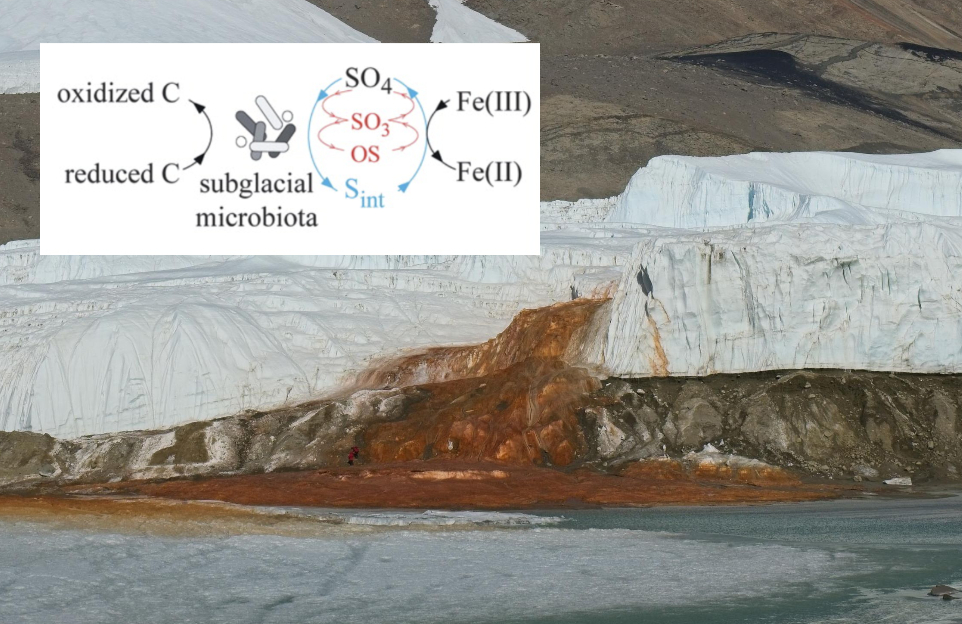
Figure 1. Image of crimson-red outflow of hypersaline, iron-rich brine emerging from Blood Falls in the McMurdo Dry Valleys, Antarctica. In dark, anoxic reservoirs, subglacial microbes survive without photosynthesis by coupling carbon oxidation reactions with sulfur and iron reduction (Mikucki et al. 2009). Microbes reduce sulfate (SO₄²⁻) to sulfite (SO₃²⁻), and other compounds (OS, Sᵢₙₜ). These compounds interact with ferric iron (Fe(III)) from bedrock, reducing it to soluble ferrous iron (Fe(II)), keeping it in a dissolved form in the reservoir. When this ferrous-rich brine reaches the surface and hits oxygen, it oxidizes to form red iron precipitates. (Image adapted from Mikucki et al. (2009); modifications made by the author).

The microbial community within this environment includes members of Proteobacteria, Bacteroidetes, and other microbial groups (Mikucki and Priscu 2007). These organisms exhibit adaptations that allow them to survive multiple environmental extremes. Psychrophiles tolerate extremely cold temperatures, halophiles thrive in highly saline conditions, and anaerobes are adapted to environments lacking oxygen. The high salt concentration of the brine also lowers its freezing point, allowing liquid water to persist despite the subzero temperatures beneath the glacier (Lyons et al. 2019). The persistence of liquid water is particularly important because it provides the aqueous environment necessary for microbial metabolic processes.

Microorganisms within this subglacial environment demonstrate the remarkable adaptability of life, challenging perceptions of habitability. Blood Falls is one of many examples on Earth that show how conditions that may initially appear inhospitable support complex microbial ecosystems. This highlights the importance of broadening our understanding of where life can exist. Although Earth analogues remain valuable in the search for other life forms, we must avoid limiting our expectations to environments that resemble those most familiar to us. Even some of Earth’s coldest, saltiest, and bloodiest environments can support life.

References

Lyons, W. B., J. A. Mikucki, L. A. German, et al. 2019. “The Geochemistry of Englacial Brine from Taylor Glacier, Antarctica.” Journal of Geophysical Research: Biogeosciences 124: 633–648. https://doi.org/10.1029/2018JG004411.

Mikucki, J. A., C. M. Foreman, B. Sattler, et al. 2004. “Geomicrobiology of Blood Falls: An Iron-Rich Saline Discharge at the Terminus of the Taylor Glacier, Antarctica.” Aquatic Geochemistry 10: 199–220. https://doi.org/10.1007/s10498-004-2259-x.

Mikucki, Jill A., Ann Pearson, David T. Johnston, et al. 2009. “A Contemporary Microbially Maintained Subglacial Ferrous ‘Ocean.’” Science 324 (5925): 397–400. https://www.science.org/doi/10.1126/science.1167350

Mikucki, Jill A., and John C. Priscu. 2007. “Bacterial Diversity Associated with Blood Falls, a Subglacial Outflow from the Taylor Glacier, Antarctica.” Applied and Environmental Microbiology 73 (12): 4029–4039. https://doi.org/10.1128/AEM.01396-06

Comments

6 Responses to “Life Beneath Blood Falls”

  1. Amelia Nolan Avatar
    Amelia Nolan

    Hi iSci!

    This post draws on extremophiles, redox reactions and thermochemistry/solubility we learned in LifeSci and Chemistry. It also ties into habitability and space exploration from RP1. I thought it was really interesting how this unique environment was actually a place where organisms thrive. Researching about this ultimately (once again), expanded my perspective on habitability. Enjoy reading– I look forward to hearing your thoughts!

    – Amelia

  2. Naomi Georges Avatar
    Naomi Georges

    Hi Amelia,

    I really enjoyed your blog post and you did very well integrating multiple scientific concepts! Here are a couple suggestions:

    – Typically, in reports I have read, there aren’t equation captions. I think you can keep it there if you feel like it provides information, but I found that you explained it pretty well in the last sentence of P2. You can probably combine the information in the equation caption and P2S4.
    – After you mention that ferrous iron is Fe²⁺ and ferric iron is Fe³⁺, you don’t have to specify that again. So in P3, you can just refer to them by the chemical symbol (or by the Latin name), but you don’t have to do both.
    – If you found anything in your research about where, specifically, these extremophilic traits may be useful extraterrestrially (like how methanogens on Earth could be related to Titan’s environment), you could include that in your conclusion, but it’s definitely not necessary!

    Overall, I really liked your post and I look forward to reading your final copy!
    Naomi

  3. Ethan Yoon Avatar
    Ethan Yoon

    Hello, Naomi! Awesome job on your blog post, and it was so interesting reading about yet another wonder of nature that I never knew existed! I just have a couple of comments:
    1. Paragraph 2, sentence 1: This sentence reiterates what you talk about in the first paragraph, making both a bit repetitive. Consider moving this sentence up or getting rid of it!
    2. Paragraph 3, sentence 2: Consider defining anoxic, as it’s not the most common term (even though we’ve definitely heard it a lot in iSci!).
    3. Paragraph 4, sentence 1: Since Proteobacteria and Bacterioidetes are phyla, it would be awesome if you italicized them.

    Once again, awesome job, and I can’t wait to see the final version!

    – Ethan

    1. Ethan Yoon Avatar
      Ethan Yoon

      Sorry! I meant Amelia – where did I get Naomi from?

  4. Ayn Son Avatar
    Ayn Son

    Hi Amelia!

    Loved reading your post! I loved the connection to RP1!

    Here are a couple of suggestions:

    P2S4: You have “(Equation 1) (Mikucki et al. 2004).” Rather than having two sets of parentheses next to each other, it would be more seamless to make it (Equation 1; Mikucki et al. 2004).

    From P2-P3: You already specify what ferrous iron and ferric iron are in P2, so you don’t have to reiterate in P3.

    P3S1: You might want to use the word “proposes” instead of “propose.”

    Loved reading your blog post. I look forward to reading the final draft.
    Ayn

  5. Cassia Moracci Avatar
    Cassia Moracci

    Hi Amelia!

    I really enjoyed reading your blog post. I really enjoyed reading more about Blood Falls since I’ve only ever heard of it in passing!

    – Throughout your post, you’ve written “sulfur,” which is the American spelling; consider changing those to “sulphur” to adhere to the British conventions we use here.
    – For your last source, I think you may have added an extra “Enter,” which could have slightly messed up the format.
    – Finally, I just think you could reword P3S1 to “Mikucki et al. (2009) propose that microbial metabolic processes also support the accumulation of dissolved iron beneath the glacier.” to help the sentence flow better.

    Overall, great post, can’t wait to read the final product!
    Cassia

Leave a Reply