Depression is a state of mind that almost everyone will experience at one point or another in their life. Many theories for why depression occurs and how we can combat it exist but the one that interests me the most is the one that suggests that depression, far from being an abnormality, exist as an evolutionary survival mechanism. One of the most interesting psychological patterns that can occur with depression is learned helplessness (Miller et al. 1975). One of the first papers to report this phenomenon was a 1967 study in which dogs were automatically shocked and either had the option to stop the shocks by doing some action or the shocks would occur completely independent of their actions (Seligman and Maier 1967). Since this study was released numerous studies have been done looking at this phenomenon. However, for some the learned helplessness hypothesis does not fully encapsulate the behaviours that they are witnessing.
One interesting hypothesis that may be in play along with the learned hypothesis model in the altered hypothesis pool model. This model suggests that instead of subjects learning that their choices do not matter, instead it leads them to assume that the solutions to their problems are highly complex (Peterson 1978). In one experiment, rats, who were pretreated with no shocks, escapable shocks or inescapable shocks, were put in a y-shaped maze with one arm of the maze halting shocks after being moved into (Minor et al. 1984). In addition, different arms of the maze were illuminated for various groups of rats to test how irrelevant cues would affect the rats decision making process. Interestingly, the inescapably shocked group of rats were the only ones affected by the irrelevant cues and mainly had more errors when the correct path was illuminated (Figure 1).
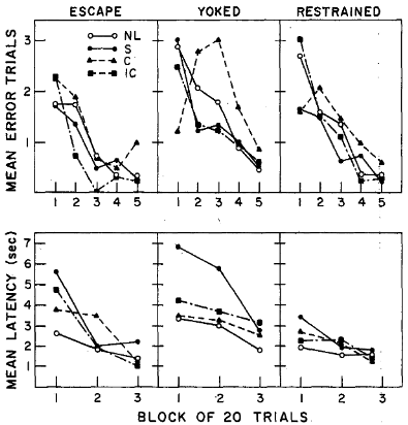
In addition, there was no meaningful connection between the latency of decision making and number of errors. This may suggest that the rats are actually testing hypotheses that the light is signaling the incorrect pathway. In addition, in a study conducted by Lee and Maier (1988) it was found that rats exposed to inescapable shocks fared much worse when presented with irrelevant cues but when presented with relevant cues their performance increased dramatically, making the rats exposed to the inescapable treatment perform even better than the other two (Figure 2).
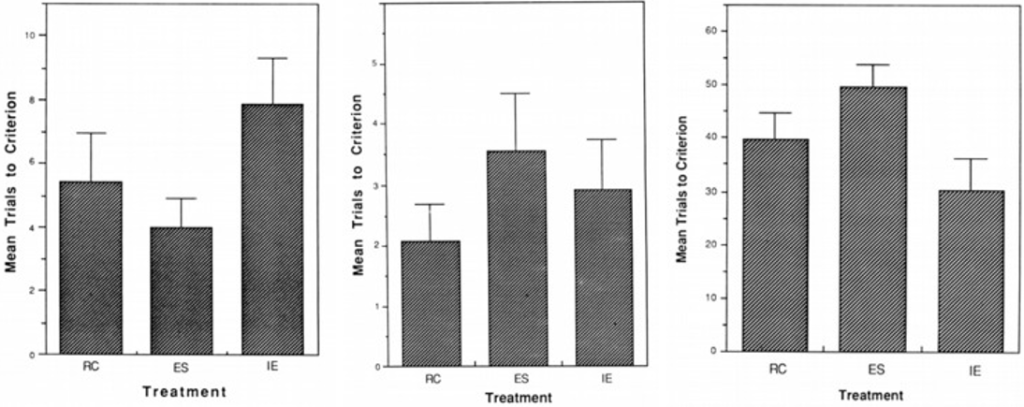
These experiments suggest that when exposed to harmful stimuli, rats have a tendency to perceive external stimuli as more important to determining correct responses than internal ones. This conflicts with some aspects of the learned helplessness hypothesis as it does not suggest that the rats consider all actions as irrelevant but instead that the information necessary to finding solutions lies in external cues not internal ones.
Given this information, depressive episodes that closely display these “learned helplessness” patterning’s may suggest that depressive episodes are not the individual giving up on the world but instead entering into a deeply reflective state on how the forces of the world are acting upon them. This state of down-regulated social activity and up-regulated hypothesis synthesis may aid individuals in discovering new connection in their life that can be used to solve problems they might be facing. On the other hand, in extreme cases over-emphasizing the role that external factors play in ones life may lead to feelings of helplessness in which there are no solutions that can be found. Utilizing the learned helplessness and the altered hypothesis pool models, depressive behaviours may be able to be better identified and dealt with.
References
Lee, Robert K., and Steven F. Maier. 1988. “Inescapable Shock and Attention to Internal versus External Cues in a Water Discrimination Escape Task.” Journal of Experimental Psychology: Animal Behavior Processes (Washington, US) 14 (3).
Miller, W. R., M. E. Seligman, and H. M. Kurlander. 1975. “Learned Helplessness, Depression, and Anxiety.” The Journal of Nervous and Mental Disease 161 (5): 347–57.
Minor, Thomas R., Raymond L. Jackson, and Steven F. Maier. 1984. “Effects of Task-Irrelevant Cues and Reinforcement Delay on Choice-Escape Learning Following Inescapable Shock: Evidence for a Deficit in Selective Attention.” Journal of Experimental Psychology: Animal Behavior Processes (Washington, US) 10 (4): 543–56. https://doi.org/10.1037/0097-7403.10.4.543.
Peterson, Christopher. 1978. “Learning Impairment Following Insoluble Problems: Learned Helplessness or Altered Hypothesis Pool?” Journal of Experimental Social Psychology 14 (1): 53–68. https://doi.org/10.1016/0022-1031(78)90060-4.
Seligman, Martin E., and Steven F. Maier. 1967. “Failure to Escape Traumatic Shock.” Journal of Experimental Psychology (US) 74 (1): 1–9. https://doi.org/10.1037/h0024514.

Leave a Reply
You must be logged in to post a comment.