Humans have used domestication as a concept for millennia. Many plants and animals have been domesticated for the improvement of food production and transportation. One of the oldest domestications was Saccharomyces cerevisiae, or baker’s yeast. This microscopic fungus has evolved through winemaking, brewing, and breadmaking. While yeast was not traditionally bred, human cultivation practices created selective pressures that changed the organism’s evolutionary trajectory.
Domestication takes place when repetitive selection (human-associated) creates phenotypically and genetically different populations that have adapted to human-controlled environments (Sampaio and Pontes 2025). With yeast, this occurred through repeated harvesting and propagation in successful fermentation cultures. Throughout generations, dominance prevailed among certain strains that had fermented more efficiently (Figure 1) (Sampaio and Pontes 2025).
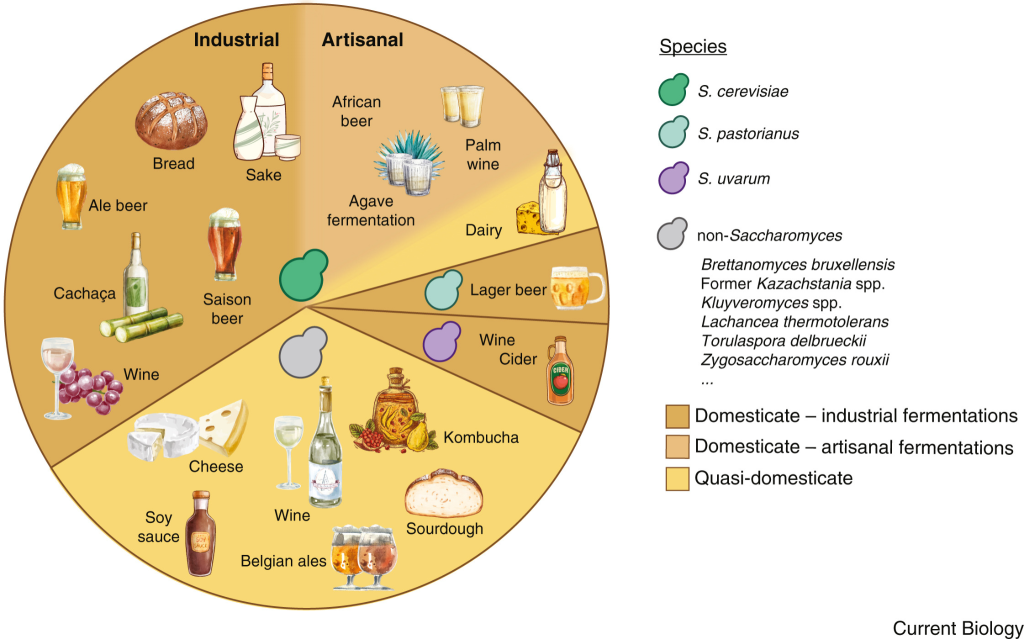
This system also created genetic bottlenecks. When a minor subset of yeast cells was moved into the subsequent fermentation batch, a substantial amount of the original genetic diversity of that population was lost (Sampaio and Pontes 2025). Continual isolation and bottlenecks contributed greatly to the distinct domesticated yeast strains in different fermentation industries (Sampaio and Pontes 2025). Through comparison of genomes, industrial yeast populations are shown to originate from very few ancestral populations, succeeded by substantial divergence (Sampaio and Pontes 2025; De Chiara et al. 2022).
De Chiara et al. (2022) analyzed 1011 isolates; domesticated strains were found to generally have not only enhanced fermentation growth when compared to wild strains, but also altered stress tolerance, impaired sexual reproduction and reduced respiratory growth. The rapid consumption of sugar had become more advantageous, while other traits required within fluctuating habitats were not as essential.
More wine-associated strains have more copies of CUP1, involved in chromosomal rearrangements and copper tolerance to increase expression of SSU1. This was to assist in the cell export of sulphite. These specific traits are sought after in wine-making, where the copper compounds and sulphite can induce stress (Brach and Schacherer 2026). In strains for brewing, amplifying maltose-utilizing genes improves sugar utilization, which is abundant in malt-based fermentation (Sampaio and Pontes 2025).
Mating between different strains or occasionally related species has then combined their genetic backgrounds. Later chromosome loss, recombination, and selection could stabilize useful combinations. A few wine yeasts have also gained genes horizontally from other fungi. This includes transporters that support nutrient uptake during fermentation (Brach and Schacherer 2026). This adaptation is therefore not only driven by gradual mutation, but gene flow shows to introduce more useful functions in a more efficient manner.
Despite this, there are trade-offs that exist with yeast domestication. An analysis of 687 genomes by Chen et al. (2024) found that domestication isolates had carried a greater burden of potential deleterious single-nucleotide variants than other wild isolates, showcasing how specific selection as well as restricted population histories can preserve genetic costs.
In all, this demonstrates a human-driven accidental evolution without deliberate breeding. The continuous creation of sugar-rich fermentation environments favoured particular traits and lineages, all leading to the yeasts we see today.
References
Brach, Gauthier, and Joseph Schacherer. 2026. “From One Genome to Thousands, and Beyond.” FEMS Yeast Research 26. https://doi.org/10.1093/femsyr/foag038.
Chen, Guotao, Guohui Shi, Yi Dai, Ruilin Zhao, and Qi Wu. 2024. “Graph-Based Pan-Genome Reveals the Pattern of Deleterious Mutations during the Domestication of Saccharomyces Cerevisiae.” Journal of Fungi 10 (8): 575–75. https://doi.org/10.3390/jof10080575.
De Chiara, Matteo, Benjamin P. Barré, Karl Persson, et al. 2022. “Domestication Reprogrammed the Budding Yeast Life Cycle.” Nature Ecology & Evolution, February 24, 1–13. https://doi.org/10.1038/s41559-022-01671-9.
Sampaio, Jose Paulo, and Ana Pontes. 2025. “Yeast Domestication.” Current Biology 35 (11): R575–86. https://doi.org/10.1016/j.cub.2025.04.056.


Leave a Reply
You must be logged in to post a comment.