Once in a while, while taking in your garbage bins for the week, one may be disappointed to discover that a neighbourhood raccoon has rummaged through them. Despite general annoyance with animals such as raccoons and rats within cities, there has been growing evidence of these animals becoming more domesticated and appealing to human environments.
Animals of the order Carnivora found in urban environments, such as foxes and raccoons, have been found to have similar morphological and behavioural differences compared to populations of the same species in rural environments. Similar to current domesticated animals, these urban animals have recently started showing features like shorter snouts, wider skulls, smaller teeth and docile natures (Apostolov et al. 2025, Parsons et al. 2020). The main theory involving these changes is the self-domestication hypothesis (SDH), where features like tameness increase the population’s fitness in environments where they may interact with humans, eventually leading to physical changes. SDH is also the belief behind early dog domestication. More docile wolves have access to new ecological opportunities and food sources due to proximity to early human settlements, before eventually being artificially selected by humans (Hare et al. 2012).
The self-domestication theory may be more relevant due to the accelerating effects of climate change. Climate change and urbanization are some of the most prominent drivers of biodiversity and ecosystem change around the world (Urban et al. 2024). Urbanization accelerates habitat destruction and fragmentation, leading to changes in gene dispersion and accelerates extinction. For example, Californian metropolitans created isolated lion populations and are threatened with extinction (Urban et. al 2024). Due to rapid environmental and climate changes, species respond to this with rapid behavioural changes, like developing use of human food and avoidance of new dangers like traffic.
Cities also serve as an environmental niche with high potential, due to the availability of food and lack of natural predators (Sluka et al. 2025). Eventually, animals with urban-adapted genes may dominate due to their selected gene as urbanization continues around the world, and gene flow between these regions may decrease as they are limited to the urban niche. However, human niches may benefit larger and more noticeable animals first, while species perceived as pests or that do not interact with humans like insects, might experience more specific adaptations to climate and environment changes (Apostolov et al. 2025).
This shift of small populations as “founders” into cities is theorized to be because of the Behavioural drive hypothesis (BDH), where behavioral shifts initiate evolutionary change because of new selective pressures (ie. environmental), eventually causing divergent evolution and speciation (Figure 1) (Caspi et al. 2022). While certain species benefit from the urban niche, the founder effect also causes the loss of gene variation within the urban population. With habitat destruction as the barrier, only more exploratory animals move into cities and survive to become the founder.
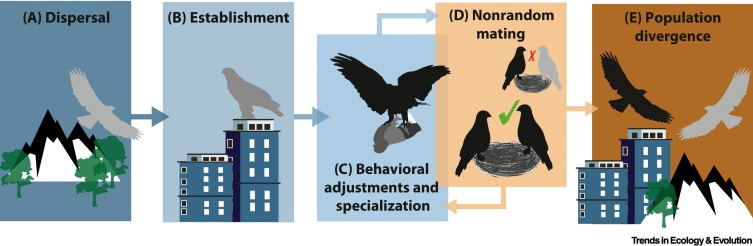
Figure 1: The process of BDH causing the founder effect and leading to speciation in certain populations. In A, forced dispersal due to habitat destruction occurs, and the animal establishes itself in urban environments (B). Populations with adapted behaviour then increase (C), and proliferate (D), and population divergence may lead to speciation (E).
Additionally, SDH can emerge from non-anthroprogenic causes, and is observed outside of city dwelling foxes and raccoons. Notably, bonobos are less aggressive in comparison to chimpanzees, which is the effect of intraspecific interactions creating selective advantage. Bonobos were selected for decreased aggression through advantageous female-female alliances, whereas male aggression decreased fitness in mating (Hare, Wobber and Wrangham 2011).
Overall, behavioural and phenotypic changes due to human impact on the environment are still in early stages, and the exact evolutionary mechanisms are still unclear. However, as the world hits unprecedented population growth, nature finds their own ways to adapt and survive.
References
Apostolov, Artem, Alanis Bradley, Shane Dreher, et al. 2025. “Tracking Domestication Signals across Populations of North American Raccoons (Procyon Lotor) via Citizen Science-Driven Image Repositories.” Frontiers in Zoology 22 (1): 28. https://doi.org/10.1186/s12983-025-00583-1.
Caspi, Tal, Jacob R. Johnson, Max R. Lambert, Christopher J. Schell, and Andrew Sih. 2022. “Behavioral Plasticity Can Facilitate Evolution in Urban Environments.” Trends in Ecology & Evolution 37 (12): 1092–103. https://doi.org/10.1016/j.tree.2022.08.002.
Hare, Brian, Victoria Wobber, and Richard Wrangham. 2012. “The Self-Domestication Hypothesis: Evolution of Bonobo Psychology Is Due to Selection against Aggression.” Animal Behaviour 83 (3): 573–85. https://doi.org/10.1016/j.anbehav.2011.12.007.
Parsons, K. J., Anders Rigg, A. J. Conith, A. C. Kitchener, S. Harris, and Haoyu Zhu. 2020. “Skull Morphology Diverges Between Urban and Rural Populations of Red Foxes Mirroring Patterns of Domestication and Macroevolution.” Proceedings of the Royal Society B: Biological Sciences 287 (1928): 20200763. https://doi.org/10.1098/rspb.2020.0763.
Sluka, Christina M, Mark T Clementz, Sarah Benson-Amram, and Merav Ben-David. 2025. “Patterns of Raccoon Craniodental Morphology Under Urbanization.” Integrative And Comparative Biology 65 (2): 236–48. https://doi.org/10.1093/icb/icaf094.
Urban, Mark C., Marina Alberti, Luc De Meester, et al. 2024. “Interactions between Climate Change and Urbanization Will Shape the Future of Biodiversity.” Nature Climate Change 14 (2024): 436–47. https://doi.org/10.1038/s41558-024-01996-2.


Leave a Reply
You must be logged in to post a comment.