Imagine a neurological disease that is 100% fatal and may stay hidden for months or even years before it slowly kills you. Luckily, there have been no human cases of Chronic Wasting Disease (CWD) ever reported. CWD is a transmissible spongiform encephalopathy (TSE) that affects members of the deer family (white-tailed deer, mule deer, Rocky Mountain elk, moose, etc). It is caused by misfolded prion proteins that build up in the nervous and lymphoid systems. CWD was discovered in the 1960s and has been researched and managed ever since, yet it keeps spreading across North America (Williams 2005). This begs the question, if scientists understand CWD so well, why has it been so hard to stop?
CWD was first found in Colorado and Wyoming in the 1960s and has now been found in 32 states and 4 provinces. Not only is this disease’s range expanding but so is its frequency, some populations of deer are experiencing up to an 85% infection rate. Clearly there is a discrepancy between the knowledge of a disease and its control (Bartz et al. 2024).
Part of the answer is how quietly CWD moves. Many infected deer don’t show any symptoms of infection. In a landmark experiment, every healthy deer given saliva or blood from CWD-positive deer became infected. This suggests that normal animal behavior like grooming and sharing the same feeding source can pass the disease along (Mathiason et al. 2006). Furthermore, mule deer begin shedding prions in their feces long before they show any clinical signs (Tamgüney et al. 2009). Before anyone notices the thin, zombie looking deer, it could have been passing the disease to other deer for months.
Prions are not alive, so unlike bacteria, they do not ‘die off’ when they are outside a host. Prions bind tightly to soil minerals such as montmorillonite clay and stay infectious (Johnson et al. 2006). Some cases have seen healthy mule deer infected by just living where an infected carcass had decomposed almost 2 years earlier, or where infected deer had lived 2.2 years before as seen in figure 1 (Miller et al. 2004). Furthermore, grass roots and leaves can bind and take up prions from soil, urine, and feces (Pritzkow et al. 2015). Even if every infected deer in a population was removed, the environment could keep the outbreak going.
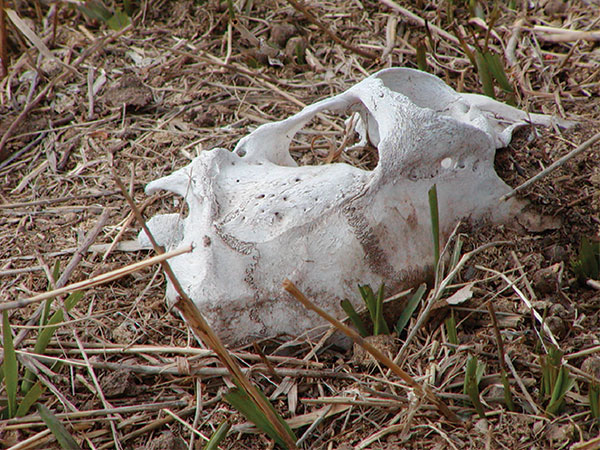
Figure 1: Green grass growing where the carcass of a CWD positive deer decomposed. Deer were drawn to this spot as evident by the freshly eaten blades of grass, which may have infected them with CWD (Miller et al. 2004).
There has yet to be a treatment developed for CWD, so conservationists can only use tools like testing animals harvested by hunters, putting restrictions on baiting, restricting the movement of dead deer, and controlling infected areas (Rivera et al. 2019). Solutions like this can be expensive and often face harsh feedback. When a wild reindeer population in Norway tested positive for CWD, authorities made the choice to wipe out an entire herd of more than 2,000 animals, this decision faced a lot of backlash (Mysterud and Rolandsen 2018). In North America, where deer hunting is a cultural tradition and an important economic contributor, drastic steps are often impossible.
The gap between understanding and control of CWD is not a scientific failure, but a result of the disease’s biology. A pathogen that spreads before any symptoms become evident, stays in soil and plants for years, and resists treatment is very difficult to stop. Slowing CWD will depend on early detection, cross-border unified carcass control, and hunters who are willing to get their meat tested. In the meantime, the best defence is keeping it out of the places it hasn’t reached yet.
References:
Bartz, Jason C., Rebeca Benavente, Byron Caughey, et al. 2024. “Chronic Wasting Disease: State of the Science.” Pathogens 13 (2): 138. https://doi.org/10.3390/pathogens13020138.
Johnson, Christopher J., Kristen E. Phillips, Peter T. Schramm, Debbie McKenzie, Judd M. Aiken, and Joel A. Pedersen. 2006. “Prions Adhere to Soil Minerals and Remain Infectious.” PLoS Pathogens 2 (4): e32. https://doi.org/10.1371/journal.ppat.0020032.
Mathiason, Candace K., Jenny G. Powers, Sallie J. Dahmes, et al. 2006. “Infectious Prions in the Saliva and Blood of Deer with Chronic Wasting Disease.” Science 314 (5796): 133–36. https://doi.org/10.1126/science.1132661.
Miller, Michael W., Elizabeth S. Williams, N. Thompson Hobbs, and Lisa L. Wolfe. 2004. “Environmental Sources of Prion Transmission in Mule Deer.” Emerging Infectious Diseases 10 (6): 1003–6. https://doi.org/10.3201/eid1006.040010.
Mysterud, Atle, and Christer M. Rolandsen. 2018. “A Reindeer Cull to Prevent Chronic Wasting Disease in Europe.” Nature Ecology & Evolution 2 (9): 1343–45. https://doi.org/10.1038/s41559-018-0616-1.
Pritzkow, Sandra, Rodrigo Morales, Fabio Moda, et al. 2015. “Grass Plants Bind, Retain, Uptake, and Transport Infectious Prions.” Cell Reports 11 (8): 1168–75. https://doi.org/10.1016/j.celrep.2015.04.036.
Rivera, Nelda A., Adam L. Brandt, Jan E. Novakofski, and Nohra E. Mateus-Pinilla. 2019. “Chronic Wasting Disease In Cervids: Prevalence, Impact And Management Strategies.” Veterinary Medicine: Research and Reports Volume 10 (October): 123–39. https://doi.org/10.2147/VMRR.S197404.
Tamgüney, Gültekin, Michael W. Miller, Lisa L. Wolfe, et al. 2009. “Asymptomatic Deer Excrete Infectious Prions in Faeces.” Nature 461 (7263): 529–32. https://doi.org/10.1038/nature08289.
Williams, E. S. 2005. “Chronic Wasting Disease.” Veterinary Pathology 42 (5): 530–49. https://doi.org/10.1354/vp.42-5-530.


Leave a Reply
You must be logged in to post a comment.