Despite the ridicule behind Love is Blind and The Bachelorette, the complex bridge that connects the realm of human emotions with the scientific understanding of our bodies does exist, in the form of love. From a scientific perspective, the early stages of falling in love behave similarly to the consumption of cocaine, with both processes triggering feelings of euphoria and influencing the same regions of the brain (Nordqvist, 2010).
The process of falling in love is a combination of various neurotransmitters, chemicals and hormones that function simultaneously to trigger the reward circuit of the human brain. The process produces physiological and emotional stimuli such as racing hearts, sweaty palms feelings of passion, and anxiety (Edwards, 2015). In that ‘love at first sight’ moment, it would take just a fifth of a second to experience a flurry of in-love feelings according the The Journal of Sexual Medicine (Ortigue, 2010). Through the early stages of love, the stress hormone cortisol becomes secreted more often, as the newfound rush of emotions creates a state of ‘crisis’ amongst the body’s homeostasis (Shintizky, 2001). The increased secretion of cortisol depletes the levels of tryptophan available, an essential building block for serotonin, whilst also reducing the density and reactivity of serotonin receptors (Edwards, 2015). The low concentration of the serotonin neurotransmitter creates infatuation and obsession behaviours amongst new lovers. Figure 1 showcases the relationship between the serotonin uptake concentration and the increasing cortisol concentration.

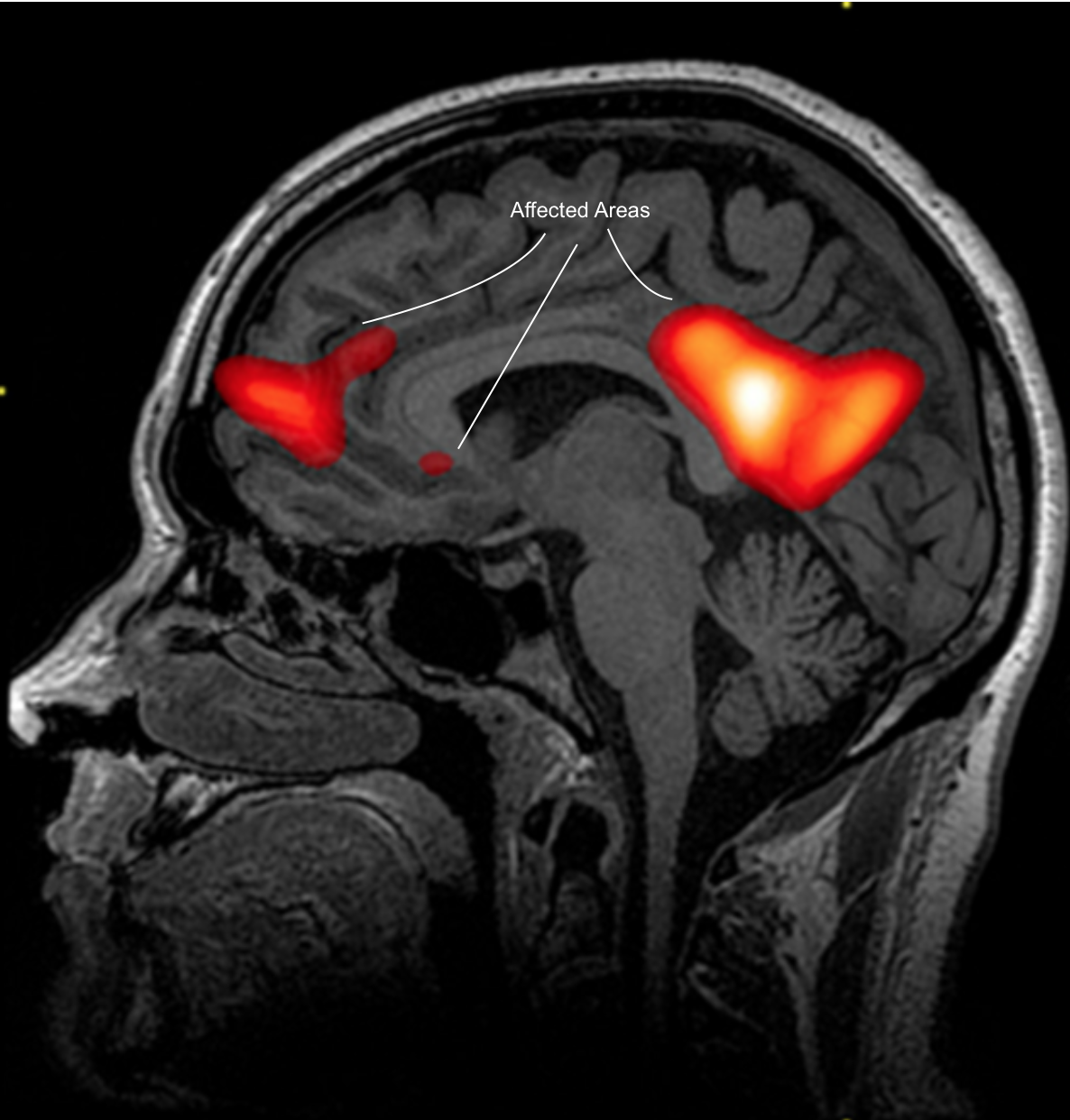
With the use of fMRIs and PET scans, anthropologist Helen Fisher conducted a groundbreaking lab testing over 2500 students in the clutches of love, revealing the illuminating changes across the brain. The caudate nucleus, putamen and ventral tegmental areas of the brain showcase the greatest activity within the specific neurochemical pathways attributed to love (Edwards, 2015). With extensive research and testing, these regions are associated with reward, pleasure and satisfaction systems along with hosting the neurological basis of euphoric emotion (Ortigue, 2010). Figure 2 is an exemplary fMRI scan depicting the different areas of the human brain that can show the greatest activity under feelings of love.

John Bowlby’s attachment postulates how the different forms of affection and relationships with caregivers can shape different attachment styles in people, and in turn, determine the nature of how love appeals to them throughout life. Those raised with responsibility and a consistent source of support find love within intimate, mentally strong partners who can fulfil the role of a beam of support (Cherry, 2023). Others with a more avoidant, emotionally unavailable caregiver tend to appeal towards a more independent, free-willed love. Such attachment styles can branch widely; the basis of love can be credited towards childhood experiences, and through recognition and mutual support, couples can work to foster healthier and sustainable connections (Cherry, 2023).
Through the studies of serotonin neurotransmitter release, dopamine feedback loops, fMRI scans, and Bowlby’s attachment theories, falling in love can be said to be safely scientifically reinforced.
References:
Cherry, K., 2023. What is attachment theory? [online] Verywell Mind. Available at: https://www.verywellmind.com/what-is-attachment-theory-2795337. [Accessed 26 November 2023].
Edwards, S., 2015. Love and the Brain | Harvard Medical School. [online] hms.harvard.edu. Available at: https://hms.harvard.edu/news-events/publications-archive/brain/love-brain#:~:text=When%20we%20are%20engaged%20in [Accessed 27 November 2023].
Nordqvist, C., 2010. Falling In Love Hits The Brain Like Cocaine Does. [online] www.medicalnewstoday.com. Available at: https://www.medicalnewstoday.com/articles/205973#1. [Accessed 23 November 2023].
Ortigue, S. et al. (2010) Neuroimaging of Love: fMRI Meta-Analysis Evidence toward New Perspectives in Sexual Medicine, The Journal of Sexual Medicine. Available at: https://doi.org/10.1111/j.1743-6109.2010.01999.x (Accessed: 10 March 2024).
Pierre, J., 2016. Your Brain in Love | Psychology Today Ireland. [online] www.psychologytoday.com. Available at: https://www.psychologytoday.com/ie/blog/psych-unseen/201602/your-brain-in-love [Accessed 27 November 2023].
Shinitzky, M. Tafet, G.E., and Toister-Achituv, M. 2001. Enhancement of serotonin uptake by cortisol: A possible link between stress and depression. Cognitive, Affective, & Behavioral Neuroscience, 1(1), pp.96–104. https://doi.org/10.3758/cabn.1.1.96. [Accessed 26 November 2023].
Comments
21 Responses to “Love: A Social Construct or Just Science?”
Hey iSci. Throughout the RP2 lessons throughout all of the iCons, I found a general interest in the function of neurotransmitters and their connection with several neurological reactions. As someone who always wondered about the realities of love, I strung together the information and created connections between falling in love, neurotransmitters and feedback systems. As a topic that truly encompasses the sciences of chemistry, biology and psychology, this was a truly phenomenal topic of interest to research! Hope you learn something interesting in the read.
Hey Vibi,
This was a really interesting blog to read, I am also very interested in neuroscience and this is a cool application I hadn’t thought of before. I have a few editing suggestions:
-The sentence “The process of falling in love is a combination of various neurotransmitters, chemicals and hormones that function simultaneously to trigger the reward circuit of the human brain, producing physiological and emotional stimuli such as racing hearts, sweaty palms and feelings of passion and anxiety (Edwards, 2015).” Is very long and could be broken into two smaller sentences between “… human brain” and “producing physiological…”
-In the fourth paragraph, you only need to cite (Edwards, 2015) once because all the information is from the same source and the sentences are adjacent.
-At the start of your fifth paragraph, you say theory’ which should either be theory’s or theory
-I like the ending but I don’t know about ending on a rhetorical question. Could change it to just say love is a scientifically observable phenomenon and leave it at that but thats personal opinion.
Overall, well written and very interesting, I look forward to reading the final copy!
Jonah
Hey Jonah! I split the starting sentence into two, corrected the grammar mistakes and re-worded my conclusion. Thank you for your helpful feedback, it really helped tie together my blog post!
Hey Vibi!
I really loved this blog post as it is a very popular debate:) This is very well written, here are some points to consider that could enhance your blog post:
1. Your references are not in alphabetical order, also maybe the numbers in front of each reference don’t need to be there…..
2. Your second figure will look better if it was centered.
3. Talk about the correlation of love and cocaine earlier maybe? To help tie it in better:)
Amazing job though Vibi, I actually really thought this was such a cute blog post:)
Cassie
Hey Cassie! Thank you so much for your insightful feedback! I re-did the bibliography and removed the numbers, re-centered my pictures and took the cocaine correlation more seriously within the blog!
Hello Vibishan,
This post presented the topic of relationship formation in a unique and scientifically-focused way. I have a few suggestions to further the quality of the post.
– Change the name of the “bibliography” to the “References”.
– Many of your sources seem to be from websites and not journal articles. Focus on using journal articles from reputable scientific journals which have DOIs. Ensure that you avoid the use of student-run newspapers (as in your Davidowitz, Y., 2021 citation) due to the differing level of scientific rigour in the source.
– For Figure 2, make sure to bold the title of Figure 2. Also, put the “Adapted from” before the in-text citation rather than at the beginning of the figure caption.
– In the second sentence of the second paragraph you state that the finding is according to the Journal of Sexual Medicine but then cite the source (Migala, 2019). Consider finding the primary source on this and citing that, instead of the Migala, 2019 if at all possible.
Overall, this is an interesting topic which could benefit from some minor edits. Good luck with the rest of the editing process!
Cheers,
Jeremy
Hey Jeremy, thank you for your super helpful feedback! I will definitely look into journals in lieu of websites and I’ve made the necessary edits! I’ve fixed the citations as well, once again super insightful feedback.
Hi Vibishan,
I loved your blog post! I thought it followed a very interesting theme and was a very engaging read. Below are some questions/comments that I hope will help you in your editing process:
1. I believe that ‘Bibliography’ is typically used as a reference list title for Chicago style citations, consider using ‘References’ instead.
2. This was already mentioned in a previous comment but don’t forget to to alphabetize your resource list and remove the numbers.
3. Make sure that you put an accessed date after every website!
4. Don’t forget to reference your figures before inserting it into your post.
5. I agree that ending your post with a question reads a bit odd. Consider adapting it to say: “Through the studies of serotonin neurotransmitter release, dopamine feedback loops, fMRI scans and Bowlby’s attachment theories; falling in love may share some of the same neurological effects as cocaine.” or something to this effect
Congratulations once again on a great blog post, I look forward to reading the final draft!
All the best,
Allison 🙂
Hey Allison, thank you for your much-needed feedback! I fixed the citations and added sentences before each image that explain it’s relevance! Once again, thank you!
Hi Vibishan,
Very interesting post on love. Here are some suggestions that will hopefully make your post even better:
1. It does make sense grammatically, but I would consider breaking up the first sentence of the second paragraph as it is quite long.
2. In the second sentence of the second paragraph the journal is mentioned in the sentence; typically the author of the particular article is only mentioned (i.e. according to Migala (2019).)
3. I don’t believe Figure 1 and Figure 2 are referenced in text, and they should be referenced in the text.
4. For the first sentence of the fourth paragraph, Helen Fisher is mentioned in the text; I’m not too sure if this is an in-text citation, and if it is, the date should be included as well and referenced in the reference list. Also, I would suggest citing directly from the study instead of from the harvard.edu website.
5. For the last sentence of the fifth paragraph, a semicolon (;) is typically used instead of the comma before ‘however’.
Overall, this was a well-written post, and I look forward to reading your final draft!
Jonathan
Hey Jonathan! Thank you for your insightful feedback! I took into consideration all of your comments and made the necessary edits regarding the citations and journal choices!
Hi Vibi!
Your post is super interesting, and I love some of the connection to RP2! Here’s a couple suggestions:
– The use of the period in the title feels a bit jarring, I would recommend a semi-colon or using the words “is it”
– There were a few instances of you citing the same author two sentences in a row, consider changing this
– While I appreciate the inclusion of the two scientists, their methods and contributions to your topic, they seem a bit out of place in the flow. Consider including a topic sentence at the beginning of your blog stating what you will be covering, if word count allows of course
– I believe for this citation style it is references
– Make sure that your citations are alphabetized
Overall, this is a very interesting post and I look forward to reading the final version!
-Gabriele
Hey Gabriele! Thank you for your amazing feedback! It was super helpful and really made my blog post more professional and finished. I fixed the citations and made the right grammar corrections, thank you!
!
Hey Vibishan,
This was an awesome blogpost. The content was super interesting and you did a great job writing this. Here are a few suggestions for your future edits:
– You should change “bibliography” to “references” and bold it so that it helps differentiate from the rest of the text!
– In your citation list, remove the numbers and organize them alphabetically instead.
– In your fourth paragraph, you only need to cite (Edwards, 2015) once at the end of the paragraph since it is all gathered from one source.
– The first sentence of the second paragraph seems to be a little long. You could try separating it like this: “The process of falling in love is a combination of various neurotransmitters, chemicals and hormones that function simultaneously to trigger the reward circuit of the human brain. This further leads to the production of physiological and emotional stimuli such as racing hearts, sweaty palms and feelings of passion and anxiety.”
– I also wanted to say your hook was a great way to start the blogpost!
Great job again, and I look forward to reading the final post!
Jana
Hey Jana! Thank you for your insightful feedback! Many of your comments have been repeated before and I’m glad you brought them to my attention! I have corrected the grammar and made the necessary corrections, thank you!
Hello Vibishan, your blog post was very clear and I loved the topic you picked!
Here are a few suggestions:
– In your title, consider adding a colon between the words “love” and “A.” Like this: “Love: A Social Construct or Just Science?” I think that this makes your title more effective rather than just having a period between the words.
– Your last sentence isn’t a question. Either change the question mark to a period or if you want to leave off on a question, consider changing the words around to make it “So can falling in love be scientifically reinforced in parallel to the effects of cocaine?”
– This is generic, but you use a lot of commas throughout all of your sentences and the length of your sentences are all relatively the same. For a more engaging read, I recommend varying your sentence lengths, having some long and short, or rewording some sentences to get rid of the commas. It is not a major issue, just personal preference, so just think about it while you are editing.
Overall, good work!
Hey Mara! Thank you for your amazing feedback. After making the corrections and taking your opinions into consideration, it really helps my blog post flow better and seem more formal. Thank you!
Hey Vibi! I love the comparison you made between love and cocaine, and thought this was a very unique approach to an age-old debate. Your writing style is very eloquent. I have a few suggestions to further enhance your piece:
– Your first sentence is a great hook that grabs readers’ attention while introducing the topic, but it is a bit wordy. Consider rephrasing it the second clause of the sentence to improve sentence flow to read something like, “emotions work in conjunction with anatomical mechanisms to form love.”
– The second sentence could also be made more concise. For example, “love is the product of neurological reactions that create euphoric states within the human brain.”
– The last sentence of your introductory paragraph could be restructured to be more grammatically correct: “the human brain behaves similarly during the early stages of falling in love and the consumption of cocaine.”
– The first sentence in the last paragraph could be more concise, but still equally impactful. Consider changing it to, “At its core, the brain is a complex orchestra that uses various processes to maintain homeostasis within the body.”
Overall, amazing job and I can’t wait to see the final product!
Hey Richelle! Thank you for your insightful feedback! It really did help tie together all my points in my blog and make it flow better! I made the corrections and split the sentences, fixing the grammar on the way as well. Thank you!
Hi Vibishan,
This was an very interesting and interdisciplinary blog post, especially with its connections to RP2. I have left some feedback below which I hope you find helpful in the editing stage:
– If the word count allows, consider explaining “saturation phases” in paragraph three.
– If the word count allows, it may be good practise to state the name of fMRI and PET scan before using the short form even if it is background knowledge.
– Consider making your references section a heading similar to your title for flow.
– I do not think it is necessary to number each reference.
– Consider removing the hyperlink for each reference.
Overall, great job and very interesting blog post. I look forward to reading the final version.
-Lucas M
Hey Lucas! Thank you for your super helpful feedback! I’ve made the necessary corrections and added more information where you specified! Thank you