Public executions, considered unjust by most countries, are still practiced in some regions. There have been 27 public executions from 2006-2008 in North Korea and 157 during 2015 in Saudi Arabia (Gilbert 2017; Database Center for North Korean Human Rights 2009). To understand the unjust nature of public executions, particularly hangings, increased biological, psychological, and dynamical awareness is required.
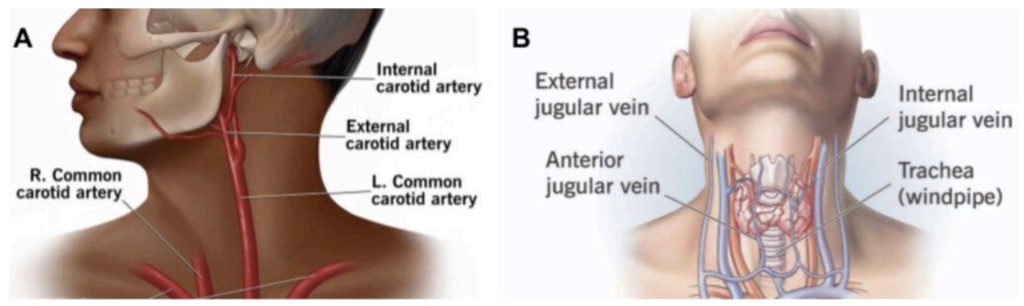
The mechanism of death by hanging is complex since various aspects of the neck may be compressed. Airway obstruction can result through tracheal compression, preventing the trachea from performing its function (Gilbert, Jensen, and Byard 2008). When air cannot pass to and from the lungs, “wheezing” respiration occurs. However, it takes 3-7.5 times more force to compress the trachea relative to the carotid artery and jugular vein, making the mechanism of death more likely to be cerebral hypoxia, where blood flow to the brain is obstructed (Figure 1). This obstruction can cause dyspnea (shortness of breath), loss of consciousness, convulsions with loss of bowel and bladder control, and eventually the stop of all respiration (Gilbert, Jensen, and Byard 2008; Mayo Clinic 2020). Making matters worse, none of this is instant, it is slow and torturous. If the rope is long enough for a quick end, the lengthy fall can still lead to subsequent decapitation.
Regarding the public, though they are not experiencing the physical pain of a violent death, their mental trauma is long lasting. Post-traumatic stress disorder (PTSD) occurs from direct victimization and through indirect exposure from witnessing traumatic events (Attari, Dashty, and Mahmoodi 2006). The hanging serves as an extreme traumatic stressor. Children, as an example, can experience the associated symptoms of fear and helplessness, distressing recollections of the event, and avoidance of triggering reminders for at least one month post-event. A study on 200 children in the Islamic Republic of Iran who witnessed public hangings showed that 52% of them displayed at least one symptom of PTSD after three months and most experienced moderate or severe stress (Attari, Dashty, and Mahmoodi 2006). PTSD’s correlation with public hangings indicates how they harm the general public through indirectly punishing those undeserving of it, reinforcing that hangings are inhumane.
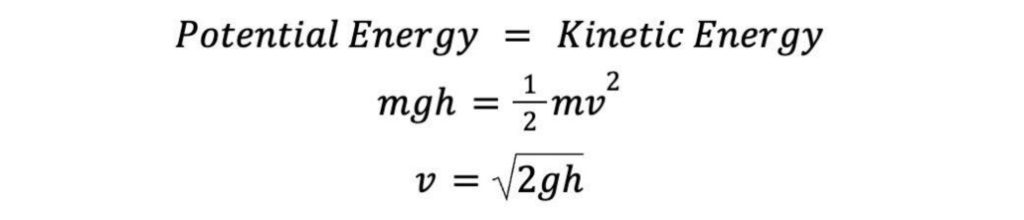
Moreover, unless the body of the deceased is taken down carefully, the fall from an uncontrolled hanging release can further mutilate it (Thollon et al. 2013). The angle of the body directly influences the velocity reached before impact with the ground. A body that falls backwards, rather than sideways or forward, reaches a far greater velocity, increasing the likelihood of skull fractures. If the hanging height is increased, the head impact velocity would decrease for the backward fall. Greater height leads to more gravitational potential energy converting into kinetic energy as the body falls, leading to a greater velocity overall (Equation 1). Consequently, more fractures are anticipated. However, head acceleration decrease can be explained by energy distribution within the body. The lower limbs, ankles and tibia, absorb more energy when the body falls from a higher height, leaving less energy for the head to absorb, and so head velocity is lower (Thollon et al. 2013). These dynamic intricacies make it difficult to control the state of the body as it is taken down, highlighting that even after death, the horror of this execution continues.
This post examined the scientific evidence of suffering inflicted upon the condemned and the witnesses, ranging from PTSD, biological harm, and the physics behind bodily harm continuing post mortem. Being familiar with the pain associated with public hangings may spark empathy and put pressure on countries to abolish public hangings globally.
References
Attari, A., S. Dashty, and M. Mahmoodi. 2006. “Post-Traumatic Stress Disorder in Children Witnessing a Public Hanging in the Islamic Republic of Iran.” Eastern Mediterranean Health Journal 12 (1–2): 72–80. Gale Academic OneFile. https://link-gale-com.libaccess.lib.mcmaster.ca/apps/doc/A159922283/AONE?u=ocul_mcmaster&sid=bookmark-AONE&xid=0e38dbfb.
Database Center for North Korean Human Rights. 2009. WHITE PAPER ON NORTH KOREAN HUMAN RIGHTS 2009. https://web.archive.org/web/20131104094518/http://nkdb.org/bbs/data/publication/2009_NKDB_whitepaper_english.pdf.
Gilbert, John D., Lisbeth Jensen, and Roger W. Byard. 2008. “Further Observations on the Speed of Death in Hanging.” Journal of Forensic Sciences 53 (5): 1204–5. https://doi.org/10.1111/j.1556-4029.2008.00840.x.
Gilbert, Kimutai. 2017. “Countries Where Public Executions Are Still Held.” WorldAtlas. August 1, 2017. https://www.worldatlas.com/articles/countries-where-public-executions-are-still-held.html.
Mayo Clinic. 2020. “Shortness of Breath.” Mayo Clinic. 2020. https://www.mayoclinic.org/symptoms/shortness-of-breath/basics/definition/sym-20050890.
Thollon, Lionel, Maxime Llari, Lucile André, Pascal Adalian, Georges Leonetti, and Marie-Dominique Piercecchi-Marti. 2013. “Biomechanical Analysis of Skull Fractures after Uncontrolled Hanging Release.” Forensic Science International 233 (1–3): 220–29. https://doi.org/10.1016/j.forsciint.2013.08.015.