Gum is a soft, elastic substance that comes in a variety of flavours and colours. Many people chew gum in order to relieve stress, improve concentration, amuse themselves, or to cover up bad breath. The most intriguing characteristic of gum is its flavour; unfortunately, this property does eventually fade as the compounds are released and the concentration decreases.
There are two main components of chewing gum: the water-insoluble phase and the water-soluble phase, which are formulated in a ratio of 1:3 (Hinderink et al. 2018). The water-insoluble phase is primarily composed of an elastomer solvent, which provides the gum with its stretchy texture and structural integrity. The water-soluble phase contains up to 60% sugar compounds and less than 1% flavour compounds. In mint gum, acesulfame-k and menthone compounds are commonly used to provide the sweetness and minty flavour (Konar et al. 2016; Feng et al. 2026) . Prior to chewing, the water-soluble phase is encapsulated in the water-insoluble phase. When mastication begins, the soluble compounds are pushed to the surface of the gum (Feng et al. 2026; Hinderink et al. 2018). Flavour perception is the result of two stimuli, flavour compounds at the surface of the gum are dissolved by saliva and carried to taste receptors in the mouth which sends an electrical signal to the brain. Additionally, mastication results in the release of volatile aroma compounds which bind the olfactory epithelium in your nose by travelling up the throat or by escaping the mouth. The olfactory epithelium then sends an electric signal to the brain (Konar et al. 2016).
As gum is chewed, flavour begins to deplete as a result of the affinity of the flavour compounds to the elastomer solvent (Hinderink et al. 2018; Konar et al. 2016) . Two main factors that impact the release of the flavour and aroma compounds are the Henry equilibrium constant, a measure of how the compounds partition between gas and liquid, and the logF equilibrium constant, a measure of how the compounds partition between the gum base and saliva. Compounds with a smaller Henry equilibrium constant require less force to enter the gas phase and contribute to aroma perception. Compounds with a smaller logF equilibrium constant require less force to diffuse into saliva (Hinderink et al. 2018). Initially, flavour concentrations are high within the gum and low within the saliva, creating a gradient, which results in the burst of flavour that occurs in the first few minutes. As mastication continues, flavour is more controlled by the partitioning properties (Konar et al. 2016; Hinderink et al. 2018). Figure 1 shows flavour release curves for various compounds, illustrating that flavour release is a unique characteristic of each compound. A study conducted by Feng et al. determined that flavour perception begins to decrease while release is still relatively constant. It was determined that our receptors become less responsive to the continuous exposure to stimuli, which cause an initial decrease in perceived flavour followed by a decrease in release of flavour compounds (Feng et al. 2026).
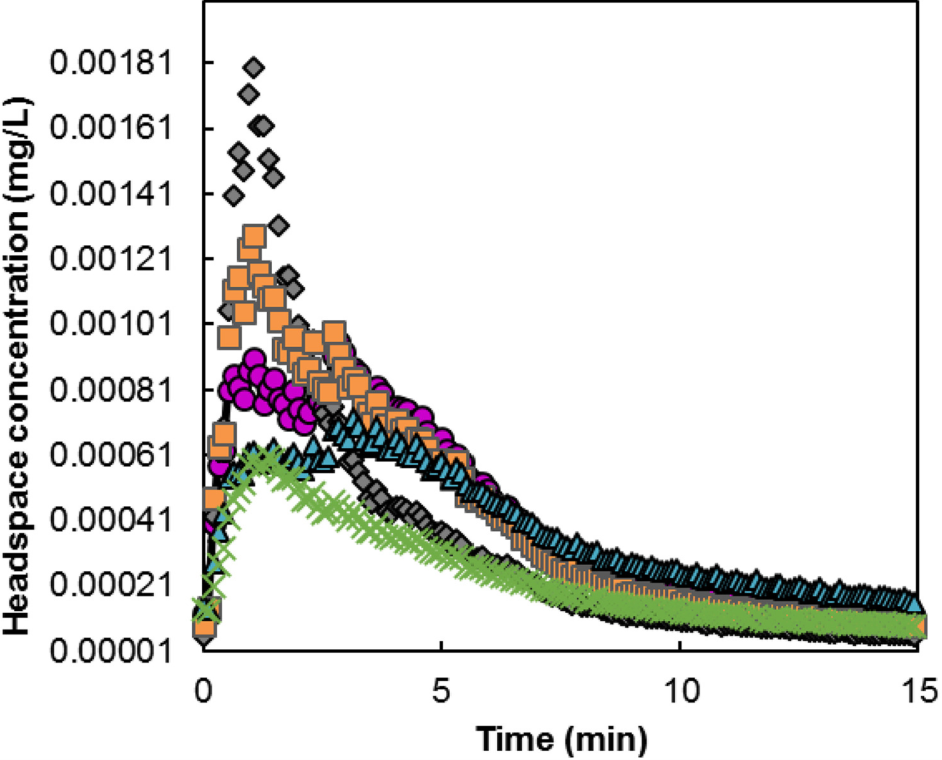
Figure 1: release of flavour compounds in an in-vitro system for isopropyl acetate (grey), amyl acetate (orange), menthyl acetate (blue), terpineol (green) and amyl butyrate (purple) (Hinderink et al. 2018).
The loss of flavour while chewing gum is a unique property that is influenced by many properties. The intensity of flavour not only decreases due to the preferred affinity to the gum based, but also because the perception of stimulus in the mouth and nose receptors diminishes.
References
Feng, Jing, Gary Gray, Rebecca Ford, Moira A. Taylor, and Ni Yang. 2026. In Vitro and in Vivo Release Profile of Acesulfame-K and Menthone, and Their Changes in Flavour Perception during Chewing Gum Consumption. September. https://doi.org/10.1016/j.lwt.2026.119798.
Hinderink, Emma, Shane Avison, Remko Boom, and Igor Bodnar. 2018. Dynamic Flavor Release from Chewing Gum: Mechanisms of Release. 116 (September). https://doi.org/10.1016/j.foodres.2018.09.002.
Konar, Nevzat, Ibrahim Palabiyik, Omer Said Toker, and Osman Sagdic. 2016. Chewing Gum: Production, Quality Parameters and Opportunities for Delivering Bioactive Compounds. September. https://doi.org/10.1016/j.tifs.2016.07.003.


Leave a Reply
You must be logged in to post a comment.