DNA is a powerful tool. We, as humans, leave traces of our presence in the form of imprints and surface contact that analytical forensic scientists can analyze to track us down. Experts can even use these DNA imprints to match them with ancestral DNA to further identify potential suspects. Well, that is exactly what Barbara Rae-Venter did when she collaborated with law enforcement and helped identify the Golden State Killer after police had been searching for over 40 years (O’Toole 2018). And the best part? Rae-Venter made this discovery from the comfort of her own computer.
The Golden State Killer, Joseph James DeAngelo Jr., is an American serial killer and rapist who pleaded guilty in 2018 to his numerous murders and sexual assaults committed between 1974 and 1986 (John 2020). Barbara Rae-Venter described him as a nightmare come to life (Rae-Venter 2024). Over time, the case became more personal for her as she read more about his crimes. In late 2017, she began investigating the ongoing case with some help from law enforcement. However, as a regular civilian, her resources were limited. She was able to access ancestry sites such as MyHeritage and GEDmatch and identify potential relatives based on the DNA found at crime scenes.
Independently, Rae-Venter uploaded a forensic DNA profile the FBI had developed from DNA found at a crime scene to MyHeritage and GEDmatch. Specifically, single nucleotide polymorphisms (SNPs) were digitally analyzed to identify distant relatives (Rae-Venter 2024). SNPs are specific variations within a single nucleotide of DNA (Wickenheiser 2019). Barbara Rae-Venter used these variations to identify distant genetic relatives of the Golden State Killer, allowing her to reconstruct family trees and help investigators narrow down potential suspects.
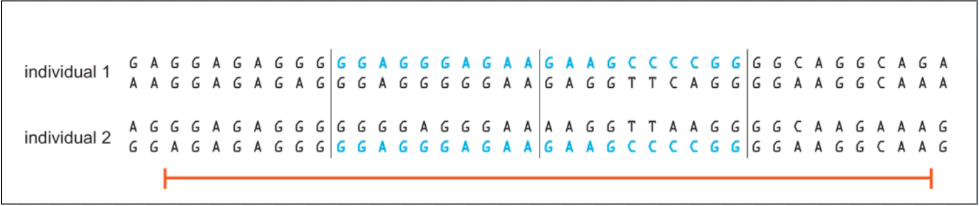
Rae-Venter stumbled upon close matches to distant cousins of DeAngelo by analyzing that the DNA profile had a considerable number of nucleotide matches to other DNA profiles that were already uploaded on ancestry sites (Edge and Coop 2019). From there, Rae-Venter constructed extensive family trees using historical records and birth certificates, creating a major step forward in identifying the prime suspect (Rae-Venter 2024). Eventually, after narrowing down the suspects, the FBI was able to identify DeAngelo as the culprit, as he was the only suspect remaining who fit the profile, leading to his arrest. Finally, after 42 years of relentless investigations, DeAngelo is now serving a total of 26 life sentences thanks to Rae-Venter’s efforts.
Barbara Rae-Venter’s work with computational forensics and genealogy is a prime example of how modern forensics has become an extraordinary tool for criminal justice. Her methods of analyzing SNPs provided law enforcement a major step forward toward identifying one of the most brutal and savage criminals in the United States. She utilizes human traces and imprints by identifying DNA profiles with nucleotide matches to construct a map of DeAngelo’s ancestry, cornering him and making him spend the rest of his life in a jail cell. Moreover, the fact that Rae-Venter is just a civilian with a background in biology who decided to look into this case and managed to solve it speaks volumes about the power of DNA analysis and how digital DNA profiles can be used as a tracker for wanted criminals.
Bibliography
A. Ball, Catherine, J. Barber, Mathew, Byrnes, Jake, et al. 2016. AncestryDNA Matching White Paper. March 31. https://crain-platform-genomeweb-prod.s3.amazonaws.com/s3fs-public/files_copied/ancestrydna-matching-white-paper.pdf
Edge, Michael, and Graham Coop. 2019. “How Lucky Was the Genetic Investigation in the Golden State Killer Case?” Preprint, bioRxiv, January 29. https://doi.org/10.1101/531384.
Kling, Daniel, Christopher Phillips, Debbie Kennett, and Andreas Tillmar. 2021. “Investigative Genetic Genealogy: Current Methods, Knowledge and Practice.” Forensic Science International. Genetics 52 (May): 102474. https://doi.org/10.1016/j.fsigen.2021.102474.
O’Toole, Mary Ellen. 2018. “Understanding Serial Predatory Behavior Through the Lens of the Golden State Killer.” Violence and Gender 5 (2): 65–66. https://doi.org/10.1089/vio.2018.29016.meo.
Rae-Venter, Barbara. 2024. I Know Who You Are: How an Amateur DNA Sleuth Unmasked the Golden State Killer and Changed Crime Fighting Forever. Random House Publishing Group. https://books.google.ca/books?id=OX3cEAAAQBAJ&printsec=frontcover&source=gbs_ge_summary_r&cad=0#v=onepage&q=SNP&f=false
St. John, Paige. 2020. “The Untold Story of How the Golden State Killer Was Found: A Covert Operation and Private DNA.” Los Angeles Times, December 8. https://www.latimes.com/california/story/2020-12-08/man-in-the-window.
Wickenheiser, Ray A. 2019. “Forensic Genealogy, Bioethics and the Golden State Killer Case.” Forensic Science International: Synergy 1 (January): 114–25. https://doi.org/10.1016/j.fsisyn.2019.07.003.


Leave a Reply
You must be logged in to post a comment.