Imagine walking to a class when a crow suddenly starts screaming at you. You haven’t done anything wrong, at least not today. Maybe you accidently scared it months ago, and now it has decided you’re an enemy for life. It sounds ridiculous, but what if crows really could remember the people who wronged them? Research suggests these birds have an extraordinary ability to recognize threatening faces, and they might even warn their friends about them.
To investigate this, researchers at the University of Washington conducted an unusual experiment. They wore distinctive masks while capturing, banding, and releasing American crows. Later, people wearing the same masks returned to the area, alongside others wearing neutral masks. The birds responded differently depending on which face they saw. Crows directed harsh alarm calls, known as scolding, towards the threatening masks and sometimes gathered in groups to follow the wearer. Remarkably, they could recognize the dangerous face even when someone else was wearing it (Marzluff et al. 2010).
However, remembering a face is only part of the story. Researchers discovered that the proportion of crows scolding the threatening mask increased from 26% shortly after trapping to 66% approximately 2.7 years later (Cornell, Marzluff, and Pecoraro 2012). As figure 1 illustrates, recognition of the perceived threat persisted and became more widespread rather than disappearing with time.
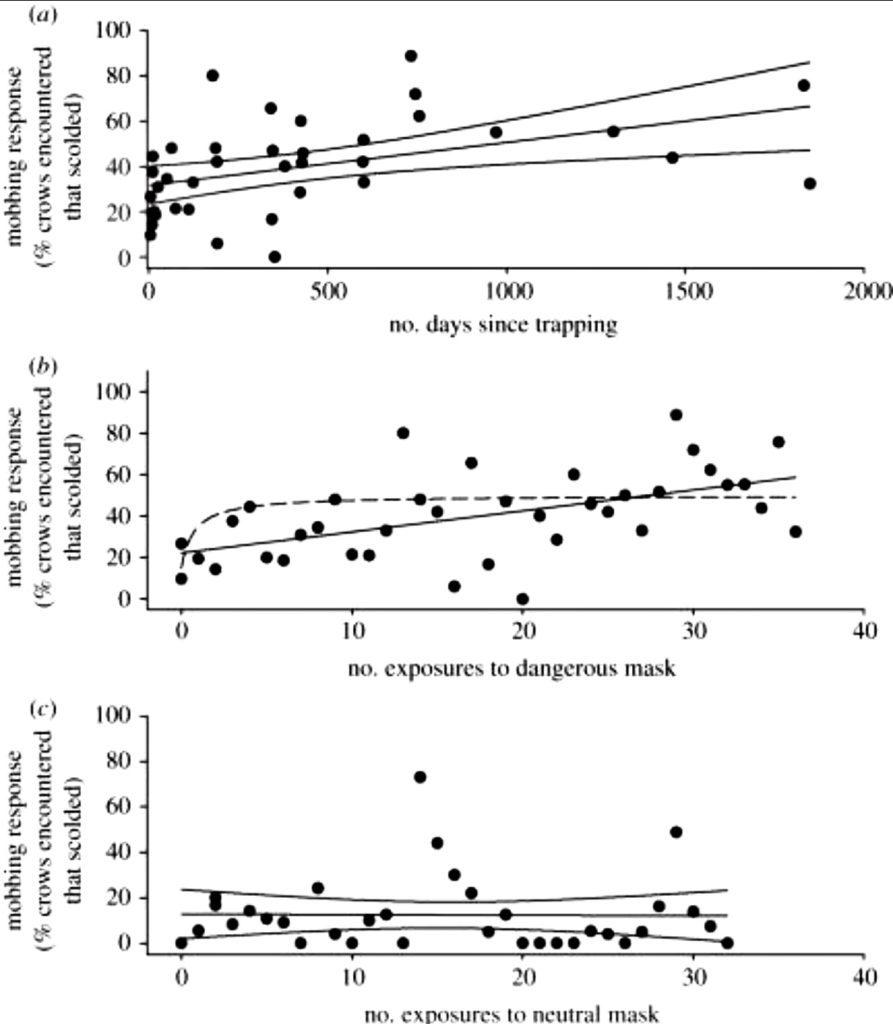
Figure 1. American crows’ scolding responses in relation to time since trapping (a), exposure to the threatening mask (b), and exposure to the neutral mask (c). Responses to the threatening mask increased, supporting the persistence and social spread of threat recognition. Source: Cornell, Marzluff, and Pecoraro (2012).
So how did more crows recognize a dangerous face when most had never been captured? The explanation involves social learning, which occurs when animals acquire information by observing others. Researchers observed young crows joining their parents in scolding the threatening mask. More surprisingly, some crows that had never been captured responded to the mask while alone, suggesting they had learned to recognize it from earlier encounters with other birds (Cornell, Marzluff, and Pecoraro 2012). Essentially, a crow could learn to distrust someone without having a bad experience with that person.
The mystery becomes even more fascinating when we look inside their brains. Using brain imaging, Marzluff et al. (2012) found that threatening human faces activated regions associated with attention, fear, and defensive behaviour. This suggests that recognizing a dangerous individual involves coordinated neurological responses rather than simply reacting to an unfamiliar appearance. Nevertheless, describing this behaviour as holding a grudge raises an important distinction. The experiments demonstrate long term memory and social learning, but they cannot establish whether crows experience resentment like humans do. Recognizing threats may instead be an evolutionary advantage that helps them avoid danger.
Perhaps the real surprise isn’t that crows remember threatening people, but that their knowledge can spread to birds that were never harmed. So, the next time a crow starts yelling at someone on campus, maybe it isn’t just making noise. Maybe that person reputation has already made its way through the neighbourhood.
References
Cornell, Heather N., John M. Marzluff, and Shannon Pecoraro. 2012. “Social Learning Spreads Knowledge about Dangerous Humans among American Crows.” Proceedings of the Royal Society B: Biological Sciences 279 (1728): 499–508. https://doi.org/10.1098/rspb.2011.0957.
Marzluff, John M., Robert Miyaoka, Satoshi Minoshima, and Donna J. Cross. 2012. “Brain Imaging Reveals Neuronal Circuitry Underlying the Crow’s Perception of Human Faces.” Proceedings of the National Academy of Sciences 109 (39): 15912–15917. https://doi.org/10.1073/pnas.1206109109.
Marzluff, John M., Jeff Walls, Heather N. Cornell, John C. Withey, and David P. Craig. 2010. “Lasting Recognition of Threatening People by Wild American Crows.” Animal Behaviour 79 (3): 699–707. https://doi.org/10.1016/j.anbehav.2009.12.022


Leave a Reply
You must be logged in to post a comment.