As I’m sure you have learned, almost 2,000 years ago the infamous Mount Vesuvius erupted and destroyed the cities of Pompeii and Herculaneum. What you likely haven’t learned is that, despite this destruction, a library of unlikely scrolls managed to survive. Over 1,500 years after the eruption, these scrolls, known as the Herculaneum Papyri, were found buried under 30 m of volcanic material (Ceccarelli et al. 2025). This collection is one of the only libraries to survive from the Greek-Roman civilizations and is a valuable opportunity to obtain primary literature from this period (Fowler 2024).
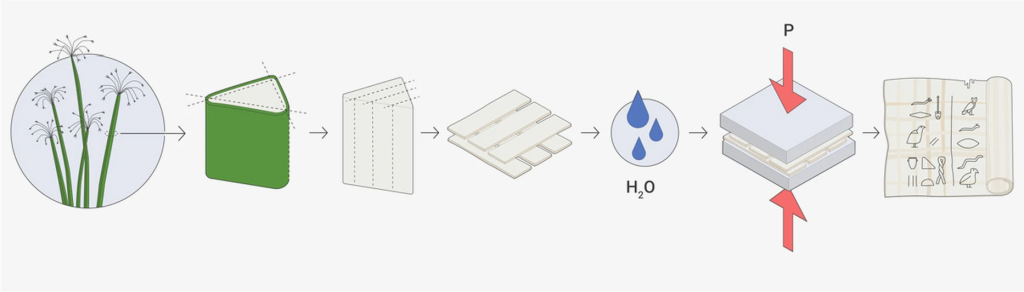
So, how exactly were these scrolls preserved? The contents of the scrolls were written on papyrus, a writing material made from the Cyperus papyrus plant (Figure 1). To create the papyrus material, the outer layers of the plant are removed to expose the central tissue, known as the pith. Wet layers of pith are then arranged into sheets and flattened to produce a material suitable for writing (Bausch et al. 2022). Papyrus is mainly composed of hemicellulose, cellulose, and lignin, all of which are organic compounds (Lucejko et al. 2020).
The extreme heat from the volcano created ideal conditions for carbonization, or pyrolysis, to occur. The deposition of volcanic debris generated an anaerobic environment where organic compounds, such as the Herculaneum scrolls, could not burn due to the absence of oxygen. Rather, the compounds that made up the scrolls were carbonized, preserving original structure and form (Ceccarelli et al. 2025). Following this, the scrolls continued to survive over the last 1,500 years because they were anaerobically buried which created a uniquely ideal condition for their preservation as bacteria could not flourish and degrade the carbonized material (Fowler 2024).
Understandably, today the scrolls are incredibly fragile and brittle. Unrolling the scrolls often results in damage and the loss of valuable information (Seiler et al. 2026). Therefore, scientists are working to develop technologies to read the scrolls without physically unrolling and disturbing them.
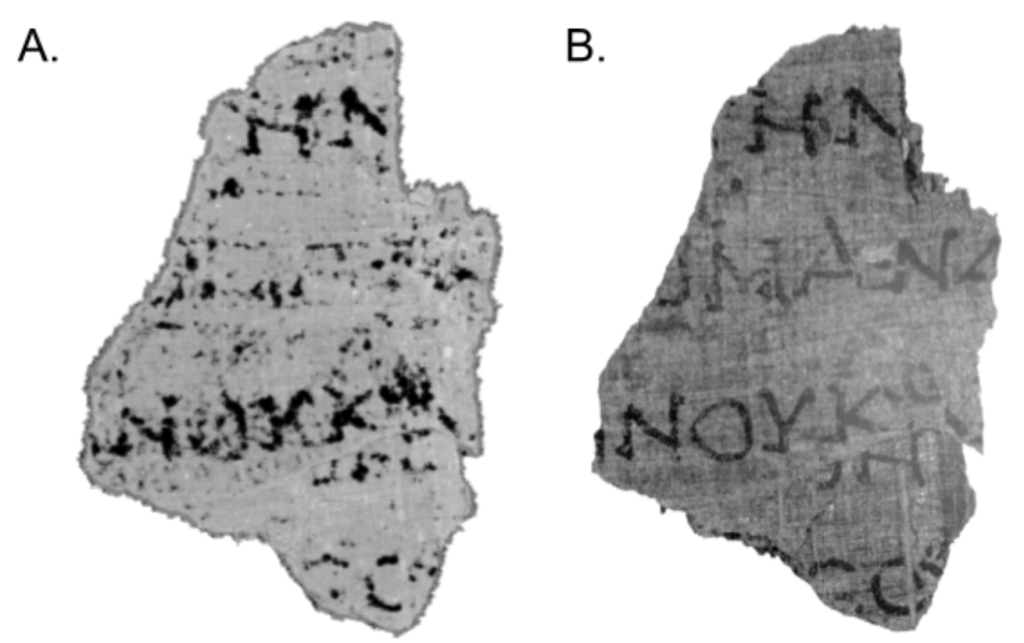
The most promising of these strategies is the combined use of X-ray tomography with machine learning analysis (Fowler 2024). In this process, X-ray computed tomography takes thousands of images of the scroll and reconstructs them into a three-dimensional map of the scroll’s interior. However, a challenge with this process is differentiating the ink from the papyrus itself, as both are largely carbon based and have similar X-ray properties (Seiler et al. 2026). This is where machine learning comes in. Models are being trained to detect the presence of ink, scanning the images pixel by pixel to fill in where it predicts ink to be found (Figure 2) (Parker et al. 2026).
The eruption of Mount Vesuvius is known for the destruction it caused, but its eruption also inadvertently created a unique environment that led to the preservation of these incredible historical scrolls. Using multidisciplinary approaches to better understand the biological and chemical composition of the papyrus, together with emerging technologies to safely allow for further investigation of the scrolls’ contents without risking damage, we are one step closer to uncovering the mysteries of ancient civilizations.
References
Bausch, Florian, Mario J. Rosado, Jorge Rencoret, et al. 2022. “Papyrus Production Revisited: Differences between Ancient and Modern Production Modes.” Cellulose 29 (9): 4931–50. https://doi.org/10.1007/s10570-022-04573-y.
Ceccarelli, Sofia, Massimo Rippa, Giovanni Caruso, et al. 2025. “Pulsed Thermographic Analysis of Herculaneum Papyri.” Scientific Reports 15 (1): 34466. https://doi.org/10.1038/s41598-025-19911-w.
Fowler, Robert L. 2024. “The Herculaneum Papyri.” Manuscript and Text Cultures (MTC) 3 (1): 84–105. https://doi.org/10.56004/v3.1rlf.
Lucejko, J. J., M. P. Colombini, and E. Ribechini. 2020. “Chemical Alteration Patterns of Ancient Egyptian Papyri Studied by Pyrolysis-GC/MS with in Situ Silylation.” Journal of Analytical and Applied Pyrolysis 152 (November): 104967. https://doi.org/10.1016/j.jaap.2020.104967.
Parker, C. Seth, Kristina Gessel, Stephen Parsons, et al. 2026. Volume Cartographer. V. v2.28.0. Zenodo, released March 23. https://doi.org/10.5281/ZENODO.4604881.
Seiler, Douglas, Jacob Michael LaManna, Michael McOsker, David Kreimer, Michael Cyrus Daugherty, and Jens Dopke. 2026. “A Model Carbonized Papyrus Scroll Opens a Novel Path to Identifying Readable Scrolls of the Herculaneum Library.” PLOS ONE 21 (9): e0353485. https://doi.org/10.1371/journal.pone.0353485.

Leave a Reply
You must be logged in to post a comment.