There are so many different lakes found on earth, from giant lakes created by scars left by glaciers, such as the Canadian great lakes, to tiny lakes such as Crawford Lake also located in Canada. While they both look identical, apart to their size to each other on the surface, these two examples are wildly different when it comes to what’s below.
Starting off with the great lakes, they are what is known as Holozoic. Holozoic lakes apply to lakes that have circulating water, from top to bed, when the lake cools and warms (Allaby 2020a). They have two distinct layers the epilimnion, which is the upper, warmer, circulating stratified layer (Allaby 2020b), and hypolimnion which is the lower, colder, non-circulating stratified layer (Allaby 2020c). These are your basic dime, a dozen lakes that comprise almost all lakes on earth. And granted while they are different types of holozoic lakes, we have a more interesting type of lake to talk about.
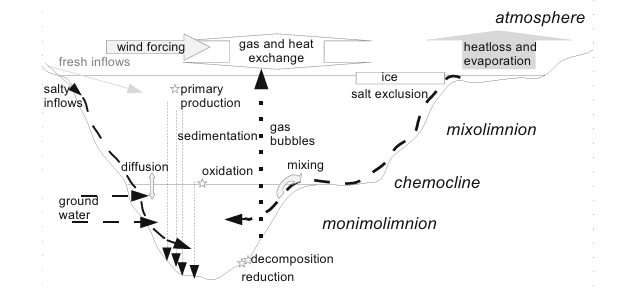
Figure 1: Sketch of a Meromictic lake (Boehrer et al. 2017)
Meromictic lakes are lakes who have permanently stratified water layers due to a chemical difference that cause them two have two different densities between the epilimnion and hypolimnion waters (Allaby 2020d). Unlike holozoic lakes, they have three distinct layers. There is the monimolimnion (the deeper layer, similar to hypolimnion), the mixolimnion (the upper layer, similar to epilimnion) and the boundary layer named the chemocline which separates the two layers (Zadereev et al. 2017) (See figure 1). It is important to point the major difference in holozoic lakes and meromictic lakes by the difference in the monimolimnion layer and how it differs from regular hypolimnion layers. They differ by the fact that monimolimnion are not stagnant and are constantly shifting due to pressure differences and that it has a constant flow and uptake from ground waters(Zadereev et al. 2017). Additionally, most of the time monimolimnion has an anoxic environment allowing for it to be colonized by diverse microzooplankton and microbial communities(Zadereev et al. 2017).
Notic how I said most? Almost all the the very rare meromictic lakes differ in and that’s what makes them special. Lake Crawford as an example is actually the opposite. It has an highly oxygenated hypolimnion level (when compared to others), that’s well above the hypoxic limit (Llew-Williams et al. 2024). This is because of the well- oxygenated ground water that leaks into the lake (Llew-Williams et al. 2024).
Each meromictic lake is different with what each layer is comprised of. They range from very low (<20g/L), to very high saturation (>300 g/L) (Schultze et al. 2017), to being very acidic to very alkaline (Schultze et al. 2017). Another example is Hot Lake (USA), which is a shallow lake that has an almost 100% saturation of soluble salts (Schultze et al. 2017) which differs physically from Crawford lake which is a 24m deep sink hole (Llew-Williams et al. 2024).
From these examples, we can see how much verity there is found within these types of lakes. Not only that, but they can help us research so many different things due to there unique environments such as researching anaerobic life!
References:
Allaby, Michael. 2020a. “Meromictic.” In A Dictionary of Geology and Earth Sciences. Oxford University Press. https://www.oxfordreference.com/display/10.1093/acref/9780198839033.001.0001/acref-9780198839033-e-5177.
Allaby, Michael. 2020b. “Hypolimnion.” In A Dictionary of Geology and Earth Sciences. Oxford University Press. https://www.oxfordreference.com/display/10.1093/acref/9780198839033.001.0001/acref-9780198839033-e-4084.
Allaby, Michael. 2020c. “Epilimnion.” In A Dictionary of Geology and Earth Sciences. Oxford University Press. https://www.oxfordreference.com/display/10.1093/acref/9780198839033.001.0001/acref-9780198839033-e-2781.
Allaby, Michael. 2020d. “Holomictic.” In A Dictionary of Geology and Earth Sciences. Oxford University Press. https://www.oxfordreference.com/display/10.1093/acref/9780198839033.001.0001/acref-9780198839033-e-3925.
Boehrer, Bertram, Christoph von Rohden, and Martin Schultze. 2017. “Physical Features of Meromictic Lakes: Stratification and Circulation.” In Ecology of Meromictic Lakes, edited by Ramesh D. Gulati, Egor S. Zadereev, and Andrei G. Degermendzhi. Springer International Publishing. https://doi.org/10.1007/978-3-319-49143-1_2.
Llew-Williams, Brendan M., Francine M. G. McCarthy, Andrea M. Krueger, et al. 2024. “Quantifying Conditions Required for Varve Formation in Meromictic Crawford Lake, Ontario, Canada: Important Process for Delimiting the Anthropocene Epoch.” Journal of Paleolimnology 71 (2): 101–24. https://doi.org/10.1007/s10933-023-00304-w.
Schultze, Martin, Bertram Boehrer, Katrin Wendt-Potthoff, Sergei Katsev, and Erik T. Brown. 2017. “Chemical Setting and Biogeochemical Reactions in Meromictic Lakes.” In Ecology of Meromictic Lakes, edited by Ramesh D. Gulati, Egor S. Zadereev, and Andrei G. Degermendzhi. Springer International Publishing. https://doi.org/10.1007/978-3-319-49143-1_3.
Zadereev, Egor S., Bertram Boehrer, and Ramesh D. Gulati. 2017. “Introduction: Meromictic Lakes, Their Terminology and Geographic Distribution.” In Ecology of Meromictic Lakes, edited by Ramesh D. Gulati, Egor S. Zadereev, and Andrei G. Degermendzhi. Springer International Publishing. https://doi.org/10.1007/978-3-319-49143-1_1.


Leave a Reply
You must be logged in to post a comment.