Creatine is widely known for its role in cognitive performance, but could it also help the brain cope with a sleepless night? The supplement has many known benefits to an individual’s cognitive function: exercise tolerance, performance, and injury prevention are just a few of it’s positive effects (Antonio et al. 2021). But the science behind creatine intake has much more complex processes that help maintain cognitive performance under conditions of metabolic stress, such as sleep deprivation.
Sleep deprivation impairs cognitive and psychomotor performance, which includes memory, reaction time, and thinking processes. To research if creatine can reduce these effects, researchers tested two groups: a creatine group and the placebo group. The participants consumed 5 g of creatine monohydrate or a placebo four times a day for 7 days. Following the intake, they underwent 24 hours of no sleep with intermittent exercise (McMorris et al. 2006).
As a result, the creatine supplementation had a positive effect on tasks that relied on the prefrontal cortex. To elucidate, the creatine group showed smaller changes in verbal recall, and mood state after 24 hours, suggesting that creatine supplementation may preserve some aspects of performance with no sleep.
One possible explanation lies in the brain’s creatine-phosphocreatine system. The brain has a continuous need for adenosine triphosphate (ATP), as it supplies useable energy for cellular processes (Nath 2025). When ATP loses a phosphate group, it is converted into ADP that releases usable free energy, seen in Figure 1. To make up for this loss, and replenish ATP during periods of increased energy demand, the brain relies on the phosphocreatine system. (Pratt et al. 2026).
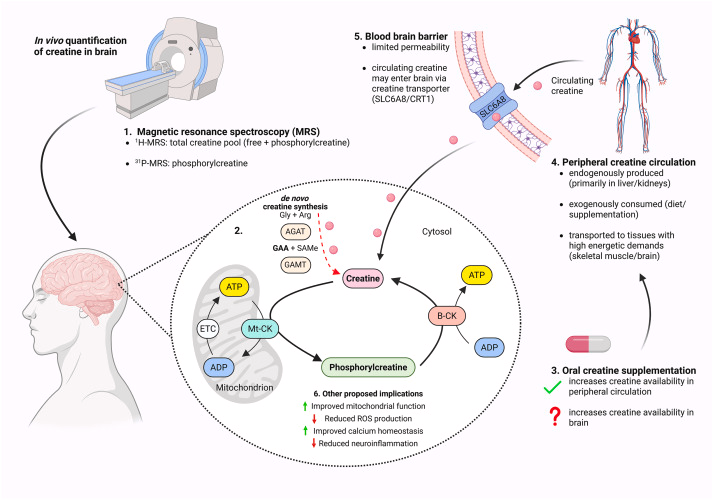
Figure 1: An overview of creatine metabolism, illustrating ATP generation through the creatine-phosphocreatine system, transport in the brain, and across the blood-brain barrier. The figure also highlights the potential positive effects of creatine, which remains an area of ongoing research and uncertainty – showing the complexity of creatines interactions with biological systems (Pratt, et al., 2026).
Creatine Kinase catalyzes the reversible reaction, where creatine accepts a phosphoryl group from ATP that creates phosphocreatine. When the reaction continues in the opposite direction, the phosphocreatine can donate a phosphate group to the ADP. Finally, ATP becomes available again, with the phosphocreatine acting as a readily available phosphate reservoir. How is this related to sleep? In short, this process is required, as the brain requires ATP, while sleep deprivation may make it harder to maintain our normal cognitive performance. As a result, the positive effects of creatine may be more pronounced during times of metabolic stress, specifically sleep deprivation, as there is an increased demand for energy.
Overall, the phosphocreatine system provides a plausible explanation of why creatine may support performance during sleep deprivation. Thus, this evidence from the studies should not be interpreted as proof, as further research is required to make an accurate statement.
References
Antonio, Jose, Darren G. Candow, Scott C. Forbes, et al. 2021. “Common Questions and Misconceptions about Creatine Supplementation: What Does the Scientific Evidence Really Show?” Journal of the International Society of Sports Nutrition 18 (1): 13. https://doi.org/10.1186/s12970-021-00412-w.
McMorris, T., R. C. Harris, J. Swain, et al. 2006. “Effect of Creatine Supplementation and Sleep Deprivation, with Mild Exercise, on Cognitive and Psychomotor Performance, Mood State, and Plasma Concentrations of Catecholamines and Cortisol.” Psychopharmacology 185 (1): 93–103. https://doi.org/10.1007/s00213-005-0269-z.
Nath, Sunil. 2025. “An Account of a Century of ATP Research.” BioSystems 256 (October): 105527. https://doi.org/10.1016/j.biosystems.2025.105527.
Pratt, Jedd, Cas J. Fuchs, Luc J. C. Van Loon, Aneurin J. Kennerley, and Craig Sale. 2026. “Creatine Supplementation and Brain Health: Methodological Challenges, Current Evidence, and Translational Perspectives.” The Journal of Nutritional Physiology 5 (April): 100017. https://doi.org/10.1016/j.jnphys.2026.100017.


Leave a Reply
You must be logged in to post a comment.