Exploring history means exploring the light, the dark and all in between. As unsettling as it may be, dark moments in history serve as reminders of how society has advanced. Executions by electrocution are one point in humanity’s dark history that has been explored from an ethical standpoint but as scientists, it’s our job to explore the ‘how’ of electric chairs; how they worked, how was the method made more humane, and how the body was affected? So, let’s do just that.
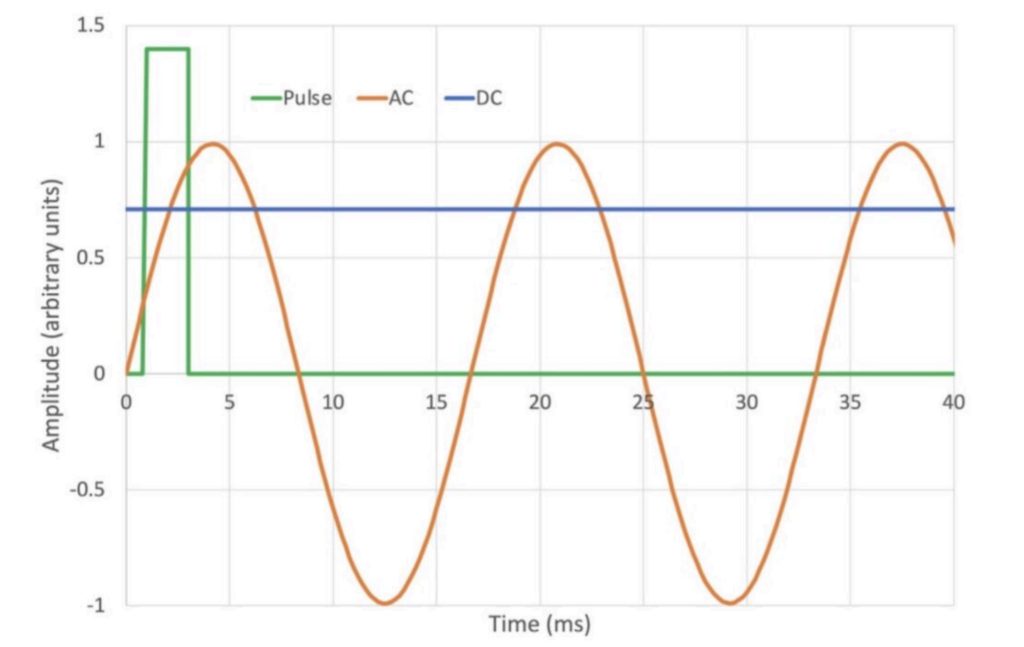
Electric chairs used in executions commonly used alternating currents (AC) which can be established through alternating magnetic fields (Lee, 1997). As seen in Figure 1, this alternating polarity results in fluctuations in voltage. This is because of Ohm’s Law, where V is voltage, I is current, and R is resistance, and since voltage is directly proportional to current, changes in voltage causes equivalent fluctuations in current. The Ohm’s Law is as follows:
V = IR
This current mediates electrochemical reactions that cause burns on the skin due to the generating of heat as electricity passes through the body (Lee and Dougherty, 2003). In fact, in judicial electrocutions, burns on the scalp and right calf, where the electrodes were placed, have been reported (Li and Hamilton, 2005). The process caused physical pain and damage to the body, and this was only the start of the cruelty.
Skin cells act as insulators and can provide a resistance of 5 x 10⁴ to 5 x 10⁵ Ω/cm2 depending on the hydration of the epidermis, a 100 to 500 μm layer of fused squamous epithelial cells (Lee, 1997). Squamous cells are epithelial cells that have a flat, sheet-like appearance (Cleveland Clinic, 2024). This is very ethically questionable given that this can prolong the death of the individual (Lee, 1997). Additionally, as established before, this can result in even more burns from electrochemical reactions as the voltage needs to be applied for a longer duration to ensure death. To minimize this, the metal cap has a sponge underneath it that is moistened with saline, the electrodes attached to the prisoner’s legs are moistened with conductive jelly, and a ‘jolt’ of 6-12 amps at 2000-3000 volts is given for a few seconds (Hillman, 1993). The saline and conductive jelly lower the resistance of the skin and the high voltage serves the same purpose since electrical resistance of the epidermis begins to decrease at voltages of 20V (Lee and Dougherty, 2003). This is because skin impedance is voltage dependent.
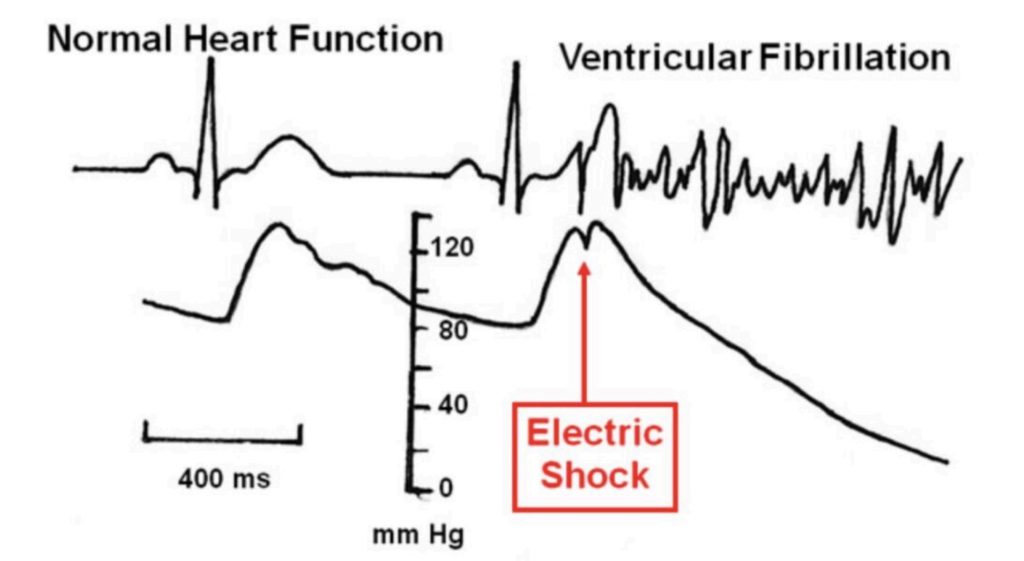
Despite the metal cap has a sponge underneath it serving to minimize the damage, biologically, this execution process is still unquestionably inhumane. When the power supply is turned on, the strapped up prisoner undergoes immense torture as the electricity effectively passes through to the neurons. The artificially imposed electric field from this electricity stimulates muscle contraction in the same way nerve mediated signals depolarize the membrane and normally cause muscle contractions (Lee and Dougherty, 2003). In other words, this electricity also allows for depolarization that is necessary for brain-muscle communication (Lee and Dougherty, 2003). However, due to the use of AC, this can lead to ventricular fibrillation (VF) as seen in Figure 2, which is irregular muscle contractions in the heart since the voltage alternates between being zero, meaning there is no current, and not being zero, meaning there is current (American Heart Association, 2005). When there is no current, no nerves are firing and so there is no muscle contraction, and when there is current, the nerves are signaling the muscles to contract (Lee and Dougherty, 2003). During VF, the heart fails to pump blood effectively and this leads to the death of the prisoner. The normal physiological process is meddled with, and the associated pain is ignored. Another cause of death, where the respiratory muscles are affected, is respiratory arrest (American Heart Association, 2005). This would only last a couple seconds and the power supply would be turned off. Only if the prisoner was pronounced dead, the execution would end, otherwise the suffering would continue.
To conclude, understanding electric chairs involves connecting physiology with the physics of electricity and this scientific knowledge can serve as a contribution to the discussion of capital punishment and further lead to the advancement of the criminal justice system. Studying this topic serves as a reminder of how the criminal justice system can have inhumane practices that should be questioned and abolished. Understanding the science of punishments can serve as an aid in that pursuit for more humane justice.
References
American Heart Association, 2005. Part 10.9: Electric Shock and Lightning Strikes. Circulation, 112(24_supplement), pp.IV-154-IV–155. https://doi.org/10.1161/CIRCULATIONAHA.105.166571.
Cleveland Clinic, 2024. Epithelium: What It Is, Function & Types. [online] Cleveland Clinic. Available at: <https://my.clevelandclinic.org/health/articles/22062-epithelium> [Accessed 31 January 2024].
Hillman, H., 1993. The Possible Pain Experienced during Execution by Different Methods. Perception, 22(6), pp.745–753. https://doi.org/10.1068/p220745.
Kroll, M.W., Luceri, R.M., Efimov, I.R. and Calkins, H., 2023. The electrophysiology of electrocution. Heart Rhythm O2, 4(7), pp.457–462. https://doi.org/10.1016/j.hroo.2023.06.004.
Lee, R.C., 1997. Injury by electrical forces: Pathophysiology, Manifestations, and therapy. Current Problems in Surgery, 34(9), pp.677–764. https://doi.org/10.1016/S0011-3840(97)80007-X.
Lee, R.C. and Dougherty, W., 2003. Electrical injury: mechanisms, manifestations, and therapy. IEEE Transactions on Dielectrics and Electrical Insulation, 10(5), pp.810–819. https://doi.org/10.1109/TDEI.2003.1237330.
Li, M. and Hamilton, W., 2005. Review of Autopsy Findings in Judicial Electrocutions. American Journal of Forensic Medicine & Pathology, 26(3), pp.261–267. https://doi.org/10.1097/01.paf.0000177337.12384.8a.
Salus Engineering International, 2020. Basic Electrical Safety. [online] Basic Electrical Safety. Available at: <https://salusengineering.com/technical%20info_basic%20electrical_pg2.html> [Accessed 28 December 2023].