From the 15th to the 18th century, two million sailors met their demise simply because they were unable to consume enough Vitamin C, also known as ascorbic acid (Asc) (Carpenter 2012). Though scurvy, a deficiency of Asc, was a menace to the navies during this historic period, it is something that can theoretically affect anyone in the modern era where socioeconomic status divides exist.
Our bodies cannot naturally produce Asc, a major component in stable collagen maturation, due to the absence of l-gulono-γ-lactone oxidase (Gulo), an enzyme involved in catalyzing the last step of Asc synthesis (Fujii 2021). The loss of Gulo’s function is theorized to be the result of mutations in the course of evolution. Considering that collagen constitutes ~30% of our total protein mass, insufficient Asc in our diet can cause several physical symptoms, as seen in Figure 1.
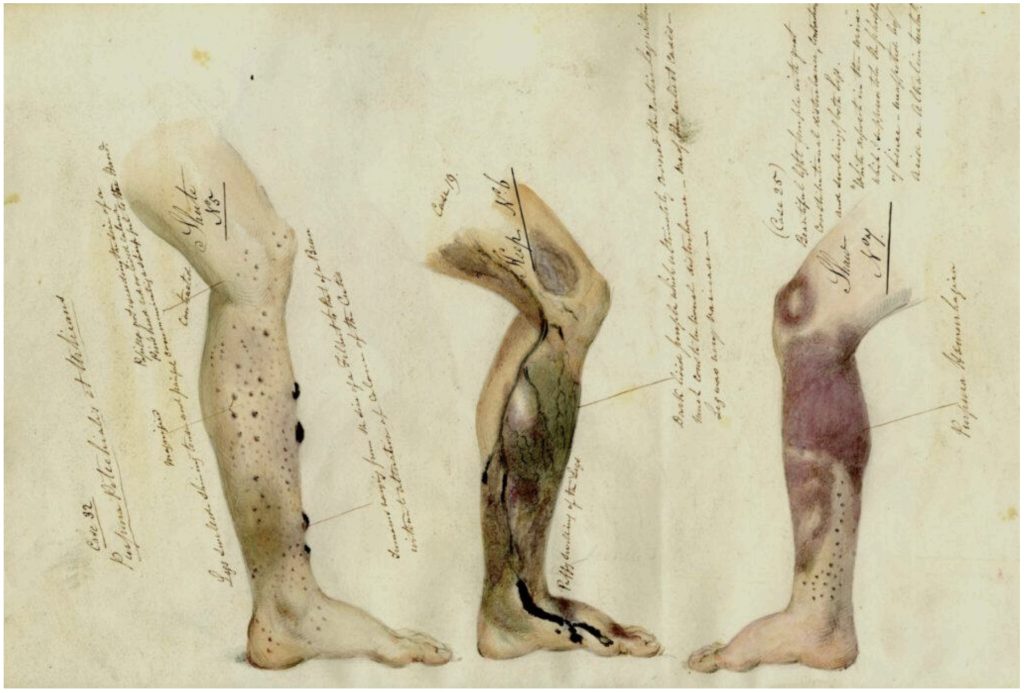
Other symptoms may include fatigue, muscle weakness, joint stiffness, mood changes, adverse effects on stability of small blood vessels, enhancing the risk of bleeding and impaired wound healing (Fujii 2021; Mirkovic, Mutke, and Muehleisen 2024). The optimal procedure for scurvy diagnosis involves running tests on the skin, a readily accessible organ affected by scurvy (Mirkovic, Mutke, and Muehleisen 2024). Through a skin biopsy, where a sample of skin is removed to be tested, and skin histology, where that sample is observed under a microscope after sectioning and staining the sample, other bleeding disorders affecting the skin can be ruled out (Gurina and Simms 2023; Mayo Clinic 2023; Mirkovic, Mutke, and Muehleisen 2024). Additionally, distinct characteristics of scurvy can be observed, such as coiled, distorted hair shafts, follicular hyperkeratosis (small bumps on the skin), and perifollicular hemorrhages (bright red hair follicles), allowing for an accurate diagnosis of scurvy (Mirkovic, Mutke, and Muehleisen 2024).
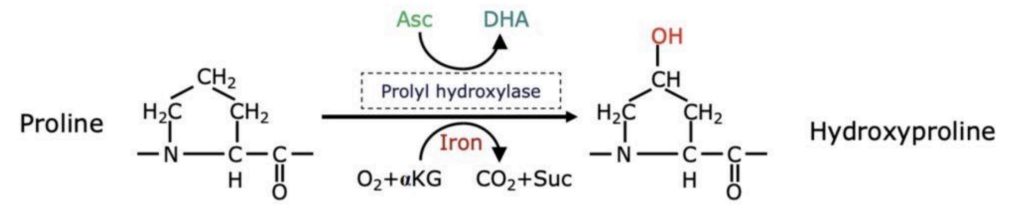
The specific reason behind these adverse effects involves the chemical role of Asc in collagen synthesis. While procollagen is going through the process of maturing in the endoplasmic reticulum, it must undergo proline hydroxylation, a process that can only occur in the presence of Asc. As seen in Figure 2, through an electron transfer between the hydroxyl (-OH) group found on Asc and proline, hydroxyproline is formed (Fujii 2021). If Asc was not present, this crucial step would remain unexecuted and the resulting triple helix of mature collagen would not be as stable resulting in scurvy (Sipilä et al. 2018).
In the past, sailors suffered due to the inability to bring perishable foods high in Asc, primarily fruits and vegetables, on their trips since they are perishable and there was no way to preserve the food at that time (Carpenter 2012). In modern society, the prevalence of scurvy largely is influenced by social factors, socioeconomic factors being the most influential. In developed countries like the United States, Vitamin C deficiency affects only 7.1% of the population but the number can get as high as 73.9% in places like northern India (Callus, Vella, and Ferry 2018). Moreover, in developed countries, the fraction of the population that is deficient are those of low economic status, such as in Paris where 95% of homeless people on the streets are deficient in Vitamin C (Callus, Vella, and Ferry 2018). Fresh produce is expensive and so low-income families may rely more on processed food, and if the deficiency gets bad enough, scurvy can develop.
Overall, scurvy can cause a multitude of biological symptoms and is ultimately the result of Vitamin C’s role in a chemical collagen synthesis reaction. Further, it is an addition to the ever growing list of examples of how socioeconomic status continues to feed social inequalities. Understanding how it works is important so that we do not overlook the diagnosis of it and simply categorize it as an ancient disease.
References
Callus, Claire Ann, Samantha Vella, and Peter Ferry. 2018. “Scurvy Is Back.” Nutrition and Metabolic Insights 11 (January):117863881880909. https://doi.org/10.1177/1178638818809097.
Carpenter, Kenneth J. 2012. “The Discovery of Vitamin C.” Annals of Nutrition and Metabolism 61 (3): 259–64. https://doi.org/10.1159/000343121.
Fujii, Junichi. 2021. “Ascorbate Is a Multifunctional Micronutrient Whose Synthesis Is Lacking in Primates.” Journal of Clinical Biochemistry and Nutrition 69 (1): 1–15. https://doi.org/10.3164/jcbn.20-181.
Gurina, Tatyana S., and Lary Simms. 2023. “Histology, Staining.” In StatPearls. Treasure Island (FL): StatPearls Publishing. http://www.ncbi.nlm.nih.gov/books/NBK557663/.
Mayo Clinic. 2023. “Biopsy: Types of Biopsy Procedures Used to Diagnose Cancer.” Mayo Clinic. 2023. https://www.mayoclinic.org/diseases-conditions/cancer/in-depth/biopsy/art-20043922.
Mirkovic, Goran, Markus Reinhold Mutke, and Beda Muehleisen. 2024. “Characteristic Skin Eruptions with a Distinct Histological Pattern Allow Early Diagnosis of Vitamin C Deficiency.” Case Reports in Dermatology 16 (1): 123–27. https://doi.org/10.1159/000538916.
Price, Catherine. 2017. “The Age of Scurvy.” Science History Institute. 2017. https://www.sciencehistory.org/stories/magazine/the-age-of-scurvy/.
Sipilä, Kalle H., Kati Drushinin, Pekka Rappu, et al. 2018. “Proline Hydroxylation in Collagen Supports Integrin Binding by Two Distinct Mechanisms.” Journal of Biological Chemistry 293 (20): 7645–58. https://doi.org/10.1074/jbc.RA118.002200.