hHow a parasitic fungus turns living ants into unwitting hosts
If you’ve ever played The Last of Us, you’ll have come across the rather terrifying concept of a fungus turning people into mindless zombies. That’s certainly something that would be limited to the realm of science fiction, yet nature has already come up with something very much like it. The deep jungles of the tropics are home to a parasitic fungus (Ophiocordyceps) that infects ants to take complete control of their behaviour, ultimately leading to their demise. It is not the Cordyceps of the fictional world that we’re talking about here; it’s very real (van Roosmalen and de Bekker 2024). The infection starts when fungal spores come into contact with a susceptible ant. The fungus then grows through the ant’s body and progressively takes over its behaviour. Rather than following the normal paths of the colony, the infected ant will wander off, climb a plant, and clamp its jaws onto a leaf or twig in what is known as the “death grip”. The ant will then die in that position, and the fungus will grow a spore-producing structure from its body, which will release spores into the environment to perpetuate the cycle (van Roosmalen and de Bekker 2024).
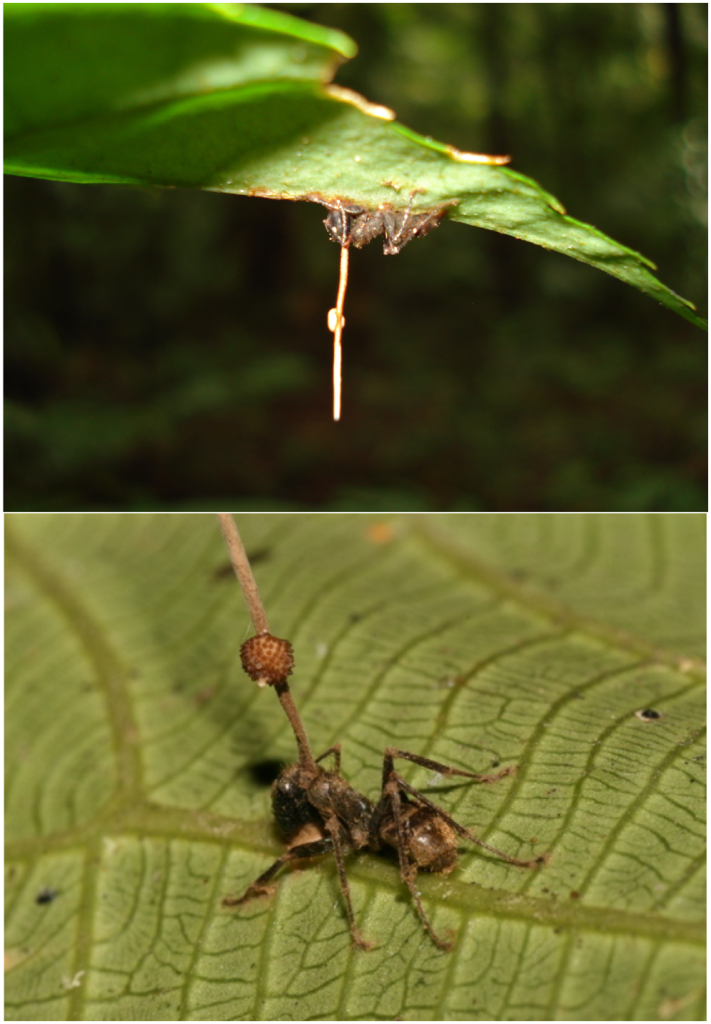
Figure 1: An ant infected with Ophiocordyceps unilateralis gripping the underside of a leaf in the characteristic “death grip.” A fungal reproductive structure extends from the ant’s head, enabling the fungus to produce and disperse spores after the host’s death. Photograph by David P. Hughes and Maj-Britt Pontoppidan (2009), licensed under CC BY 2.5.
So that leads to the question of how exactly the fungus takes over the ant’s mind? The answer may well be that it doesn’t actually invade the brain at all. In a 2017 study, researchers used 3d imaging and computer modelling to observe infected ants, and what they found was that the fungal cells had formed a very extensive network throughout the ant’s body, wrapping around the muscle fibres and leaving the brain tissue itself almost completely untouched. Therefore, scientists concluded that the fungus may be exerting its influence on the host via the muscles and other tissues rather than by taking over the brain (Fredericksen et al. 2017). The most horrifying aspect of the infection is the way the fungus compels its host to make that final, irreversible bite. Research on infected ants shows that their jaw muscles undergo hypercontraction, meaning the muscle fibres contract excessively, contributing to the ant’s inability to release its grip. Fungal structures were also seen penetrating the muscle tissue, which may be part of the reason why the ant is unable to release its bite (Mangold et al. 2019). The precise mechanism by which the fungus achieves this behavioural manipulation is still not fully understood. Some evidence suggests that fungal proteins and the host’s own biological rhythms may be key to the manipulation (van Roosmalen and de Bekker 2024). What is so fascinating about this relationship is that it’s one that truly requires a range of different scientific disciplines and lenses to understand. Microbiology will tell you about the infection itself, neuroscience and physiology will tell you about the changes in behaviour, and evolutionary biology will tell you why such a bizarre survival strategy would have evolved. It’s a perfect example of how complex the interactions between organisms can be and how that can in turn influence their behaviour.
So should this worry us as humans? There’s no evidence at all that these specialist zombie ant fungi could ever cause a human apocalypse. Their adaptations are so tightly linked to their specific insect host that the jump to humans is orders of magnitude more difficult than the films would have us believe. The relationship between Ophiocordyceps and its host does, however, pose a very disturbing question: just how much of an organism’s behaviour is actually its own? For the unfortunate ant in question, the answer may be far less than we’d like to think. So this Halloween, if you decide to watch The Last of Us, just remember that nature came up with the original nightmare way before the game developers.
References
Three-dimensional visualization and a deep-learning model reveal complex fungal parasite networks in behaviorally manipulated ants | PNAS. Accessed October 28, 2026. https://www.pnas.org/doi/full/10.1073/pnas.1711673114.
Zombie Ant Death Grip due to hypercontracted mandibular muscles | journal of experimental biology | the company of Biologists. Accessed October 28, 2026. https://journals.biologists.com/jeb/article/222/14/jeb200683/20797/Zombie-ant-death-grip-due-to-hypercontracted.
Mechanisms underlying ophiocordyceps infection and behavioral manipulation of ants: Unique or ubiquitous? | annual reviews. Accessed October 28, 2026. https://www.annualreviews.org/content/journals/10.1146/annurev-micro-041522-092522.
Pontoppidan, Maj-Britt, Winanda Himaman, Nigel L. Hywel-Jones, Jacobus J. Boomsma, and David P. Hughes. “Graveyards on the Move: The Spatio-Temporal Distribution of Dead Ophiocordyceps-Infected Ants.” PLOS ONE, March 12, 2009. https://journals.plos.org/plosone/article?id=10.1371%2Fjournal.pone.0004835.


Leave a Reply
You must be logged in to post a comment.