You enter a room for the first time, yet have a sudden sense that you have been there before. You know the setting is new, so why does it feel familiar? This experience is called déjà vu, French for “already seen.” It is a feeling of familiarity that conflicts with recognizing the situation as new. Understanding it requires exploring how memory creates familiarity and why that feeling can seem so convincing.
Cognitive psychology offers one explanation through recognition memory. Familiarity is the sense that something has been encountered before, while recollection involves retrieving details of that encounter. Cleary and colleagues tested whether spatial arrangement alone could trigger familiarity without recollection (Cleary et al. 2012). Participants viewed virtual scenes, then encountered new ones containing different objects arranged in matching or unrelated layouts (Figure 1). When participants could not recall the earlier scene, matching layouts produced greater familiarity and more reports of déjà vu than unrelated layouts. A new room might therefore feel familiar because its arrangement resembles a place we cannot bring to mind. This supports one possible explanation for déjà vu, although laboratory reports may not fully reproduce spontaneous experiences.
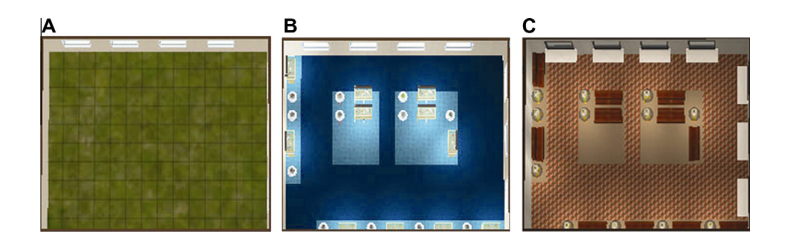
Figure 1. Different settings with matching spatial arrangements. (A) Grid used to position objects. (B) Aquarium and (C) doctor’s waiting room, with different objects occupying corresponding locations. Such matching layouts may trigger familiarity even when the earlier setting cannot be recalled (adapted from Cleary et al. 2012).
Neuroscience approaches the question by examining what happens when brain activity changes. Bartolomei and colleagues studied 24 patients with epilepsy who had electrodes implanted for evaluation before surgery (Bartolomei et al. 2004). Electrical stimulation of the rhinal cortex, particularly the entorhinal cortex, a region involved in memory and familiarity, sometimes elicited déjà vu. This shows that altering activity in memory-related circuits can produce the experience. However, it does not show that this region acts alone, confirm the spatial-similarity explanation, or demonstrate that everyday déjà vu in healthy people arises through the same mechanism.
Déjà vu often brings more than familiarity; it can also create a sense of knowing what happens next. Cleary and Claxton examined this through metacognition, how people judge their own knowledge (Cleary and Claxton 2018). Participants viewed virtual routes and predicted upcoming turns. When they could not recall a similar earlier route, reports of déjà vu were associated with stronger feelings of knowing the next turn, but not greater prediction accuracy. This helps explain why the feeling of prediction during déjà vu can be so convincing: a person’s confidence about what comes next can exceed their demonstrated ability to predict it.
Together, these studies suggest that déjà vu reflects a mismatch between a strong feeling of familiarity and the knowledge that a situation is new. Spatial similarity may trigger familiarity without recall, while brain stimulation shows that memory circuits can produce the feeling directly. Neither finding explains every occurrence, and the sense of prediction that sometimes comes with it can be misleading. That strangely familiar room may not mean you have lived the moment before; instead, it may reveal how memory quietly shapes our experience of the present.
References
Bartolomei, F., E. Barbeau, M. Gavaret, et al. 2004. “Cortical Stimulation Study of the Role of Rhinal Cortex in Déjà Vu and Reminiscence of Memories.” Neurology 63 (5): 858–64. https://doi.org/10.1212/01.wnl.0000137037.56916.3f.
Cleary, Anne M., Alan S. Brown, Benjamin D. Sawyer, Jason S. Nomi, Adaeze C. Ajoku, and Anthony J. Ryals. 2012. “Familiarity from the Configuration of Objects in 3-Dimensional Space and Its Relation to Déjà Vu: A Virtual Reality Investigation.” Consciousness and Cognition 21 (2): 969–75. https://doi.org/10.1016/j.concog.2011.12.010.
Cleary, Anne M., and Alexander B. Claxton. 2018. “Déjà Vu: An Illusion of Prediction.” Psychological Science 29 (4): 635–44. https://doi.org/10.1177/0956797617743018.
Comments
11 Responses to “Whoa, Have I Been Here Before? Exploring Déjà Vu and Why We Experience It”
Hey everyone! After a strange moment of déjà vu at the movies, I wanted to understand what my brain was actually doing. This topic connects to what we’ve learned in iSci about how electrical signals travel through neurons. The Bartolomei study shows that electrically stimulating one region of the brain’s memory network can produce déjà vu on its own, so an artificial signal can create a feeling we’d normally think of as a memory. It also builds on my last post about sound and music: in both cases, the brain constructs an experience from incoming signals rather than simply recording it. I hope you enjoy the read!
Hi Riyal,
Great post! I enjoyed how you explored déjà vu through memory and prediction. I just have a few suggestions:
Title: “Woah” is quite informal. Consider changing it to “Whoa” for a more polished title.
P4S1: The phrase “Beyond feeling familiar” is slightly awkward as a transition. Consider rewording it to make the shift from brain activity to metacognition smoother.
Happy editing!
Hassan
Hey Hassan! Thanks for the suggestions. The title now uses “Whoa,” and I’ve reworded the start of P4 so the transition into metacognition is smoother. Enjoy the reread
Hi Riyal,
I really enjoyed reading your blog post. Your figure was super interesting as well.
-P1S3: Personally, the flow is a bit awkward. I think it would be better if you could break it into two sentences. For example. “This experience is called déjà vu, French for “already seen”. It’s a feeling of familiarity that conflicts with recognizing the situation as new.”
-P1S3: In addition to breaking up the sentence into two, I think if you add “as a new experience” to the end of the sentence it would help the readability flow better.
-Your figure is super interesting! Just make sure that you actually reference it in your writing. You can add a short sentence referring to it in the paragraph before the figure to strengthen the content.
Happy editing!
Stephanie
Hey Stephanie! Thank you so much for your feedback. I’ve split the definition in P1 into two sentences so it reads more smoothly, and Figure 1 is now referenced in the paragraph before it. Enjoy the reread!
Hi Riyal,
This is an interesting post with a topic I am also curious about. Some feedback I have for you is:
– Consider having a wider variety of sources; aim for around 5 so you can cover more material about your topic rather than paraphrasing one source too much (Clearly et al.)
– In your first paragraph, do you have a citation for the definition of deja vu?
– Make sure to hyperlink your citations! I should be able to click on them and be redirected to your source.
I look forward to the final product! Happy editing!
Angie
Hey Angie, thank you for your comment! All of my citations are now hyperlinked to their sources. I chose to stay with three sources so I could analyze each study properly within the word limit, but I made sure each one supports a different perspective on déjà vu. I hope you enjoy the reread!
Hi Riyal,
This was a super interesting blog post! I really loved how you explained the phenomena of Deja Vu through different scientific lenses. If you’d like, I have a few suggestions.
– It may be useful to add in-text citations eg. (author date) to clarify which studies you are referencing when you draw conclusions or define terms.
P3S5- At the beginning of this sentence, adding a transition such as “however,” may make the phrase flow better.
P4S5- Here, it may be useful to add more detail, in order to precisely define the phenomena you are comparing. Eg, “the sense of knowing can exceed a person’s demonstrated knowledge”.
Overall your blog post was very enjoyable to read, and I found the topic to be extremely intriguing!
Happy editing!
Brianna
Hello Brianna,
Thank you for the kind words! I’ve added linked in-text citations throughout, included “however” in P3 to help the flow, and reworded the end of P4 to more precisely compare a person’s confidence with their actual ability to predict. Good catch, and thank you so much.
Hi Riyal,
Great job on this blog post – really good hook, and I’ve always wondered about this topic too, so thanks for researching it! A few suggestions, if you agree:
– figure caption: not sure if you need to reference the figure that you took the image from. Just the citation Cleary et al. 2012 is sufficient.
– figure caption: a bit unusual to have the box around it, not sure if this is encouraged. Maybe check with your scilit prof!
– make sure you reference the figure in your text!
– P3: you use the same phrase “name and colleagues” to cite, but I suggest just saying “Study” and then using in-text citations to your advantage. The names of the researchers will be in the in-text citation, and it might confuse the reader to read random names in the text body multiple times.
Other than that, great job! Happy editing:)
Janaya
Hey Janaya! Thank you so much for the feedback. I’ve simplified the figure credit to just cite Cleary et al. 2012, and the figure is now referenced directly in the text. Enjoy the reread!