The prevailing conversation about cells, especially in academic spaces, tends to focus on internal cellular processes and biological organisation. Albeit important, these discussions often overshadow those about the physical dynamics that make the cell an efficient unit, an equally important factor in cell functioning. A trend seen across all cells regardless of their type or inhabited organism is their small size, yet typically large quantity. For instance, while a mature human blood cell averages at a diameter of 8μm, a range of 20-30 trillion blood cells are present in the body at any given time. This can be explained by the surface area to volume ratio of a cell. To sustain itself, a cell must import necessary molecules such as water and nutrients while exporting cellular waste at the same rate. When the surface area and volume of a cell are low, they maintain a 1:1 ratio allowing for homeostasis in this way. However, as the cell grows, the surface area and volume increase at different rates, imposing a dilemma. Because volume grows quicker comparatively to surface area within the ratio, large cells will be unable to exchange materials along the membrane as needed to sustain its mass, making for an inefficient cell.
This phenomena, applied to bacterial bodies, was recorded by Leigh K Harris et al in their study contrasting the surface area to volume ratio in rod-shaped bacteria to wild-type bacteria. The rod-type bacteria studied, A325P MreB, were found to vary in their width at different parts of the cell but despite the fact, cellular mechanisms worked to return them to an optimal SA:V ratio. The wild-type (WT) bacteria generally maintained their SA:V ratio throughout.
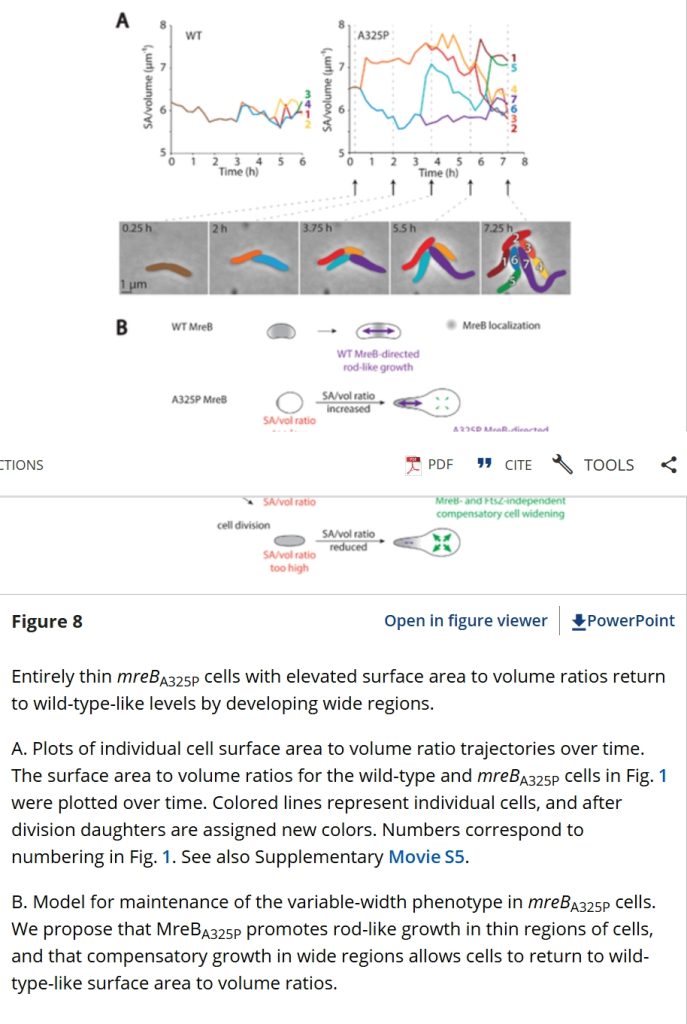
In mammalian organisms, slightly different mechanisms work to keep this ratio steady such as microvilli and cellular folding. For instance the microvilli (microscopic projections on the surface of the cell) present on “intestinal enterocytes increase to the apicalplasma membrane area significantly” (Wu 2025) playing a critical role in nutrient uptake. In other cells such as T-lymphocytes , the increased surface area resulting from microvilli “enables cell deformations necessary for tissue intravasation and migration” (2025).
All in all, the commonality between cells of various organisms is the unchanging SA:V ratio they must maintain as a working body. Though their internal makeup may vary across their domain and kingdom, the physical properties that allow the cell to sustain biological life stay the same. In this way, the biological and physical sects of science interact for a shared objective as the principles of physics influence the biological functions necessary for cellular survival.
Referances
Arman Namvar, Adam J Blanch, Matthew W Dixon, et al. “Surface Area-to-Volume Ratio, Not Cellular Viscoelasticity, Is the Major Determinant of Red Blood Cell Traversal through Small Channels.” Science Direct. February 12, 2021. https://onlinelibrary.wiley.com/doi/10.1111/cmi.13270
Leigh K Harris, Natalie A Dye, Julie A Theriot, et al. “A Caulobacter MreB Mutant with Irregular Cell Shape Exhibits Compensatory Widening to Maintain a Preferred Surface Area to Volume Ratio.” Wiley. September 30, 2014. https://doi.org/10.1111/mmi.12811.
Wu Weida, Alice R Lam , Kayla Suarez, et al. “Plasma Membrane Folding Enables Constant Surface Area-to-Volume Ratio in Growing Mammalian Cells – Sciencedirect.” Science Direct. April 7, 2025. https://www.sciencedirect.com/science/article/abs/pii/S0960982225002659.
Comments
4 Responses to “The Process That Makes Cell’s Efficient”
Hi Winning,
This was an interesting post. I find it fascinating how organisms have so many different ways to keep processes running effectively!
A couple of suggestions:
1. Your first paragraph has two very long, run-on sentences. As someone browsing through posts and picking one to read, the beginning was not enticing. I would try to provide a less complex overview of your topic in the first paragraph, both to draw in the read and to help them understand what you are going to be discussing. The later paragraphs are much easier to understand, and explain complex terms well.
2. In paragraph 3 sentence 2, I would use commas instead of a colon to identify the type of bacteria. For example: “The wild-type bacteria studied, A325P MreB, was found to vary in its width at different parts of the cell but despite the fact, cellular mechanisms worked to maintain an optimal SA:V ratio.”
3. I would consider adding a figure that shows the shapes of the different cells. You describe several unique types of cells, which is great, so it would be helpful to be able to visualize them.
4. Your references are not currently separated from the text, I would add a line break and the word “References”. You could look at some older blog posts to see how authors typically format this.
Thanks for an interesting post!
Laura
Hi Winning!
I had never really thought about why cells needed to be so small before, so I found it really interesting to learn how important the surface area-to-volume ratio is to cellular efficiency and how this concept applies across different organisms!
Here are some suggestions:
– I noticed a small grammatical issue in P4. For the sentence “Though their internal makeup … that allow the cell to sustain biological life stay the same,” I would change “stay” to “stays”.
– I would suggest adding a figure to help visualize how SA:V changes as a cell grows and how this affects efficiency, or perhaps how A325P MreB maintains an optimal SA:V ratio. This could enhance the reader’s understanding of your blog!
– I see that you have added a description at the bottom, but I would suggest posting it in the comments as well and mentioning how this relates to one of our iSci activities, as directed in the Science Literacy outline.
– For the references, I believe they should lead directly to an accessible source rather than a library-access page. The ScienceDirect link does not seem to provide direct access to the article. Perhaps you could use this PMC link instead: https://pmc.ncbi.nlm.nih.gov/articles/PMC11981834/?
– Lastly, this is more for aesthetics but I would recommend capitalizing all non-connecting words in the title!
Happy editing!
Nica Eliza
Upon a second read I have realized you were grammatically correct, my apologies and please disregard my first suggestion!
Hey iSci! I wanted to touch on the intersection of biology and physics as scientific subspecialities as they both peak my interest and aren’t often spoken about in tandem. The above specifically is focused on cell biology and physics so it expands on topics directly related to us as living organisms. Enjoy and Critic!