Not Just Grape Juice
Contrary to popular belief, most wines are not considered vegan. Pesticide use, soil treatments, additives, preservatives, and even the bottling and labelling of the finished product can result in the addition of animal-based products. Of these, fining agents are most commonly derived from animals, and can include gelatine, casein (milk protein), chitin (crustacean shell fibre), albumin (egg white protein), fish oil, and isinglass (fish bladder membranes) (Will 2022). Fining agents are used to clarify wine, and it is common practice for them to be removed prior to bottling; however, residuals can still end up in the final product. (Will 2022)
The Function and Fallbacks of Fining Agents
Wine contains many chemical compounds originating from grapes, including proteins, tannins, and other organic compounds (Will 2022). While some contribute positively to the flavour, colour, and sensory properties of wine, others can impart unwanted characteristics like bitterness or acidity (Río Segade et al. 2019). The goal of fining agents is to remove compounds to negate unwanted traits; the most common practice for winemakers is to use animal-based agents, but this can cause problems such as colour loss or unpleasant aromas, and can trigger allergies or intolerance in sensitive wine consumers (Río Segade et al. 2019).
Seeing as how fining agents can include common allergens, one may think that winemakers must indicate if their product contains such substances. This is true–but only to a certain extent. Winemakers are only required to indicate the presence of milk, egg, and fish allergens on the product’s label (Health Canada 2010). No regulation exists for other types of foreign substances that can be found in wine. In fact, a single bottle can contain up to 180 undeclared ingredients under Ontario regulations (Roman 2022). Therefore, a shift towards plant-based fining agents can help winemakers meet the health needs of consumers.
The Power of Proteins: Fining Agent Mechanism Explained
Most fining agents are protein-based so that they can interact with compounds in wine that need to be removed (Río Segade et al. 2019). Phenolic compounds are naturally occurring compounds that contain phenolic rings and contribute to both grape and wine quality (Căpruciu 2025). Protein-based fining agents initially interact with phenolic compounds through hydrogen bonding and hydrophobic interactions. They can then form either soluble complexes, which can be precipitated, or insoluble, covalently-linked protein aggregates which can interact with polysaccharides to form stable particles (Río Segade et al. 2019; Marangon et al. 2025) (Figure 1).
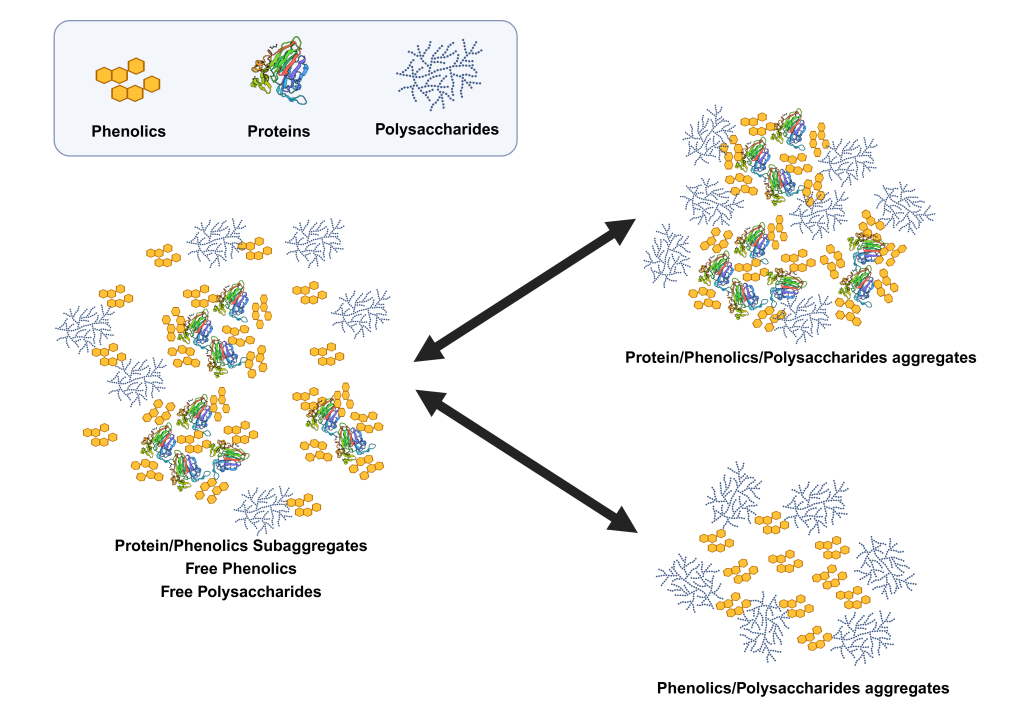
Figure 1: Mechanism for the collision of proteins (introduced through fining agents), phenolic compounds (already present in wine), and polysaccharides (already present in wine). Proteins can remove target phenolics in two ways: the first is by forming soluble complexes with the target phenolic which can be removed via precipitation (top-right) and the second is by forming insoluble complexes with polysaccharides which stabilize other free phenolics (bottom-right and left). (Marangon et al. 2025)
The question remains: can plant-based fining agents meet, or exceed, the capabilities of animal-based agents?
Plant Potential
There are many different types of plant-based proteins that can be used as a fining agent. Río Segade et al. (2020) found that pea protein was comparable to gelatine for its removal of polymeric flavanols, leading to better wine colour preservation capabilities in terms of intensity and hue. Another study by Miranda et al. (2026) found that vegan fining agents showed capable performance in maintaining wine quality, but without surpassing the fining power of gelatine. Other vegan and protein-based fining agents have been derived from cereals, legumes, potatoes, seaweeds, grape seed extracts, and yeasts (Río Segade et al. 2019). Non-protein based possibilities include bentonite clay, activated charcoal, and polysaccharide-based agents isolated from the cell walls of fruits like apples and grapes (Río Segade et al. 2019; Will 2022).
The Future of Wine
The movement towards plant-based fining agents addresses increasing regulatory, environmental, and ethical concerns in the winemaking industry (Miranda et al. 2026). As many nations begin to classify animal-derived fining agents as allergens, winemakers face additional steps to bring a bottle to market (Marangon et al. 2019). Many wine consumers also do not consider or prioritize sustainable attributes when choosing their next dinner bottle (Stanco et al. 2020). Therefore, consumer preference and product transparency are equally important for wineries to consider when rethinking strategies for shaping their product.
References
Căpruciu, Ramona. 2025. “Resveratrol in Grapevine Components, Products and By-Products—A Review.” Horticulturae 11 (2): 111. https://doi.org/10.3390/horticulturae11020111.
Health Canada (Government of Canada). 2010. “Health Canada Reviews and Answers Comments Received on Regulatory Project 1220 – Enhanced Labelling for Food Allergens, Gluten Sources and Added Sulphites.” Consultations. May 31. https://www.canada.ca/en/health-canada/services/food-nutrition/food-labelling/allergen-labelling/reviews-answers-comments-received-regulatory-project-1220-enhanced-labelling-food-allergens-gluten-sources-added-sulphites.html.
Marangon, Matteo, Valentina Marassi, Fulvio Mattivi, et al. 2025. “The Role of Protein-Phenolic Interactions in the Formation of Red Wine Colloidal Particles: This Is an Original Research Article Submitted in Cooperation with Macrowine 2025.” OENO One 59 (2). https://doi.org/10.20870/oeno-one.2025.59.2.8485.
Marangon, Matteo, Simone Vincenzi, and Andrea Curioni. 2019. “Wine Fining with Plant Proteins.” Molecules 24 (11): 2186. https://doi.org/10.3390/molecules24112186.
Miranda, David, Mariana Carvalho, Luís Sottomayor, António Graça, Víctor Freitas, and Diana Dias da Silva. 2026. “Vegan Fining Strategies in Port Wine: Implications for Chemical Composition and One Health Sustainability.” Scientific Letters 1 (Sup 1). https://doi.org/10.48797/sl.2026.475.
Río Segade, Susana, Maria Alessandra Paissoni, Mar Vilanova, Vincenzo Gerbi, Luca Rolle, and Simone Giacosa. 2019. “Phenolic Composition Influences the Effectiveness of Fining Agents in Vegan-Friendly Red Wine Production.” Molecules 25 (1): 120. https://doi.org/10.3390/molecules25010120.
Roman, Will. Integrated Speaker Seminar, ISCI 3A12 Wine Science Component, McMaster University, Hamilton, Ontario, September 14, 2026.
Stanco, Marcello, Marco Lerro, and Giuseppe Marotta. 2020. “Consumers’ Preferences for Wine Attributes: A Best-Worst Scaling Analysis.” Sustainability 12 (7): 2819. https://doi.org/10.3390/su12072819.
Will, Donovan (South African Food Review). 2022. “Defining and Certifying Vegan Wine.” April 1. https://doi.org/http://doi/full/10.10520/ejc-im_safr_v49_n4_a6.


Leave a Reply
You must be logged in to post a comment.