As I sat at my desk Tuesday morning getting ready for the day, I was suddenly struck by my own thoughts. I realized I was not thinking explicitly of my next thought, but rather stringing words together based on the speech patterns I was accustomed to. This “probability-based” approach reminded me of how artificial intelligence works in much the same way, using weighted probabilities to produce outcomes based on learned patterns. If these two processes were so analogous, how could I be sure I wasn’t an AI? On a greater scale, how can we be sure we’re not living in a simulation?
This concept originated from Nick Bostrom (2003), who proposed that one of three propositions was true. The first being that the human species is likely to become extinct before reaching a ‘posthuman stage’; the second being that a posthuman civilization is unlikely to run a significant number of simulations due to a lack of interest; and the last being that we are certainly already living in a simulation.
The answer has become a matter of great debate, especially with the unprecedented boom in artificial intelligence (Berkealpkeskin 2025). The consensus generally is that we can’t be sure. It’s 50/50 (Ananthaswamy 2020). Some physicists, such as Franco Vazza (2025), argue it’s impossible, defying the physical systems with which we are familiar. However, a recent article published by Melvin Vopson (2025), a leading physicist from the University of Portsmouth, argues that simulation theory could be valid if we expand on the physical systems we know.
Dr. Vopson compares the known properties of thermodynamics to theoretical properties of data: infodynamics. This theoretical property suggests that, over time, the entropy of information, a metric of the uncertainty of possible outcomes, tends to approach equilibrium. To achieve this, it must either decrease or remain constant. This is quantified by the Shannon information entropy formula. From viruses evolving to lower Shannon entropy to electrons obeying Hund’s rule, natural systems consistently organize to reduce information entropy (Lukaszyk 2023; Ostrowski et al. 2024). Similarly, computers work more efficiently as data is compressed. Dr. Vopson suggests the universe is just a computer that compresses data through one key mechanism – gravity (Vopson 2025).
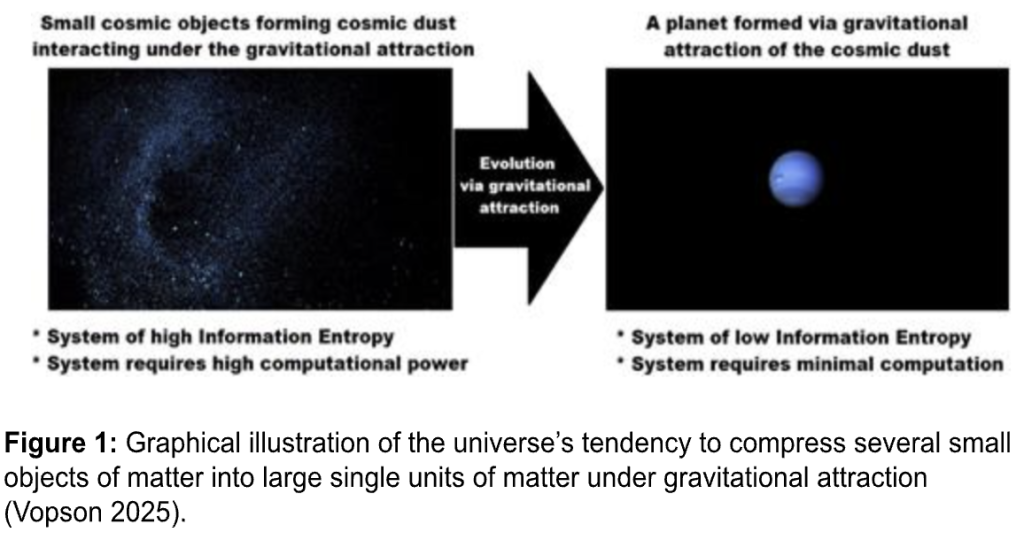
If space-time is treated as discrete, as supported by quantum mechanics, it can be represented as a mesh, similar to that of pixels, storing information about position and momentum in each unit. Using Shannon’s information entropy formula, it is possible to calculate the information per event over the span of these units. Unsurprisingly, having lots of information at different points has high entropy, whereas combining these points at one location has significantly lower entropy (Fig. 1). This effect is eerily similar to the effects of gravitational attraction (Vopson 2025).
Dr. Vopson is not the first to propose this mechanism. Professor Erik Verlinde of the University of Amsterdam came to similar conclusions in a paper titled “On the Origin of Gravity and the Laws of Newton” published in 2011. Verlinde proposed that complex space can be represented by simpler space projections–the holographic principle. Using this in tandem with information-theoretic principles, Newtonian formulas for gravity arose naturally (Verlinde 2011).
Alternatively, what can be said about the observation effect? While gravity acts at the macroscopic level, electrons on the microscopic level alter their behaviour based on observation (Borowski 2012; Baclawski 2018). Behaving as particles when observed and as waves when not (Borowski 2012). This too could act as a mechanism of data compression, similar to culling in games (“Photon Quantum 3 | Prediction Culling” 2026).
Whether you choose to believe we live in a simulation is up to your interpretation. Yet, in a time where artificial intelligence is reaching capabilities that may exceed our own, it is a question that becomes increasingly glaring. Most of what we can postulate is highly theoretical, but it still stands to highlight the intriguing intersection of philosophy and science.
References
Ananthaswamy, Anil (Scientific American). 2020. “Do We Live in a Simulation? Chances Are about 50–50.” October 13. https://www.scientificamerican.com/article/do-we-live-in-a-simulation-chances-are-about-50-50/
Baclawski, K. 2018. “The Observer Effect.” 2018 IEEE Conference on Cognitive and Computational Aspects of Situation Management (CogSIMA), June, 83–89. https://doi.org/10.1109/COGSIMA.2018.8423983
Berkealpkeskin. 2025. “Are We Living in a Simulation? AI Just Made the Question Impossible to Ignore.” Medium, November 1. https://medium.com/@berkealpkeskin/are-we-living-in-a-simulation-ai-just-made-the-question-impossible-to-ignore-8c7c0ecf7c59
Borowski, Susan. 2012. “Quantum Mechanics and the Consciousness Connection | American Association for the Advancement of Science (AAAS).” July 16. https://www.aaas.org/membership/scientia/quantum-mechanics-and-consciousness-connection
Lukaszyk, Szymon (ResearchGate). 2023. “Shannon Entropy of Chemical Elements.” November. https://doi.org/10.20944/preprints202310.1112.v3
Ostrowski, J., M. Ozimek, and K. W. Fornalski. 2024. “Entropy of Mutating Viruses.” Acta Physica Polonica A 146 (3): 265–265. https://doi.org/10.12693/APhysPolA.146.265
“Photon Quantum 3 | Prediction Culling.” 2026. June 11. https://doc.photonengine.com/quantum/v3/manual/prediction-culling
Vazza, F. 2025. “Astrophysical Constraints on the Simulation Hypothesis for This Universe: Why It Is (Nearly) Impossible That We Live in a Simulation.” Frontiers in Physics 13 (April). https://doi.org/10.3389/fphy.2025.1561873
Verlinde, Erik. 2011. “On the Origin of Gravity and the Laws of Newton.” Journal of High Energy Physics (Berlin/Heidelberg) 2011 (4): 029–. https://doi.org/10.1007/jhep04(2011)029
Vopson, Melvin M. 2025. “Is Gravity Evidence of a Computational Universe?” AIP Advances (Melville) 15 (4): 045035-045035–37. https://doi.org/10.1063/5.0264945
Comments
15 Responses to “Were You Programmed To Read This?”
Hi Claire,
What a wonderfully written blog post! Your title was well thought out and summarized your topic well. I have a few suggestions for you to consider:
– In your first paragraph, I am a bit confused by the first few sentences. I understand that you’re trying to demonstrate how AI works through a human perspective, but I think you can definitely make this clearer with a bit of re-wording. For example, “Every morning as I get ready for the day thoughts roll around in my head. When most people think, they do not necessarily think about their next thought but rather fill in the blank based on…” I am also slightly confused about what you mean by “used to hearing” as well. It makes it sound like you’re referencing a conversation and not an internal monologue. I’d focus on making your intro less narrative and more straightforward to clearly set up your argument.
– Regarding the Bostrom paper in the second paragraph, you do not need to include an in-text citation at the end of the sentence since you referenced the paper in your writing (for example, “this concept originated from Bostrom et al. (2003) who…”). Furthermore, I recommend stating the concepts in a sentence rather than a list to keep your writing more fluid.
– In the beginning of the third paragraph, you must include a citation for the “recent article” you are talking about (the author’s name is not enough since that doesn’t tell the reader how to find the paper).
– You referenced Figure 1 in the text, but I can’t see any figures in your post…Maybe this is an uploading error?
Overall, I thought your post was well written and included a lot of evidence. I cannot wait to read the final version 🙂
Happy editing,
Chloe
Hi Chloe! Thanks for all your feedback! I implemented all your recommendations, and I think it reads much clearer now, so thank you :). I’m unsure as to why the image wasn’t showing up for people, as I could see it on my end, but I tried to reformat it, so hopefully it’s visible now!
Claire
Hi Claire,
Super interesting blog post! I enjoyed your perspective in the first paragraph! Here are some suggestions I had while reading:
– P4S1: This sentence is a little bit repetitive, as it mentions that the Dr is a physicist twice. I would also suggest that the end “we are.” is a bit confusing, as it can be unclear what you are refering too.
– After P5 there is an extra space.
– In P5S1 and P5S2 I would consider adding a citation, as these might not be common knowledge.
Overall, this was a very well researched blog, and I can’t wait to read the final version!
Best,
Tsippora
Hi Tsippora! Thanks for your recommendations! I reworked the wording for P4S1 and the formatting for P5. As for the citations in P5S1/2, they actually are referencing Vopson, so (I think) it’s okay to leave it as the citation at the end of the passage? Thanks again for your feedback :)!
Hi Claire,
I can’t help but continue reading this post as soon as I see the title. The title represents your philosophical thinking well and I agree with your point about whether agency truly exists.
Here are some small suggestions.
You mentioned “physicist…a leading physicist from the University…”. This is redundant as they overlap. I would consider rephrasing this sentence.
I found your thesis remains unclear throughout the article. You begin with debating agency, then gravity can be understood as information compression, and eventually the connection between science and philosophy. Which one is your main argument? Evidence you provided suggests that we live in a simulator, while your conclusion states the intersection between science and philosophy.
You also referenced Fig.1, which is not in your post. I recommend double checking that.
Overall, I enjoy reading your post. Don’t forget to write a comment explaining your connection!
Best,
Edgar Lee
Hi Edgar! Thanks for your feedback and the reminder to comment! I reformated my paragraphs, introduction and conclusion, so hopefully the blog reads a bit clearer and flows nicer from idea to idea. As for the image, I’m still not sure why it wasn’t showing up for people, as I could see it on my end, but I tried adding it in again, so hopefully it’s visible now. Thanks again for your advice!
Claire
Hello Claire, This is a really interesting topic and honestly something that has crossed everyone’s mind at one point or another!
I just had a few suggestions while reading:
– As far as I can tell, you don’t currently have a figure included, and there seems to be a large gap in the middle of your paper after paragraph four.
– Your introductory paragraph feels a little repetitive at times because you’re walking the reader through your thought process step by step. There are a lot of “then” statements, which can make the flow feel a bit choppy. I think varying the transitions and making the connections between ideas a little more direct would help.
– “Tuesday morning, as I was getting ready for the day, I was thinking to myself. As most people hopefully do…” These probably don’t need to be separate sentences. A comma would work just fine here. I was also left wondering what exactly you were thinking about.
– Later when you say: “I then realized that I was not necessarily thinking about my next thought…” I wasn’t totally sure what this meant. Maybe something more along the lines of realizing that your thoughts were influenced by familiar patterns or things happening around you rather than being completely original.
– I also got a little lost in the jump from that idea to probability and AI. I think the progression could be made more obvious: You’re thinking – you realize you’re responding to familiar patterns – that’s similar to how AI predicts responses based on learned information – could humans work in a similar way? – could reality itself be a simulation?
That would make the logic easier for the reader to follow.
In paragraph three, you write:”A recent article published by a physicist, Dr. Melvin Vopson, a leading physicist from the University of Portsmouth, suggests that we are…” This sentence feels incomplete. Suggests that we are what?
Overall though, I really enjoyed reading it and learning a bit more about the idea that reality could be interpreted as a simulation through gravity.
Happy editing!
Ava 🙂
Hi Ava! Thanks for all your feedback. I reworked the introductory paragraph, so hopefully it flows nicer. I also removed all the redundancies and repetitions! As for AI, I tried to make that connection a little cleaner in my introduction and conclusion now so it fits more with the topic. Thanks again for your advice :)!
Claire
Hi iSci! I think I explained how I came up with this topic above, but I thought it had a lot of ties to different concepts we’ve learned in class, such as the Shannon diversity index, wave-particle duality, the formation of the universe, and, of course, our first RP! Particularly, it reminded me of how we’re using analogous Earth systems to create new hypotheses of life on Titan, in a similar way that Vopson uses thermodynamics to create a new hypothesis, infodynamics. Anyways, thank you in advance for reading and your feedback :)!
Claire
Hi Claire,
This is such a cool blog post and creative title! I really enjoyed reading this.
A few suggestions for editing:
P1S1-2: I believe replacing the period for a comma after “myself” would help with flow.
If your word count permits, it may be beneficial to define “Shannon information entropy” for clarity.
I loved reading this blog and thinking about this theory further. Thanks for writing this!
Joud 🙂
Hii Joud, I added a definition for Shannon information entropy and information entropy in general. I also cleaned up the introduction a little more. I wonder where I got the title idea from… Thanks again for your feedback :)!
Claire
Hi Claire,
Wonderful job on the title! Really hooked me in — I just had to read the post. Overall, really amazing job, I thought it was really interesting how Newtonian formulas for gravity naturally arose from information-theoretic and principles. It’s definitely a little bit eerie. I have a few small suggestions:
P4: Define what information entropy is
Citations: Hyperlink your DOIs
Extra line between P3 and P4
Correct me if I’m wrong, but I think there’s also been a scientist who published a paper some time ago energetically proving that we aren’t in a simulation? I think I remember seeing something about it on social media. It might be an interesting add to your blog post!
Happy editing!
Vani
Hi Vani, thanks for all your suggestions! I added a definition for information entropy and hyperlinks for my DOI’s. I also cleaned up the formatting! Thanks for sharing information about the counterargument; I added a sentence about Franco Vazza’s work, quite interesting the spread of opinions on this!
Claire
Hi Claire!
Before I give any advice, I just wanted to say that your blog was incredibly interesting to read! The topic itself was really interesting, and I loved the way that you explained it!
A few comments though:
– In P4, explaining what Shannon information entropy is would be great, as it’s likely that most readers won’t know what it is.
– In P5, you reference a figure that does not exist.
– In P6, you should actually name the paper that you are talking about
Otherwise, fantastic work!
Happy editing,
Daniel
Hi Daniel, thanks for all your feedback! I added a definition for Shannon information entropy and explicitly called out Erik Verlinde’s paper. I’m not sure why my figure doesn’t show up on my blog as I could see it, but I tried adding it in again, so hopefully it is visible now. Thanks again for all your recommendations :)!
Claire