Imagine your sex was determined by the temperature outside rather than your chromosomes. Pretty crazy, right? Well, this is exactly how it works for sea turtles. Unlike humans, a sea turtle’s sex is determined by the temperature of their egg during a specific stage of embryonic development (Woolgar et al. 2013). Unfortunately, rising global temperatures threaten this process and the future of sea turtle populations.
Seven living species of sea turtles exist, and all seven of them exhibit a process called temperature-dependent sex determination (TSD). This occurs because sea turtles lack the sex chromosomes that determine human sex and instead develop testes or ovaries based on the temperature at which their eggs are incubated (Woolgar et al. 2013). Usually, cooler temperatures produce males, while warmer temperatures produce females, with the pivotal temperature, which is the temperature at which 50% of the hatchlings are female, differing from species to species. It is also important to note that the pivotal temperature is very specific, as, for most species, an increase of 1 °C can cause around 80% of hatchlings to be female (Blechschmidt et al. 2020).
During sea turtle embryonic development, egg temperatures can influence the expression of genes that are responsible for reproductive organ development (Ge et al. 2018). At cooler temperatures, a histone demethylase called KDM6B promotes the transcription of a male sex-determining gene called Dmrt1. It does this by eliminating the trimethylation of H3K27 near its promoter, encouraging testicular development (Ge et al. 2018). At higher temperatures, increased calcium signalling activates a protein called STAT3 through phosphorylation, binding the Kdm6b locus and suppressing Kdm6b transcription (Weber et al. 2020). Warmer temperatures can also increase the production of aromatase, promoting ovary differentiation and development while helping to maintain the ovarian structure (Pieau et al. 2001). While this research grants us insight into how TSD works, it was conducted on red-eared slider turtles, and the exact mechanism could differ between species.
As global temperatures rise due to climate change, warmer nesting beaches are producing more female-biased populations (Blechschmidt et al. 2020). A study on green sea turtles from Australia’s Great Barrier Reef showed that 99.1% of juveniles originating from the warmer northern nesting beaches were female, while turtles originating from cooler southern nesting beaches were approximately 65–69% female (Blechschmidt et al. 2020). As shown in Figure 1, females also outnumbered males across all three life stages (juvenile, subadult, and adult) at a northern Great Barrier Reef foraging ground (Jensen et al. 2018).
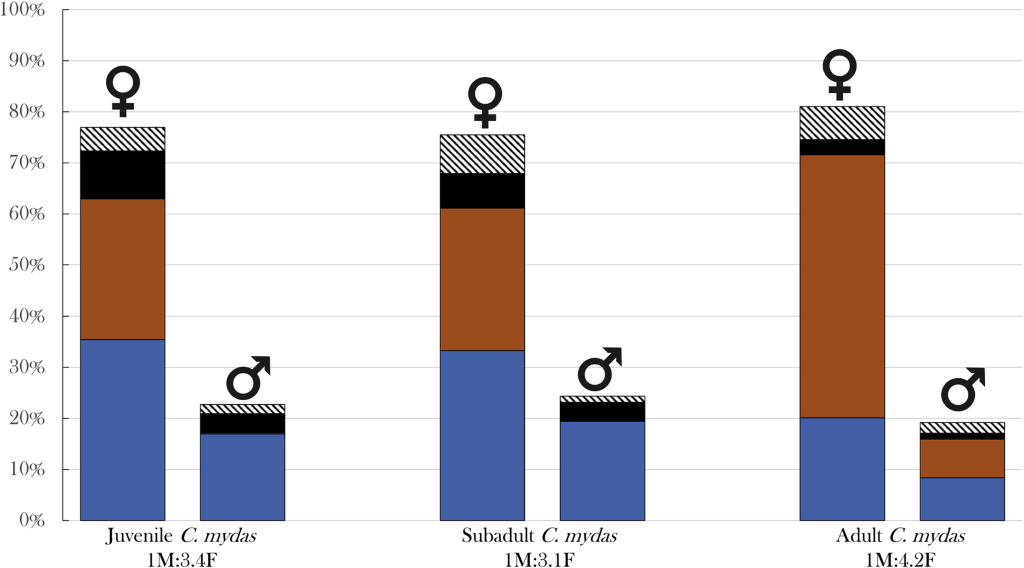
Figure 1. Relative proportions of male and female green sea turtles (Chelonia mydas) at a northern Great Barrier Reef foraging ground, categorized by life stage (juvenile, subadult and adult) and nesting-beach origin. The brown sections represent turtles originating from the northern Great Barrier Reef, blue represent turtles from the southern Great Barrier Reef and Coral Sea. Black sections represent turtles from other nesting populations, and black-and-white striped sections represent turtles whose nesting origins could not be identified. Younger turtles reflect more recent incubation temperatures, while adults reflect earlier conditions, allowing researchers to examine how sex ratios may have shifted over time as temperatures have increased. Note that the y-axis is the percentage of the population (Jensen et al. 2018).
With global mean temperatures expected to increase by 1.0 °C to 3.7 °C until 2100, the population of females could significantly increase and may lead to mate-finding difficulties, reproduction failure, and potential population declines (Blechschmidt et al. 2020). While it is true that female-biased populations are not necessarily harmful, extreme imbalances could eventually threaten reproduction. Male turtles can mate more frequently than females, meaning fewer males can still support reproduction. However, continued climate warming could eventually produce too few males to sustain populations (Blechschmidt et al. 2020).
Ultimately, as global temperatures continue to rise, it is important to remember that climate change affects more than just humans. Protecting nesting habitats, limiting further climate warming, and continuing research into TSD are important steps towards maintaining healthy sea turtle populations and ensuring their survival.
References
Blechschmidt, Jana, Meike J. Wittmann, and Chantal Blüml. 2020. “Climate Change and Green Sea Turtle Sex Ratio—Preventing Possible Extinction.” Genes 11 (5): 588. https://doi.org/10.3390/genes11050588.
Ge, Chutian, Jian Ye, Ceri Weber, et al. 2018. “The Histone Demethylase KDM6B Regulates Temperature-Dependent Sex Determination in a Turtle Species.” Science (New York, N.Y.) 360 (6389): 645–48. https://doi.org/10.1126/science.aap8328.
Jensen, Michael P., Camryn D. Allen, Tomoharu Eguchi, et al. 2018. “Environmental Warming and Feminization of One of the Largest Sea Turtle Populations in the World.” Current Biology 28 (1): 154-159.e4. https://doi.org/10.1016/j.cub.2017.11.057.
Pieau, C., M. Dorizzi, and N. Richard-Mercier. 2001. “Temperature-Dependent Sex Determination and Gonadal Differentiation in Reptiles.” EXS, no. 91: 117–41. https://doi.org/10.1007/978-3-0348-7781-7_7.
Weber, Ceri, Yingjie Zhou, Jong Gwan Lee, et al. 2020. “Temperature-Dependent Sex Determination Is Mediated by pSTAT3 Repression of Kdm6b.” Science (New York, N.Y.) 368 (6488): 303–6. https://doi.org/10.1126/science.aaz4165.
Woolgar, Lorian, Sabrina Trocini, and Nicola Mitchell. 2013. “Key Parameters Describing Temperature-Dependent Sex Determination in the Southernmost Population of Loggerhead Sea Turtles.” Journal of Experimental Marine Biology and Ecology 449 (November): 77–84. https://doi.org/10.1016/j.jembe.2013.09.001.
Comments
9 Responses to “Can Climate Change Affect Sex? Sea Turtles Say Yes ”
Hey iSci!
I decided to write about this topic because, in our climate change class, we were discussing rising global temperatures, and it got me thinking about how climate change could affect other species. My friend later mentioned that sea turtle gender is determined by temperature, and I thought it would be cool to see how the two affect each other. Hope you enjoy!
-Claire
Hello Claire, I loved your title and it instantly drew me into your writing!
Here are some suggestions:
– I would maybe change all statements involving gender to sex since gender does not align with what you are saying.
Pulled from google…
Sex – Biological basis: Sex refers to a set of biological and physiological traits that humans and animals are born with, including chromosomes, gene expression, hormone levels, internal reproductive organs, and external genitalia.
Gender – Social and cultural basis: Gender refers to the socially constructed roles, behaviors, expressions, and identities that a given society considers appropriate for girls, women, boys, men, and gender-diverse people.
– I think you explained the science and the overall process quite well in paragraph 3, maybe you could include a figure of a qualitative representation of this. I know it helps me understand biological processes.
Overall, amazing job! I had no clue sea turtles did this! – Ava:)
Hey Ava,
Thank you so much for reading my blog post and for your feedback! I agree that using sex instead of gender is more scientifically accurate, so I’ll make sure to change that throughout my blog. I also really like your suggestion of adding a figure to explain the biological process; however, I couldn’t find one that was accurate and fit what I was trying to convey.
Thank you again!
Claire
Hi Claire!!
I really liked this!! I knew temperature could influence sex determination in some reptiles, but I had no idea the mechanism was this specific. I thought the KDM6B/STAT3 section was especially cool, and you explained it in a way that was actually easy to follow 🙂
I just had a few thoughts while I was reading:
– When you mention that a 1 °C increase can lead to around 80% female hatchlings, I wonder if it might be worth specifying that this can vary depending on the species or population. Since you explain right before that the pivotal temperature differs between species, I think adding that little qualifier would keep the statistic from sounding universal across all sea turtles.
– For Figure 1, I think it could be helpful to point out that the sex ratios shown are from turtles at a foraging ground and include different life stages and nesting origins, rather than being a direct measurement of hatchling sex ratios from one beach. The figure is really useful, but I think one sentence explaining what it can and cannot tell us about current warming would make the interpretation even stronger.
– I also thought the difference between the juvenile and adult groups in the figure was really interesting. Since adult sea turtles would have hatched much earlier than the juveniles, I wonder if you could briefly connect that to the idea that younger turtles may reflect more recent warming conditions. I think that would make the figure feel even more connected to your climate change argument instead of just showing that females currently outnumber males.
Overall though I genuinely really liked this, especially how you went from the molecular mechanism all the way to what this could mean for whole populations. Such a cool topic 🙂
Happy editing!
Saniyah
Hey Saniyah,
Thank you so much for reading my blog post and for your feedback! I made the change about the 1 °C so thank you for pointing that out. I also added some more information to my figure caption so hopefully that helped.
Thank you again!
Claire
Hi Claire,
This was such an interesting blog post! I also love how you organized the information, beginning with the overall sex effects, then the genetic mechanism and then the consequences for the population as a whole. Here are a few suggestions:
Paragraph 3: this is very well explained. Something to consider would be adding a figure to illustrate the mechanism.
Figure 1: I think this is a perfect selection to reinforce what you are describing in the paragraph before. It might be helpful if you could add a y-axis label to the graph so that readers can easily tell this refers to percentage of females.
In the Pieau citation in the references section, is there supposed to be a comma after EXS and between 91? Is “no. 91” referring to the volumne number?
Happy editing,
Ria
Hi Ria!
Thank you so much for reading my blog post and for your feedback! I really like your suggestion of adding a figure to explain the biological mechanism; however, I couldn’t find one that was accurate and fit what I was trying to convey. I did add a sentence in the figure caption clarifying the y-axis, so thank you for that advice. I also double-checked the Pieau citation, and it seems like the formatting is correct!
Thank you again!
Claire
Hey Claire,
This was such an interesting post! Very related to our current climate change course, and it’s very alarming how much global warming has impacted turtles. The 99% statistic was jaw-dropping! Here are my editing suggestions if you see fit:
– I’m wondering why the title has some inconsistencies in capitalization? It may be nice to rewrite it as such: “Can Climate Change Impact Gender? Sea Turtles Say Yes”
– In paragraph 2, it may be more accurate to say, “…sea turtles lack similar sex chromosomes that determine sex in humans and instead…”
– Paragraph 3 is very scientific! It may help readability if you expand on certain terminology used; consider defining histone demethylase, locus, and androgens/estrogens (which can be simplified to hormone replacement),
– I didn’t know that a turtle’s first life stage was called juvenile, and this caught me off guard! It’s very interesting! It may be helpful for the reader to define this earlier, because you go on to define it later (“…three life stages (juvenile, subadult, and adult”).
Overall, great work! This was certainly a fun read. Happy editing, and I look forward to reading the final version!
Leah
Hi Leah!
Thank you so much for your feedback! Unfortunately, I don’t have the word count to clarify certain terminology, but if I end up having space, I will be sure to do so. I did change my title, so thank you for that feedback. As for clarifying the different life stages of sea turtles, I actually did that right above the figure caption, so hopefully that is good.
Thank you again!
Claire