Red hair has always stood out, but in a healthcare setting it does more than just turn heads; it complicates pain management. From anesthesia resistance to decreased pain tolerance, the Redhead Paradox is reshaping how doctors consider treatment, along with the anxiety that can come with it.
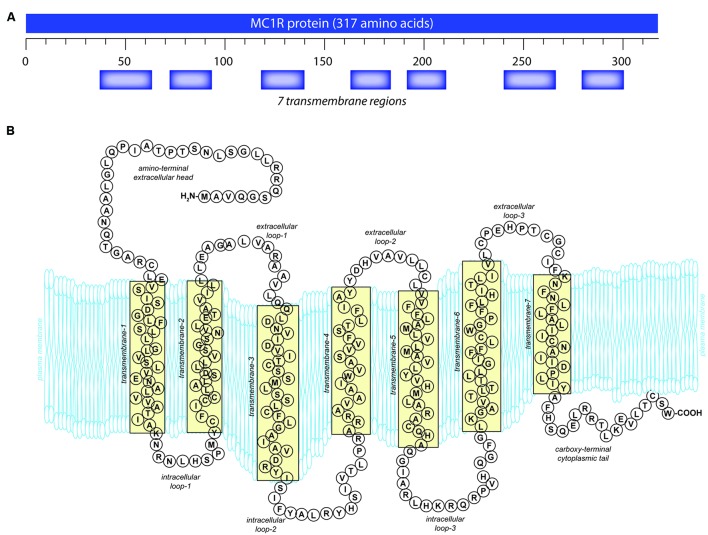
The red hair phenotype results from mutations of the melanocortin-1 receptor (MC1R), which was originally discovered and sequenced in 1992 by two separate research groups: Chhajlani and Wikberg, and Mountjoy et al. (Figure 1; Wolf Horrell et al. 2016). The protein is highly polymorphic, meaning it varies a lot between individuals. Typical expression of MC1R produces eumelanin, a dark brown coloured pigment, and much less pheomelanin, a yellow-red pigment (Liem et al. 2004). Loss-of-function mutations to the MC1R receptor result in excess production of pheomelanin, giving the reddish colour to hair.
Typically, anesthesia requirements are dependent on factors such as age and body temperature, but an experiment by Liem et al. in 2004 showed that significantly more desflurane, a volatile anesthetic, was needed for red-haired individuals compared to those with dark coloured hair (p=0.0004). Multiple studies support these experimental results for general anesthetics, but no consistent patterns are seen for local anesthetics (Meretsky et al. 2024).
Although altered anesthesia efficacy is a well-known phenomenon for redheads, other healthcare factors are also affected by MC1R mutations. Research has shown that lower doses of opioids are needed for redheads to get the same pain relief as those with dark hair (Meretsky et al. 2024). Studies have also compared pain perception and tolerance between redheaded and non-redheaded populations. Although no electrical stimuli differences were seen, there were significant thermal results (Table 1; Liem et al. 2005). It was shown that redheads are more sensitive to thermal pain, meaning that pain signalling pathways, particularly temperature sensitive ones, may function differently in redheaded individuals.
Table 1: Thermal Perception, Pain Perception, and Pain Tolerance Thresholds. Data is presented as medians [interquartile range]. Comparisons were made with the Mann-Whitney rank-sum test. Red-haired women perceived cold pain at significantly higher temperatures (p = 0.004), and exhibited significantly elevated cold pain thresholds (p = 0.001). They also had a lower temperature for heat perception (p = 0.015) and a lower tolerance threshold for heat pain that was significant (p = 0.009) (Liem et al. 2005).
| Red Hair | Dark Hair | p | |
| Cold Sensory Perception Threshold (°C) | 30.7 [30.3, 31.0] | 30.5 [29.9, 31.2] | 0.596 |
| Cold Pain Perception Threshold (°C) | 22.6 [15.1, 26.1] | 12.6 [0.0, 20.0] | 0.004 |
| Cold Pain Tolerance Threshold (°C) | 6.0 [0.0, 9.7] | 0.0 [0.0, 2.0] | 0.001 |
| Heat Sensory Perception Threshold (°C) | 33.8 [33.5, 34.0] | 33.5 [33.4, 33.8] | 0.015 |
| Heat Pain Perception Threshold (°C) | 41.4 [39.7, 43.1] | 42.4 [41.3, 44.6] | 0.059 |
| Heat Pain Tolerance Threshold (°C) | 46.3 [45.7, 47.5] | 47.7 [46.6, 48.7] | 0.009 |
Many theories exist on the mechanisms of these alterations, however they remain unclear. For example, anesthetics directly affect the central nervous system, yet it is not a major site of MC1R expression (Liem et al. 2005). Despite the fact that the system is not well understood, and experiments yield insignificant results, the clinical relevance is clear. A study of MC1R gene variants revealed that those with variants were more than twice as likely to avoid dental care (Binkley et al. 2009). Participants reported that failed dental anesthesia or unusually high doses were often needed, and this led to dental anxiety due to the fear of future risks from anesthesia complications.
Red hair is more than just a cosmetic trait; it is a window to the unique biology and medicinal requirements of individuals with MC1R mutations. The variants’ effects on medicines, pain tolerance, and how these can be anxiety-inducing highlight the importance of healthcare accommodating patients’ needs, histories, and genetic backgrounds.
References
Binkley, Catherine J., Abbie Beacham, William Neace, Ronald G. Gregg, Edwin B. Liem, and Daniel I. Sessler. 2009. “Genetic Variations Associated with Red Hair Color and Fear of Dental Pain, Anxiety Regarding Dental Care and Avoidance of Dental Care.” Journal of the American Dental Association (1939) 140 (7): 896–905. https://doi.org/10.14219/jada.archive.2009.0283.
Liem, Edwin B., Teresa V. Joiner, Kentaro Tsueda, and Daniel I. Sessler. 2005. “Increased Sensitivity to Thermal Pain and Reduced Subcutaneous Lidocaine Efficacy in Redheads.” Anesthesiology 102 (3): 509–14. https://doi.org/10.1097/00000542-200503000-00006.
Liem, Edwin B., Chun–Ming Lin, Mohammad–Irfan Suleman, et al. 2004. “Anesthetic Requirement Is Increased in Redheads.” Anesthesiology 101 (2): 279–83. https://doi.org/10.1097/00000542-200408000-00006.
Meretsky, Christopher R, Victoria E Plitt, Brooke L Friday, Anthony T Schiuma, and Mohammed Ajebli. 2024. “A Comparative Analysis of the Efficacy of Local Anesthetics and Systemic Anesthetics in the Red-Headed Versus Non-Red-Headed Patient Population: A Comprehensive Review.” Cureus 16 (6): e61797. https://doi.org/10.7759/cureus.61797.
Wolf Horrell, Erin M., Mary C. Boulanger, and John A. D’Orazio. 2016. “Melanocortin 1 Receptor: Structure, Function, and Regulation.” Frontiers in Genetics 7 (May). https://doi.org/10.3389/fgene.2016.00095.
Comments
17 Responses to “The Redhead Paradox: Where Hair Colour Meets Health”
Hi iSci!
I was inspired to write this post after we looked at tolerance to alcohol a bit in Wine Science. It got me thinking about how factors affect tolerances to other medications. My dad is a redhead, and after hearing about some unique experiences he felt he had with anesthesia, it got me curious about the topic as a whole. I hope you enjoy reading, and I am open to any suggestions!
Maya
Hi Maya!
I really enjoyed reading your blog! I had no idea about the correlation between red hair and pain tolerance.
I have a few minor suggestions:
– In paragraphs 1 to 3 you don’t indent your paragraphs, but after that you do. Either indent all paragraphs or none for constancy.
– Your first paragraph is very content heavy, and may be a lot to unpack for those who aren’t familiar with the subject. If word-count permits it might benefit you to summarize it in layman’s terms at the end.
– Your concluding sentence is a bit wordy. Consider cutting out one of the lists, i.e. “anesthetics, opioids, and pain tolerance” or “needs, history and genes”.
Overall this was a very well written and highly informative blog.
I hope this helps,
Sydney
Hi Sydney, thank you for the feedback. I have implemented your first and third suggestions; however, I do not think the introductory paragraph is too heavy.
Thank you for the suggestions!
Maya
Hi Maya,
I really enjoyed reading your post! I thought the topic was super interesting and I could relate to my best friend (a redhead) having extreme sensitivity to cold temperatures.
I only have a couple of suggestions! In paragraph 2, consider moving ‘a yellow-red pigment’ to the 2nd sentence right after you mention pheomelanin for the first time, instead of in the third sentence. Otherwise, I thought your blog was well-written and followed a logical struture. I thought you touched upon different topics nicely and explained more complicated mechanisms well. One suggestion I have would be to expand on the Table 1 results or its implications a bit more, as I thought this was an interesting topic.
I look forward to seeing the final post!
Jaden
Hi Jaden, I appreciate the suggestions!
I made all of the edits that you suggested.
Thanks!
Maya
Hi Maya!
I really enjoyed reading your blog! The science behind red hair and pain tolerance was fascinating. I had no idea anesthesia could vary that much.
I have a few minor suggestions:
– In the sentence “Tests have also been carried out to test pain perception and tolerance on redhead vs non-redhead population”, you could reword for clarity, for example you could say “Studies have compared pain perception and tolerance between redheaded and non-redheaded populations”.
– In your Figure 1 description, you might want to briefly define terms like “transmembrane regions” or “1-letter codes” so readers without a molecular biology background can follow along more easily
– In your concluding sentence, “…highlight the importance of healthcare and accommodating based on the needs, history and genes of patients”, consider rephrasing for smoother grammar (e.g., “highlight the importance of healthcare accommodating patients’ needs, histories, and genetic backgrounds”).
Overall this was a super engaging blog! I look forward to reading the final post!
Ananya
Thank you so much for all of the great recommendations, Ananya. I have added them all to my writing.
Maya
Hi Maya!
Super interesting post, I think you’ve gone very in-depth into the mutations and genetic factors. I also appreciated how you’ve added a statistic to further your point. A couple of suggestions that I hope can help with your editing process:
1) in the second paragraph, in the sentence “The red hair phenotype results from mutations of the melanocortin-1 receptor (MC1R), which was originally discovered and sequenced in 1992 by two separate research groups”, I’m not sure if the second part is necessary, since the two research groups are not mentioned again.
2) Super small thing, but the paragraphs after the third paragraph are indented, while the first three are not.
Overall super cool post, can’t wait to see the finished product!
Thank you for the suggestions, Kaiya!
I am choosing to leave in the part about two research groups discovering it, as I sort of think it is like a fun fact! I have corrected all of the indenting, so thank you for pointing that out. Thanks again for the feedback!
Maya
Hi Maya,
Great blog post! I loved reading the pain tolerance differences between red and non-red hair. Here are some suggestions I have for next time:
-Remove the comma after ‘tolerance’ in paragraph 2
-Double check all your citations are linked and are peer reviewed
-To avoid super content heavy paragraphs, try defining and summarizing it in layman’s terms in the intro
Overall great blog post! Excited to read what you write next!
Lola
Thank you for the suggestions Lola, I have implemented them where I see fit.
– Maya
Hi Maya, I really loved this blog post and found the topic really interesting and unique!
Here are just a few potential edits:
– P2 you discussed your first figure in paragraph then placed the figure after this paragraph. It may be more clear if you placed the figure before you discussed it in your writing as this allows the reader to be formiliar with teh figure before you explain its importance to the research.
– P2 you have ‘(Figure 1) (Wolf Horrell et al. 2016)’, you can replace this with ‘(Figure 1; Wolf Horrell et al. 2016)’
^The same for table one being referanced before it is presented. (Table 1; Liem et al. 2005) instead of (Table 1) (Liem et al. 2005).
– Also you could maybe define anethetics if it doesn’t mess with your word count to much.
Overall I really enjoyed your blog Maya, I found it really interesting and cool that you were able to integrate a physical trait with how it impacts our body, health, and response to different elements, in this case anesthesia!!
Great Job! – Ava
Hello Ava,
I have implemented your second and third suggestions into my writing. For the first suggestion, it is a general rule that you reference the figure before it comes up in the text, so I will be keeping it the way it is.
Thanks for the feedback!
– Maya
Hi Maya,
What a wonderfully written blog post! Your title is really well thought out and I liked how I knew exactly what the post was going to be about before I read it. I have a few suggestions for you to consider:
– In your introduction, it might be a good idea to add a citation to show where the Redhead Paradox originated from. Was there a specific paper that presented the idea or a group of papers that are really prominent in this topic?
– Since I had to google was polymorphic meant, it would be nice if you included a very brief definition in your second paragraph.
– I think your figure is very informative yet simplistic enough that I understand what is going on. However, I had a bit of difficulty reading the smaller font since it was blurry. Increasing the quality of the image would definitely prevent this. Maybe you could take a screenshot from the actual paper instead of copy-pasting?
– In your third paragraph, I am confused as to why you included the specific p-value? There is no such thing as something being “more significance” than something else, so you’ve already proven your point by using the word “significantly” in your sentence. In my opinion, adding the specific p-value is redundant. If you want to use the statistic because it relates to your table, then you should also cite the table.
– I LOVE your table! It is very clear with large font and only included relevant data 🙂
– A final small comment, but you forgot a period after the Binkley et al. citation in your second last paragraph.
Overall, I thoroughly enjoyed reading your blog and I can’t wait to tell my red-head friend about how cool her hair colour actually is!
Happy editing,
Chloe
Hi Chloe, I appreciate your feedback.
It is not really possible to add a citation to the first sentence, as it is more of a general idea, and would be impossible to credit just one source for a field of research. In terms of the p-values, you actually have to report what they are in order to say the word significant. That is why there are p-values all throughout my writing, as I want to use the word significant, and I can not without the p-values. I have implemented your other suggestions into my writing.
Thanks,
Maya
Hi Maya!
This is a wonderfully written blog post! I absolutely love the topic. I’ve seen videos about this online, and it was so interesting to read about the science behind it. Here are some suggestions, and many are autographical tweaks that might improve readability for other first-time readers (pls ignore any that don’t align with your writing style 🙂
P1S1: Consider removing the comma after setting for better flow
P1S2: consider adding increased/decreased or a similar adjective to indicate if they have better or worse pain tolerance off the bat. (Resistance implies they need more anesthesia, but here it’s unclear which way they go).
P2S1: consider stating the groups, ie. …in 1992 by the blank and blank research groups. It’s a fun fact if you have the word count for it. Also, if you need to cut words, you can probably end the sentence after 1992, if you’re not going to talk about the two groups later on.
Figure: love it! easy to understand image with a great caption
P3S1: consider swapping out ‘like’ for a more professional word ex, ‘such as’ or ‘including’
P3S1: might flow better to integrate the year more. ex. a 2004 study by Liem et al. ….
P3S2: consider swapping ‘seem to be apparent’ for something more confident to strengthen your point such as ‘are seen’ or something along those lines
P4S1: i can’t put my finger on it but something seems off with phrasing. maybe try something along the lines of: ‘although altered anesthesia efficacy is a well-known phenomenon for redheads, other healthcare factors are also affected by MC1R mutations’
or add a noun after ‘known’ since this clause is incomplete
or maybe move the middle to sandwich the independent clause: ‘Although anesthetics are the most well-known, other factors are also affected by MC1R mutations, when it comes to redheads and medicine.’
P4S3 & P4S4: the end of S3 is fully restated in S4, if you need to cut down on words u definitely can combine ‘there were significant thermal results’ and ‘it was shown that redheads are more sensitive to thermal pain’ or eliminate one.
figure: great use of p-values and stats analysis to show and compare significance
P5S1: Consider using however instead of but, since the rest of your post has really nice elevated language so the but kind of jumps out
P5S2: consider swapping ‘anesthetics’ and ‘for example’ for better flow. as a first-time reader knowing you’re about to go into an ex. sooner is better.
P5S3: add a period before participants or make participants lowercase.
P5S4 & S5: consider combining these to improve flow (and bonus reduce word count a bit).
ex: ‘Participants reported that failed dental anesthesia or the need for unusually high doses, led to anxiety around future risks of having anesthesia complications.’
conclusion: 11/10 amazing and succinct summary, with a realistic call to action.
Overall an amazing post! I’m looking forward to reading your final post.
Happy editing 🙂
Caroline
Thank you for so many suggestions Caroline. I have edited my post according to your recommendations.
– Maya