The discovery of the CRISPR-Cas9 gene editing process won the Chemistry Nobel Prize in 2020 (The Nobel Prize 2020). This discovery revolutionized the biotechnology industry by enabling DNA modification, specifically gene editing (Jiang and Doudna 2017). DNA modification spans multiple industries, such as healthcare, to treat animal/human genetic disorders, cure diseases, and develop therapeutic drugs (Barrangou and Doudna 2016). Moreover, gene editing is utilized in agriculture to enhance crop properties, including yield, growth, and resistance, as well as to optimize livestock offspring through animal breeding (Barrangou and Doudna 2016). CRISPR-Cas9 has made a monumental contribution to the field of genetics, with numerous industrial applications; however, it has also raised some ethical dilemmas.
Clustered regularly interspaced palindromic repeats (CRISPRs) and their associated (Cas) nucleases are a dual-RNA guided protein platform used by bacteria as a defence mechanism against foreign material and infections (Jiang and Doudna 2017). Researchers have repurposed this natural process to target specific genome sequences using a small stretch of guide RNA to modify specific sections of DNA (Jiang and Doudna 2017). CRISPR-Cas9 is the most commonly used system for gene editing, where Cas9 is an endonuclease (a restriction enzyme that cuts DNA) that enables the guide RNA to bind the complementary strand of DNA (Figure 1)(Doudna and Charpentier 2014). Once this is complete, Cas9 induces a double-stranded break in that section of DNA, cleaving that sequence of DNA from the genome (Doudna and Charpentier 2014). This same process, through Cas9, can be employed to edit genes (removing a DNA sequence and inserting a new one) or to add a new sequence to DNA (Jiang and Doudna, 2017).
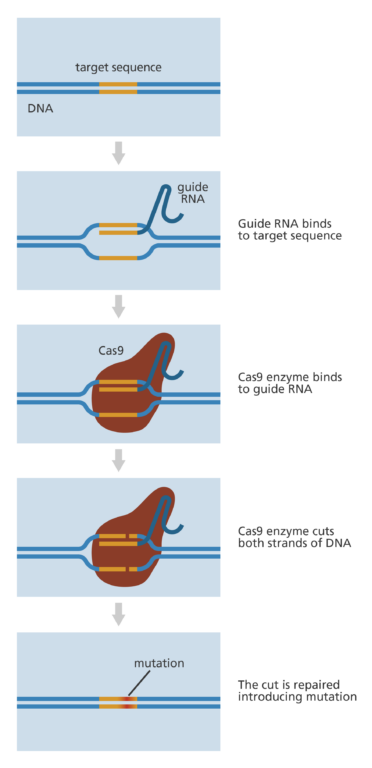
Figure 1: The Schematic above displays the steps of the CRISPR-Cas9 gene editing process. Cas9 works with a guide RNA to induce a double-stranded break, from which a deletion, insertion, or gene replacement can occur, resulting in a mutated gene (Boldú, n.d.).
Gene editing has been predominantly used in healthcare, for instance, in scenarios such as the use of CRISPR to correct mutations in a DNA sequence by removing or replacing base pairs (Jiang and Doudna, 2017). One example is the recent approval of Casgevy, a CRISPR-Cas9 treatment addressing the mutations that cause sickle cell anemia (Synthego, 2025). Sickle cell anemia is a genetic disorder that affects millions worldwide, where genes transcribe an abnormal version of hemoglobin, resulting in red blood cells having an altered, crescent shape instead of being circular and round (Figure 2) (Synthego, 2025). The differing shape of sickle RBCs affects their ability to retain and transport oxygen throughout the body, an essential element all cells require in aerobic organisms such as humans (Synthego, 2025). In this gene editing process, hematopoietic cells are extracted from the patient. CRISPR-Cas9 is used to modify the cells to produce the correct hemoglobin protein, and then they are reinserted into the patient, allowing them to produce normal red blood cells (Synthego, 2025).
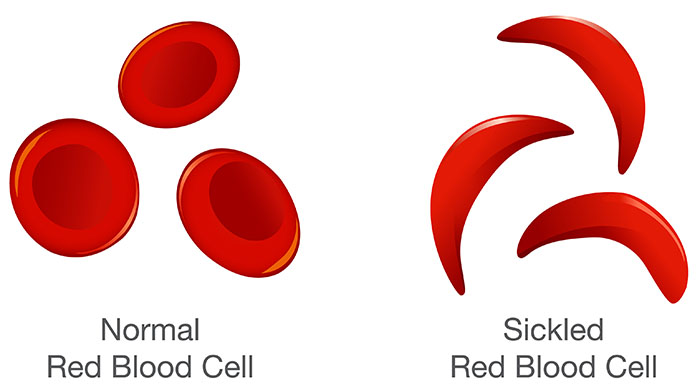
Figure 2: The schematic displays Red Blood cells (left) typically have a circular, bowl-like shape with an indentation in the middle, maximizing surface area for oxygen and carbon dioxide transport. Sickle cells (right) are shrivelled and crescent-shaped, ultimately much smaller in size and surface area, which reduces gas transport efficiency (CDC, 2021).
CRISPR-Cas9 is used similarly in conditions such as cystic fibrosis, Duchenne muscular dystrophy, viral infections, immunological disorders, and cardiovascular diseases (Barrangou and Doudna, 2016). Within agriculture, CRISPR is utilized for livestock, crops, food organisms, and industrial microbes (Barrangou and Doudna, 2016). Moreover, CRISPR is applied to disease-carrying insects with gene drives in ecology (Barrangou and Doudna 2016). However, the use of CRISPR in embryos, a technique introduced by He Jiankui at the Second International Summit on Human Genome Editing, sparked outrage (Cannon 2019). Anything involving the editing of germline cells, which ultimately develop into future offspring, carries intense ethical implications. Altering an embryo (which cannot consent) has risks of complications in the offspring and potentially the resulting progeny of the original gene-edited embryo (Cannon 2019). For this reason, germline gene editing is a controversial topic, as ethical debates surrounding it remain unsettled, necessitating thorough evaluation before pursuing research in this field (Cannon 2019).
Ultimately, the discovery of CRISPR-Cas9 has had a profound impact across numerous industries, including biology, academia, healthcare, and agriculture, leading to numerous anthropogenic advancements. However, the implications and impact of gene editing are just as equally ethical as scientific, requiring researchers to be very careful in pursuing this line of work.
References
Barrangou, Rodolphe, and Jennifer A. Doudna. 2016. “Applications of CRISPR Technologies in Research and Beyond.” Nature Biotechnology 34 (9): 933–41. https://doi.org/10.1038/nbt.3659.
Boldú, Laura Olivares. n.d. “What Is CRISPR-Cas9? | How Does CRISPR-Cas9 Work?” Accessed November 3, 2025. https://www.yourgenome.org/theme/what-is-crispr-cas9/.
Cannon, William. 2019. “Harvard Researchers Share Views on Future, Ethics of Gene Editing.” Harvard Gazette, January 9. https://news.harvard.edu/gazette/story/2019/01/perspectives-on-gene-editing/.
CDC. 2021. What Is Sickle Cell Disease (SCD)? | CDC. September 7. https://archive.cdc.gov/www_cdc_gov/ncbddd/sicklecell/features/what-is-scd.html.
Doudna, Jennifer A., and Emmanuelle Charpentier. 2014. “The New Frontier of Genome Engineering with CRISPR-Cas9.” Science 346 (6213): 1258096. https://doi.org/10.1126/science.1258096.
Jiang, Fuguo, and Jennifer A. Doudna. 2017. “CRISPR–Cas9 Structures and Mechanisms.” Annual Review of Biophysics 46 (Volume 46, 2017): 505–29. https://doi.org/10.1146/annurev-biophys-062215-010822.
Synthego. 2025. “CRISPR Sickle Cell Gene Therapy: Approaches, Challenges, and Progress.” https://www.synthego.com/crispr-sickle-cell-disease.
The Nobel Prize. 2020. “Nobel Prize in Chemistry 2020.” October 7. https://www.nobelprize.org/prizes/chemistry/2020/press-release/.
Comments
9 Responses to “Applications of CRISPR and Its Limitations due to Ethical Dilemma”
Hello ISCI!
I thought of this blog post’s topic when it was first introduced to me in Genetics (BIO 2C03) last year. I started writing, but never finished the post. However, with the emergence of CRISPR-related technologies, I finished up the blog to remind the community of the origins of CRISPR-Cas9 and the ethical dilemma associated with it.
Looking forward to hearing your suggestions!
Arham
Hi Arham,
This was a very interesting post! I like how you talked about the science behind CRISPR technology and applied to the ethical considerations of the technology. Below are a few suggestions to help with your editing process:
P1S2: I think biology should not be capitalized in this sentence. Also, consider rephrasing the sentence to, “This discovery revolutionized the biology industry by allowing for precise DNA modification”, to help improve its flow.
P1S3: To strengthen this sentence, you could consider changing the start of it to, “DNA modification can be applied to multiple industries, …”
P2S2: Instead of starting this sentence with “however”, you could consider changing it to “Researchers have repurposed this natural process to target…”, to help improve its connection with your first sentence.
Consider adding a simple figure to illustrate the CRISPR Cas-9 process you describe in the second paragraph.
Happy editing,
Julianna
Hi Julianna,
Thank you so much for your suggestions. I’ll definitely implement the restructuring of the mentioned sentences, since it helps with flow. Also, thanks for the figure idea, I’ll look into it.
Thanks,
Arham
Hi Arham,
What a wonderfully written blog post! I love how you discussed the societal implications of CRISPR but were still able to focus on the science. I have a few suggestions for you to consider:
– In your first sentence of your introduction, I think the citation should be the name of the organization and not the url. For example: (Nobel Prize, 2020). You can change this in your bibliography as well.
– Your second sentence in your introduction paragraph feels a bit unfinished. Allowing precise DNA modifications that what? I know you go into more detail later on, but a little “teaser” for the reader wouldn’t hurt.
– You use the acronym CRISPR in paragraph one, then state the full name in paragraph two. You should include the full name before using the acronym, then you can only use the acronym for the rest of your writing.
– This is just a citation convention, but you do not need to keep citing the same source after each sentence, as long as the information is coming from the same source. For example, in your second paragraph, you only need to cite (Jiang and Doudna 2017) once. Then you can site (Doudna and Charpentier 2014).
– Also, it might be nice to include who received the Nobel Prize for developing CRISPR.
Overall, I found your post to be well written and researched. I love how you included the real-world applications of CRISPR through a science perspective. I cannot wait to read the final version.
Happy editing,
Chloe
Hi Chloe!
Thank you so much for your suggestions. I really appreciate the detail and specificity of your feedback. I will definitely make sure to address the citation suggestions and the highlighted sentences in the 2nd paragraph you suggested to restructure.
Thanks,
Arham
Hey Arham!
This is a fantastically written blog post and was greatly informative! I have some suggestions I hoep will assist with the editing process. The first sentence doesnt flow that smoothly so i suggest rewording it to read “The discovery of the CRISPR-Cas9 gene editing process won the Chemistry Nobel Prize in 2020.” I suggest adding another figure between paragraph 2 and 3 just to break up some of the text. Maybe a figure showing how CRISPR-Cas9 accomplishes gene editing. This will also allow you to go further into detail if you would like. Overall, great work and good luck editing!
Ahad
Hi Ahad!
Thanks so much for your suggestions. I’ll definitely change the 1st sentence to flow better and I’ll also look into the figure that I can input to that section.
Thanks,
Arham
Hi Arham,
This was a very interesting blog post and I love your writing style and structure. Here are a few suggestions:
1. Paragraph 3, sentence 3: Perhaps shorten this sentence to improve readability. You could say “In this genetic disorder, genes transcribe an abnormal version of hemoglobin…”
2. Double check the in-text citations. Some of them have a comma before the date, while the others do not.
3. Paragraph 4, sentence 5: Restructure to remove “anything involving” and replace with “Germline cell editing, which ultimately …, comes with intense ethical implications.”
Happy editing,
Ria
Hi Ria!
Thank you very much for your feedback. I will definitely implement sentence restructuring in P3S3 and P4S5. However, for the citations, I believe that, depending on the source, Chicago includes/excludes commas.
Thanks,
Arham