Alcohol dependency is not only restricted to behaviour. Epigenetic modifications such as histone acetylation implicate specific metabolic factors in neural functions that drive addictive behaviour in alcohol dependency (Berkel and Pandey 2017). Histones are proteins around which DNA is wrapped to form chromatins. At the tails of histones, they possess lysine residues which can be acetylated. Histone acetyltransferases are a class of enzymes that facilitate the addition of acetyl groups onto histones to enable gene expression, examples include CBP/P300 and GCN5 (Steunou, Rossetto, and Côté 2013). Another enzyme that plays an important role in alcohol metabolism is Acetyl-CoA Synthetase 2 (ACSS2). Contributing to a major step of epigenetic modification, ACSS2 influences histone acetylation at genes associated with reward, processing, memory, and learning as it is often found in the nucleus of hippocampal cells. Knockdown and loss of this enzyme can lead to decline in histone acetylation and repression of certain genes (Creighton et al. 2020).
Mews et al. used mice to investigate histone acetylation rates in the brain after ethanol ingestion. The main rationale for this paper was to research how alcohol metabolism influences gene expression in the brain through histone acetylation. They hypothesized that acetate (ethanol metabolite), which is converted to acetyl-CoA by ACSS2, is a major part of histone acetylation in the brain. They employed different scientific methods for this study, which include in-vivo stable-isotope labelling of deuterated ethanol using mice, mass spectrometry, enzyme knockdown, and ChIP (Chromatin Immunoprecipitation) and RNA sequencing (Mews et al. 2019).
They compared histone acetylation at specific markers (H3K9K14, H3K18K23, H4) in the dorsal hippocampal cells (dHPC) following ethanol ingestion between wild-type mice (normal levels of ACSS2) and knockdown mice (reduced levels of ACSS2) (Figure 1). Prior to ingestion, the levels of acetylation for both mouse types were similar but after ingestion, the rates of acetylation remained the same for knockdown mice, and increased for the wild-type mice, showing the importance of ACSS2 in the incorporation of acetyl on histones to enhance gene expression. The same experiment was performed but in the ventral hippocampal cells (vHPC) (where ACSS2 levels are normal), they found no difference in the rate of histone acetylation in both mouse types, showing that knockdown was only specific to the dorsal hippocampal cells (Mews et al. 2019). ChIP-sequencing was done at the Fstl1 locus, where H3K9ac and H3K27ac mark active regulatory regions primarily by the promoter and nearby enhancers, indicating ethanol-induced chromatin activation. They only observed peaks at wild-type mice treated with ethanol, which shows that ACSS2 facilitates ethanol driven histone acetylation at certain gene loci (Mews et al. 2019).
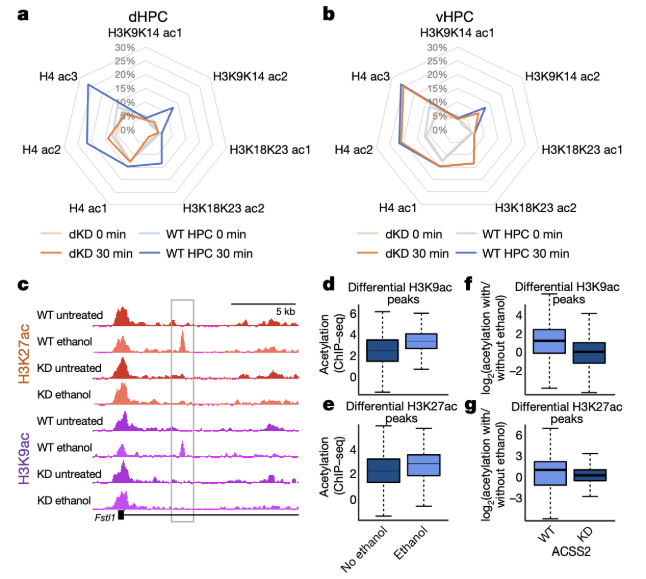
Figure 1. The statistical results of the research done by Mews et al. using mass spectrometry. Panel A and B depict radar charts showing acetyl incorporation rates in histone markers (H3K9K14, H3K18K23, H4) in the dHPC and vHPC respectively, for wild-type and knockdown mice. Panel C shows the results of ChIP-sequencing tracks done at the Fstl1 locus, where peaks can be observed at wild-type mice treated with ethanol. Panels D, E, F, and G are box plots essentially showing the effects of ethanol on histone acetylation in wild-type mice, and how histone acetylation is reduced in knockdown mice compared to wild type mice (Mews et al. 2019).
In the context of the broader epigenetic implications of alcohol consumption, alcohol intake increases histone acetylation in certain regions of the brain, which in turn enhances expression of genes linked to reward and memory, increasing the chances of alcohol dependency. Due to the hippocampal region of the brain that is associated with reward and learning, alcohol intake could reinforce drinking behaviour (Ghezzi et al. 2013). ACSS2 serves as a potential pathway to target in clinical research to reduce the risk of dependency (Egervari et al. 2024). Overall, the epigenetic effects of alcohol intake allow for positive reinforcement, contributing to compulsive drinking and the potential for alcohol dependency.
References
Anne-Lise Steunou, Dorine Rossetto, and Jacques Côté. 2013. “Regulating Chromatin by Histone Acetylation.” Springer EBooks, November, 147–212. https://doi.org/10.1007/978-1-4614-8624-4_4.
Berkel, Tiffani D.M., and Subhash C. Pandey. 2017. “Emerging Role of Epigenetic Mechanisms in Alcohol Addiction.” Alcoholism: Clinical and Experimental Research 41 (4): 666–80. https://doi.org/10.1111/acer.13338.
Creighton, Samantha D., Gilda Stefanelli, Anas Reda, and Iva B. Zovkic. 2020. “Epigenetic Mechanisms of Learning and Memory: Implications for Aging.” International Journal of Molecular Sciences 21 (18): 6918. https://doi.org/10.3390/ijms21186918.
Egervari, Gabor, Greg Donahue, Natalia A.Quijano Cardé, Desi C. Alexander, Connor Hogan, Jessica K. Shaw, Erica M. Periandri, Vanessa Fleites, Mariella De Biasi, and Shelley L. Berger. 2024. “Decreased Voluntary Alcohol Intake and Ventral Striatal Epigenetic and Transcriptional Remodeling in Male Acss2 KO Mice.” Neuropharmacology 265 (December): 110258. https://doi.org/10.1016/j.neuropharm.2024.110258.
Ghezzi, Alfredo, Harish R. Krishnan, Linda Lew, Francisco J. Prado, Darryl S. Ong, and Nigel S. Atkinson. 2013. “Alcohol-Induced Histone Acetylation Reveals a Gene Network Involved in Alcohol Tolerance.” Edited by Andrzej Z. Pietrzykowski. PLoS Genetics 9 (12): e1003986. https://doi.org/10.1371/journal.pgen.1003986.
Mews, P., G. Egervari, R. Nativio, S. Sidoli, G. Donahue, S. I. Lombroso, D. C. Alexander, et al. 2019. “Alcohol Metabolism Contributes to Brain Histone Acetylation.” Nature 574 (7780): 717–21. https://doi.org/10.1038/s41586-019-1700-7.
Comments
9 Responses to “Drinking and DNA: How Epigenetic Modifications Reinforce Alcohol Dependency ”
Hello iSci,
I decided to write about epigenetic factors that influence addiction, more specifically alcohol dependency. I was inspired by my previous blog post topics where I looked into predisposition to additive behaviours, and societal implications of addiction through the use of Naloxone. Continuing with the theme, I found histone acetylation to be an interesting topic to look into. Further research as shown that epigenetic modifications can be passed to offspring through fetal brain absorption, and clinical therapeutics could target ACSS2 production as a potential way to mitigate alcohol dependency, which is something that I found really insightful. Although, I didn’t cover much of that in this post.
I am also taking an epigenetics class as well, so that provided some of the background that I needed to look into this topic.
I hope you find it just as interesting as I do
Feedbacks are welcome.
– Tinu
Hey Tinu!
Nicely done with your blog post! I enjoyed reading about how epigenetics influences addiction. Below are some suggestions to help improve your blog:
P1S3: I suggest changing “lysine residues that can be acetylated” to “lysine residues which can be acetylated”
P2S4: The transition to discussing ACSS2 feels abrupt, I suggest adding a short lead-in sentence explaining why ACSS2 is relevant before you describe its role in histone acetylation.
P3S2: I think you mean “were” instead of “where”.
When you refer to ‘ChiP-sequencing’, it should be ‘ChIP-sequencing’, you should also introduce it as Chromatin Immunoprecipitation (ChIP-sequencing) before you use the acronym.
Overall well written!
Happy editing,
Aven 🙂
Hello Aven,
Thank you for reading through my blog post. I have taken your necessary and helpful suggestions into account.
– Tinu
Hey Tinu!
Great Job on your blog post. The title caught my attention right away and this was a great read because epigenetics and substance abuse is not discussed enough at all.
– P1S2&3: Since these sentences talk about one concept I would consider combining them!
– P1S4: I would consider replacing the semicolon with a comma or starting a new sentence, since semicolons are used to combine 2 related independent clauses and your examples are dependent!
– Additionally if time and word count permits, I would add 1-2 sentences as a quick hook. This will help ease readers into the text and provide additional context. 🙂
– Also, don’t forget to hyperlink your DOIs!
Can’t wait to read your final version!
-Ann 🙂
Hello Ann,
Thank you for reading through my blog post, I am glad you found it interesting. I have implemented some of your necessary suggestions.
– Tinu
Hi Tinu!
Really interesting post! I really liked how the experimental proof behind concepts were so specific in this post. Here are some of my suggestions to improve your blog:
– I thought the formality of the blog post was nice, but I think a small hook in the introduction may help with capturing reader attention and for introducing the main topic. Maybe the first paragraph could be more problem (alcohol) oriented?
– In the last sentence of paragraph 3: “They only observed peaks at wild-type mice treated with ethanol, which shows that ACSS2 stops ethanol driven histone acetylation at certain gene loci (Mews et al. 2019). ” From the previous explanation, I thought that ACSS2 facilitates histone acetylation at certain loci, not inhibit it: “…showing the importance of ACSS2 in the incorporation of acetyl on histones to enhance gene expression.” (P3)
-P2S3: “They hypothesized that acetate (ethanol metabolite) which is converted to acetyl-CoA by ACSS2 is a major part of histone acetylation in the brain.” Add a comma in front of “which” and after “ACSS2”.
-P3S2: You can remove the “it” from “…, and it increased for the wild type…”
Overall, that was a really fun read and I learned so much!
Thank you and happy editing,
Kurtis
Hello Kurtis,
Thank you for reading through my blog post and finding it interesting.
I have implemented all of your helpful suggestions.
– Tinu
Hey Tinu,
Really cool blog post!
Here are some editing suggestions:
1. Change the word where in “Prior to ingestion, the levels of acetylation for both mouse types where similar but after ingestion” to “were”.
2. This is just a suggestion but, you could explain more about how epigenetic regulation connects short-term alcohol exposure to long-term behavioral changes:)
Happy editing,
Cassie
2.
Hello Cassie,
Thank you for reading through my blog post, I have implemented your helpful suggestions.
– Tinu