Can touching something as common as a receipt lower testosterone? Microplastics and, more broadly, nanoplastics are used in numerous ways within society, composing many everyday items. However, the main concern with microplastics is their detrimental impact on the environment, and new research points to their adverse effects on human physiological and endocrine health (Lee et al. 2023).
Microplastics and nanoplastics (MNPs) are defined as plastic fragments with particle sizes ≤5 mm and ≤1 μm, respectively (Figure 1) (Feng et al. 2023). MNPs can originate from primary sources, such as those found in cosmetics and personal care products, or from secondary sources through processes such as weathering, degradation, and breakdown of larger plastic products like tires (Feng et al. 2023). Ultimately, the widespread and heavy use of plastic worldwide makes exposure to MNPs inevitable, making them found everywhere from outdoor air, soil, and water to beverages, food, and day-to-day objects (Feng et al. 2023).
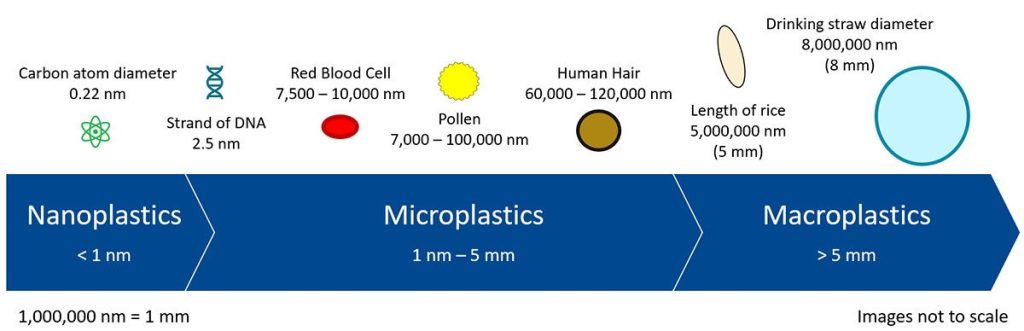
Microplastics were originally scrutinized due to their detrimental impact on the environment, especially their effects on aquatic and marine habitats and the life that inhabits them (Lee et al. 2023). Although this is still an ongoing concern, more recent research is investigating the impact of MNPs on human health. MNPs enter the body directly through food and water ingestion, absorption through contact, or inhalation of airborne MNP particles (Lee et al. 2023). When MNPs are released into the environment, it’s nearly impossible to retrieve them due to their tiny size and the immense quantities involved (Lieberoff, n.d.). MNPs can be ingested by animals and plants, and when animals consume one another, these MNPs accumulate at higher concentrations in animals at higher trophic levels within a given ecosystem’s food web (Feng et al. 2023). Ultimately, this can harm or kill various species and pose health hazards to humans who consume animal products. Airborne MNPs released into the environment from sources such as tire degradation, manufacturing plants, and the breakdown of other synthetic plastic polymers may be inhaled by both animals and humans (Feng et al. 2023). Lastly, chemicals used to make polycarbonate plastics and epoxy resins in items like receipts, such as BPA and BPS, can be absorbed directly through the skin and are also linked to endocrine disruption and cancer (Thoene et al. 2020).
MNPs can cross the gastrointestinal tract, allowing them to circulate in the bloodstream and may even cross the blood-brain barrier, resulting in accumulation within the brain (Feng et al. 2023). MNPs accumulate in multiple organs, including the liver, brain, lungs, and heart, contributing to toxicity and interfering with biological function. More concerning is MNP accumulation in endocrine glands, as in vivo and in vitro experiments have shown adverse impairments and performance of reproductive glands like the testes and ovaries, and glands responsible for metabolism like the thyroid gland. Evidence from multiple research studies suggests MNPs can impair nine organ systems, including the digestive, respiratory, circulatory, reproductive, nervous, immune, endocrine, urinary, and locomotor systems, as illustrated in Figure 2 (Feng et al. 2023).
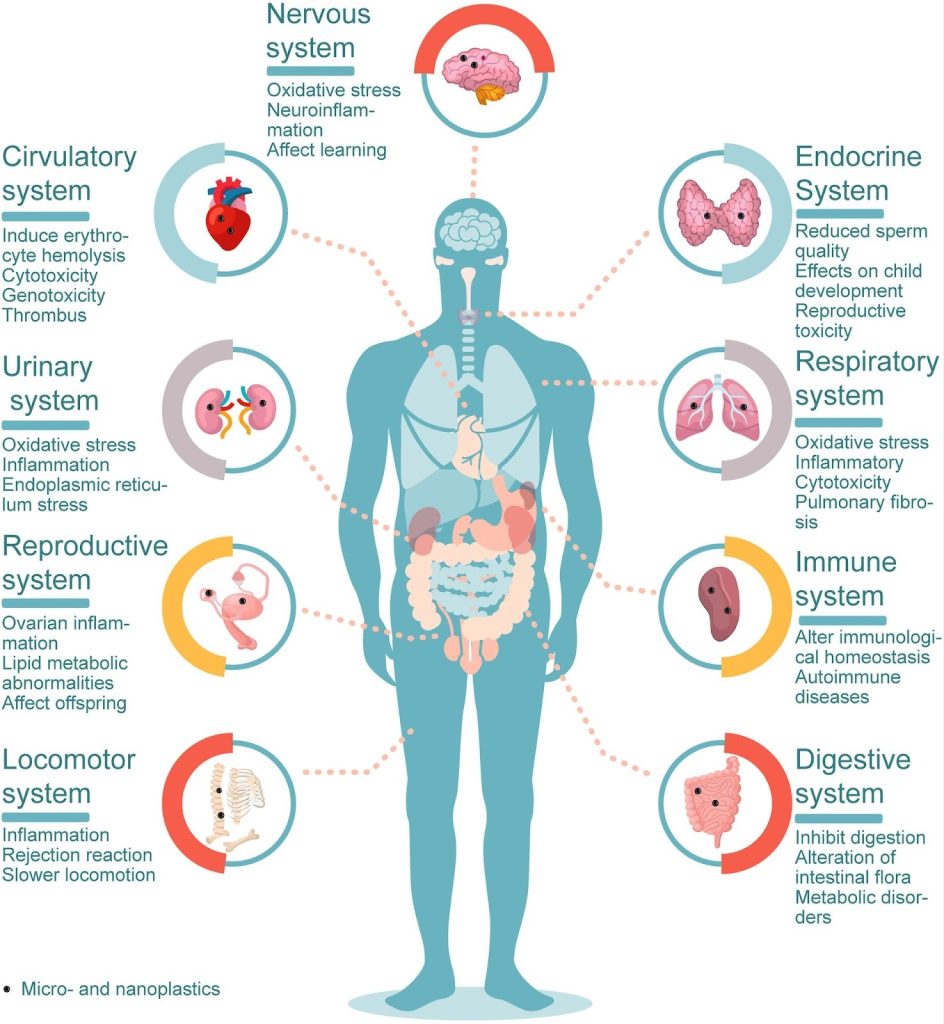
Although research has been conducted to identify the methods of MNP intoxication and their ultimate impact on human health, much is yet to be discovered. Large gaps remain in quantifying the concentration or amount of MNP exposure, identifying mechanisms of MNP intake, and, furthermore, the mechanisms of MNP intoxication and health impairment, especially in humans, due to ethical principles (Feng et al. 2023). Ultimately, this has created a gap in the literature that many future research studies can aim to fill; however, it’s certain that the impact of MNPs on human health is detrimental.
References
Feng, Yudong, Chen Tu, Ruijie Li, et al. 2023. “A Systematic Review of the Impacts of Exposure to Micro- and Nano-Plastics on Human Tissue Accumulation and Health.” Eco-Environment & Health 2 (4): 195–207. https://doi.org/10.1016/j.eehl.2023.08.002.
Lee, Yongjin, Jaelim Cho, Jungwoo Sohn, and Changsoo Kim. 2023. “Health Effects of Microplastic Exposures: Current Issues and Perspectives in South Korea.” Yonsei Medical Journal 64 (5): 301–8. https://doi.org/10.3349/ymj.2023.0048.
Lieberoff, Barb. n.d. “Microplastics.” Accessed January 5, 2026. https://epa.illinois.gov/topics/water-quality/microplastics.html.
Thoene, Michael, Ewa Dzika, Slawomir Gonkowski, and Joanna Wojtkiewicz. 2020. “Bisphenol S in Food Causes Hormonal and Obesogenic Effects Comparable to or Worse than Bisphenol A: A Literature Review.” Nutrients 12 (2): 532. https://doi.org/10.3390/nu12020532.
Comments
11 Responses to “Tiny Plastics, Big Problems: How MNPs Impact Our Health”
Hi Arham,
Great job on this blog post! You did a good job explaining concepts and I really liked your introduction. A couple of suggestions, if you agree:
– don’t forget to add a comment detailing why you chose this topic and how it relates to iSci
– instead of referencing Figure 1 in parantheses, consider just stating it, such as “as seen in Figure 1”. This avoids too many parantheses in your sentence.
– In your second figure caption: “Figure 2: This figure illustrates nine organ systems that MNPs may have a detrimental effect on”, consider rephrasing “This figure illustrates nine organ systems that MNPs can have a detrimental effect on”
Other than these, thank you for sharing this blog post! Happy editing.
Janaya
Hi Janaya,
I really appreciate the feedback! I’ve added the comment, and I appreciate the reccomended re-wording, I’ll definetely implement that. Thanks!
Arham S.
Hi iSci!
This blog post was inspired by an elective I’m taking focusing on sustainability and making the world a better place. Microplastics are something we’ve all heard rumours about, so the details about their chemical, physical and biological effects are outlined in this post. Leave any feedback you have in the comments I look forward to reading them!
Thanks,
Arham S.
Hey Arham,
Very interesting post. Here are some suggestions that might help you in the editing phase:
Title: Avoid using acronyms in the title
S3P1: “new research is now pointing to” sounds unnecessarily clunky, consider “new research points to”
S1P2: Redundancy: “Microplastics and nanoplastics (MNPs) are defined… ” You already introduced these terms in the first paragraph. You should introduce the acronym (MNPs) at the first mention in Paragraph 1 and keep using it after.
S1P3: Word Choice: “Microplastics were originally stigmatized…” “Stigmatized” usually refers to social disapproval of people or behaviors. In a scientific context, “scrutinized” or “identified as a pollutant” would be more accurate.
S1P4: Missing Citation: The first two sentences of this paragraph (“MNPs can cross the gastrointestinal tract…”)
Also, overall it seems like you’re over using some of your citations, so be careful about that and consider doing additional research.
great post overall.
Hello Charlie,
Thank you so much for your feedback! The points you’ve mentioned are very valid and I really appreciate you being detailed and thorough. I will implement these right away.
Thanks!
Arham S.
Hi Arham,
Thank you for sharing this fascinating and interdisciplinary blog post. I have left a few suggestions below which I hope you find helpful in the editing stage:
– P2: if word count allows, consider providing a statement that quantifies how widespread the use of plastic is.
– It appears in P3, your “Lieberoff, n.d.” citation is hyperlinked. Consider removing the hyperlink for in text citations while leaving it hyperlinked for the references section.
– P3: consider expanding the acronyms BPA and BPS before using them.
Overall, great job. I look forward to reading the final version.
Lucas
Hey Lucas,
Thank you so much for your feedback! I really appreciate you pointing out the hyperlinked citation, and I will clarify those acronyms. There’s not much space, so I won’t expand, though.
Thanks!
Arham S.
Hi Arham, reading this post reminded me just how bad the micro and nanoplastic problem is, and provided me with a lot of food for thought. Here are some suggestions which may improve you post.
P2S3: “making them found everywhere” reads a little awkwardly. Consider changing this part of the sentence by cutting “making them”.
For figure 1 and 2 captions, you can remove “this figure” from the first sentence. For example for figure 2, you can write “Figure 2: Nine organ system…”
If wordcount allows, this post can be made more interdisciplinary if you mention ecological impacts of NMPs such as bioaccumulation and biomagnification, or if you touch on the chemistry of BPAs.
Great work!
Olivia
Hi Olivia,
Thank you so much for your feedback! I’ll definitely be sure to reword that sentence, and I’ll change the phrasing of the figure caption as well.
Thanks so much!
Arham S.
Hi Arham!!
This post is very intriguing to me, as it is something I do think about often, but don’t know too much about! Here are a few comments to help with editing:
– In your first sentence of paragraph two, I am confused by your wording. Are the particles between 5mm and 1 micrometre the micro/nano plastics, or is it specifically less than/equal to 5mm? I would consider rewriting it to clarify – “… with micro referring to particles equal to/less than 5mm, and nano as less than/equal to 1 micrometre.”
– Your “(Lieberoff, n.d.).” in-text citation is hyperlinked, I believe, so just double-check to remove that
– I really liked looking at your figures with the text as they built off your writing and furthered my understanding!!
Overall, great job and good luck with your editing!!
Masha K.
Hello Maria,
Thank you so much for your feedback! Yes, I’ll be sure to clarify what I mean by size. Also, good catch, I’ll be sure to remove that hyperlink.
Thanks again!
Arham S.