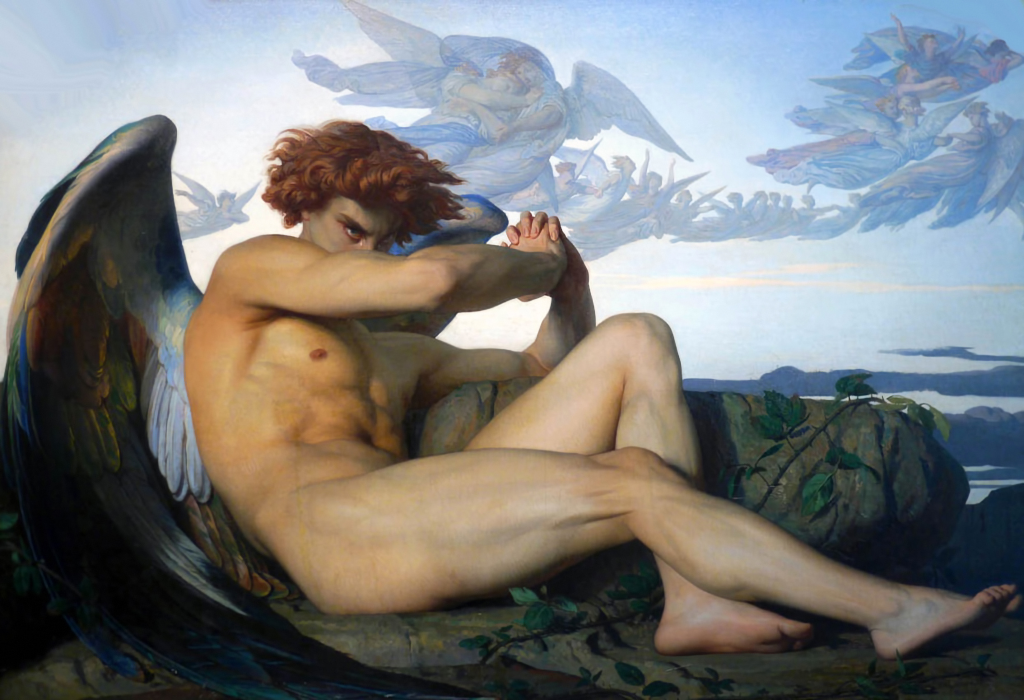
As one goes through life in the Americas, they have a non-zero chance of interacting with at least one of the great pieces of art eternalized in western pop culture, many representing either a concept or emotion, mythical or historical. A recognition of great past minds in The School of Athens by Raphael, portrayal of love through Pysche Revived by Cupid’s Kiss by Canova, of beauty through the several depictions of the Birth of Venus (Botticelli’s depiction being the most popular), and of hatred with The Fallen Angel by Cabanel. A skill shared across all these stunning pieces is the accuracy of anatomy, and an attention to how delicate the human body is (Figure 1).
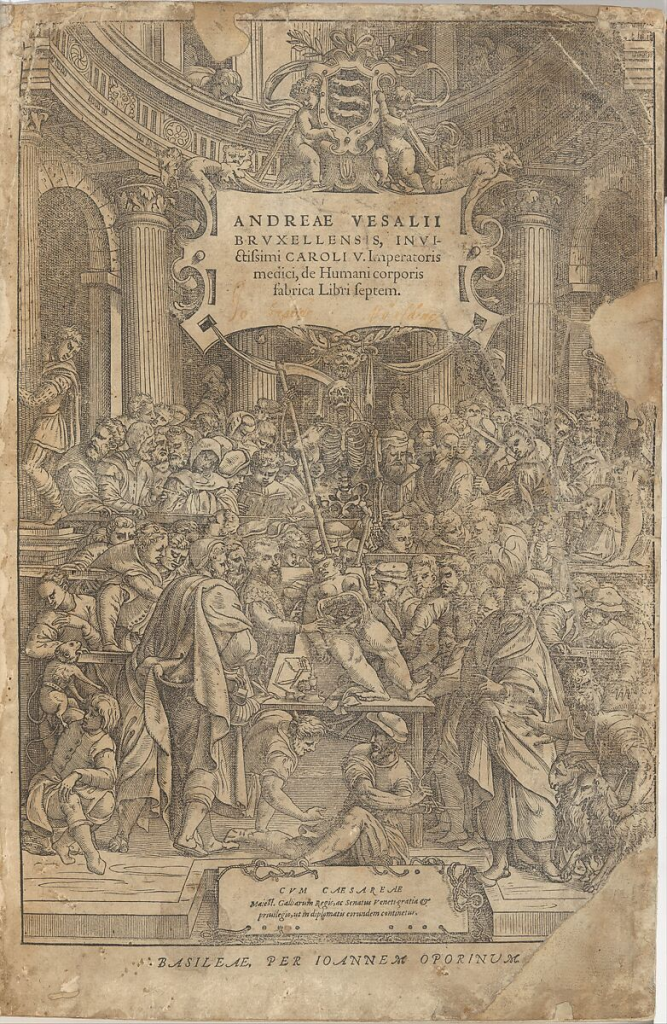
To our knowledge, dissection anatomy, the practice of learning from the human body after cutting it up, was introduced to the world as a study as early as 300 B.C., in the Greek colony of Alexandria in Egypt, the works of which were adapted by a Greek physician, Galen, who was practicing in Italy (ca. 129-199). His works were majorly based on animal dissection which were applied to the human body (Collections U of T 2024). Ever since, there have been slow but constant developments in the knowledge that was gained through dissections, including the works of Hippocrates, Aristotle, da Vinci, and their disciples. However, there was no direct piece of media to follow for anatomy until the De humani corporis fabrica by Vesalius, published in 1555 (Vesalius 1555; Collections U of T 2024; Franks 2024; Figure 2).
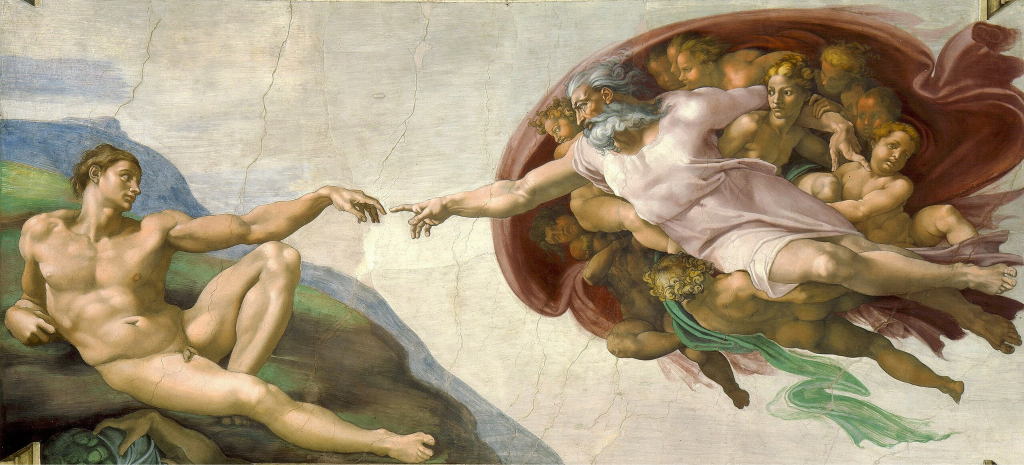
Da Vinci was famous for creating guidelines and anatomical art for reproductive sciences (Carroll 2025). His work was revolutionary, as he understood the importance of anatomy in both motion and still body art pieces. He displays this in his notebooks as he says, “you should not make all the muscles of your figures conspicuous; even if they are shown in the correct place they should not be made too evident. [..] If you do otherwise you will have produced a sack of nuts rather than a human figure.” (Victoria and Albert Museum 2025; Sealy and Lee 2020). The study of anatomy to learn the proper way to portray the human body was a skill shared throughout history and through masters teaching their disciples, and the method produced many greats, such as Michelangelo and his widely popular: The Creation of Adam (G. McMenamin 2022; Figure 3).
The addition of an institute focused towards teaching proper methods behind art, such as mathematics, geometry, anatomy, and colours, was a big step towards bringing these teachings to light and further improving the science taught behind art. This was possible through the Accademia e Compagnia delle Arti del Disegno, established on January 13, 1563, by Cosimo I de’ Medici and Giorgio Vasari (Franks 2024). It translates into Academy and Company for the Arts of Drawing. Michelangelo was appointed the first father of this institute, and an incredible number of famous painters were either members or closely affiliated with this institute, including Galileo (Gozzoli 2008; Britannica Editors 2023).
There have been literary philosophical and mind works on how art is perceived, how art is implemented into sciences, and how the human body is accurately displayed. This was heightened with the institutionalization of art, where continued practices on understanding the human body has been a great help to both the industries of sciences and art. In sciences, art has been implemented throughout history as a method of teaching disciples, and visualizing the experiences gained through generations of knowledge (G. McMenamin 2022; Martin 1978; Franks 2024).
People were able to work on art using the old methods of master to pupil just as well, like Bernini sculpting incredible works such as The Abduction of Proserpina, as he was taught directly by his father, also a sculptor, even though he was alive after the creation of the institution (Hibbard 2025; Felici 2024; Figure 4). As the world developed and moved into the mid-nineteenth century, mechanical printing and mass export of copies was able to increase the spread of art used for science, business, and even textbooks became a lot easier (Collections U of T 2024).
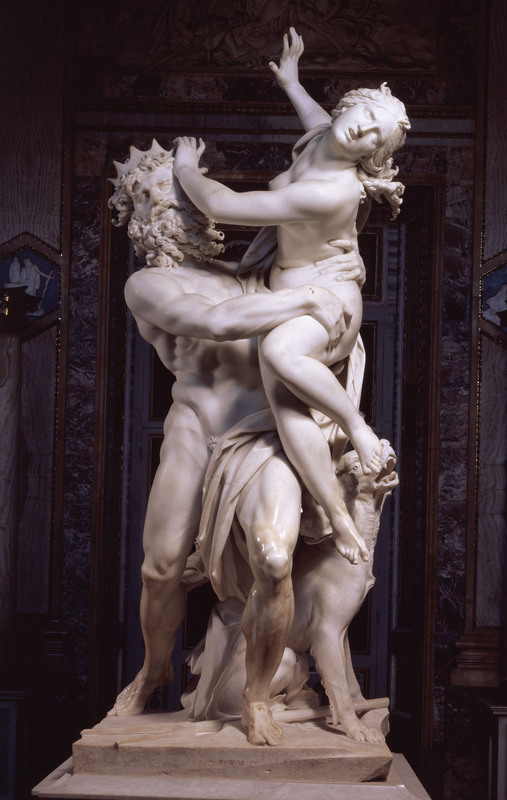
A muscle drawn on a biological textbook now was unthought of when artists were making their paintings and sculptures, so full of life, motion, and softness, yet a cold piece of marble slab to the touch. A development of science that took ages, yet goes unnoticed by the eye while flipping through pages. A history such as this cannot be repeated, so to learn it is an unforgettable beauty of itself.
References
Annenberg Learner. 2009. “Art: The Creation of Adam.” Annenberg Learner. https://www.learner.org/series/art-through-time-a-global-view/the-body/the-creation-of-adam/.
Britannica Editors. 2023. “Academy of Art | History, Education & Impact | Britannica.” February 9. https://www.britannica.com/art/academy-of-art.
Carroll, Michael. 2025. “The Renaissance of Reproductive Science: Leonardo Da Vinci’s Anatomical Contributions.” Reproductive Sciences 32 (3): 575–99. https://doi.org/10.1007/s43032-024-01772-9.
Collections U of T. 2024. “A Brief History of Anatomical Illustration · Anatomia 1522 to 1867 · Explore Collections U of T.” https://collections.library.utoronto.ca/explore/anatomia/about/history_illustration.
Felici, Sonja. 2024. “Bernini Gian Lorenzo – Rape of Proserpine.” Collezionegalleriaborghese.It. https://doi.org/10.5281/zenodo.12709573.
Franks, Juliet. 2024. “The History of Art Academies.” Blue & White Company, May 5. https://www.blueandwhitecompany.com/journal-entry/the-history-of-art-academies.
G. McMenamin, Paul. 2022. “Art and Anatomy in the Renaissance: Are the Lessons Still Relevant Today.” ANZ Journal of Surgery 92 (1–2): 34–45. https://doi.org/10.1111/ans.17268.
Gozzoli, Antonella. 2008. “Accademia Delle Arti Del Disegno.” February 26. https://brunelleschi.imss.fi.it/itineraries/place/AccademiaArtiDisegno.html.
Gurney, Tom. 2020. “Fallen Angel Painting by Alexandre Cabanel.” June 19. https://www.thehistoryofart.org/alexandre-cabanel/fallen-angel/.
Hibbard, Howard. 2025. “Gian Lorenzo Bernini | Biography, Style, Sculptures, Architecture, Paintings, & Facts | Britannica.” December 3. https://www.britannica.com/biography/Gian-Lorenzo-Bernini.
Martin, F. David. 1978. “On Perceiving Paintings and Sculpture.” Leonardo 11 (4): 287–92. https://muse.jhu.edu/pub/6/article/599196.
Sealy, U., and T.C. Lee. 2020. “Anatomy and Academies of Art I: Founding Academies of Art.” Journal of Anatomy 236 (4): 571–76. https://doi.org/10.1111/joa.13131.
Vesalius, Andreas. 1555. De Humani Corporis Fabrica (Of the Structure of the Human Body). Woodcut, Overall: 15 9/16 x 10 1/2 x 3 1/4 in. (39.5 x 26.7 x 8.3 cm) page: 15 1/4 x 10 1/4 in. (38.7 x 26 cm). https://www.metmuseum.org/art/collection/search/358129.
Victoria and Albert Museum. 2025. “Leonardo Da Vinci’s Notebooks · V&A.” Victoria and Albert Museum. https://www.vam.ac.uk/articles/leonardo-da-vincis-notebooks.
Wikipedia. 2018. “The Creation of Adam.” In Wikipedia. August 7. https://en.wikipedia.org/w/index.php?title=The_Creation_of_Adam&oldid=1323219205.
Comments
9 Responses to “The Beautiful Dead: How Anatomical Studies Evolved Arts and Science”
Hi, Vihaan.
Really enjoyed your post about classic art and its connections to anatomy. I personally love the Fallen Angel piece! Just a couple of things you should tweak:
1. Be sure to leave a comment explaining why you chose your topic!
2. Don’t forget your references page!!
3. I think the sentence “To our knowledge, dissection anatomy, the practice of learning from the human body after cutting it up, was introduced to the world as a study as early as 300 B.C., in the Greek colony of Alexandria in Egypt.” Should have a supporting citation.
Overall, very fascinating blog! Well done, brotha 👍
– Nolan
Hey Noles!
Thank you for your comment. I have fixed all of that now!
Hi Vihaan,
Very informative and artistic blog post! A few comments for improvement
1. Your sentence
: “You should not make all the muscles of your figures conspicuous; even if they are shown in the correct place they should not be made too evident. [..] If you do otherwise you will have produced a sack of nuts rather than a human figure.” (Victoria and Albert Museum 2025; Sealy and Lee 2020)
I’m not 100% sure the rules for punctuation when using a quote, but you should be good to remove the : at the start of the sentence as it’s not needed. And make sure to include a period after your citation at the end of the sentence since it’s the end of a paragraph.
2. Right now you are over the word count limit by around 100 words. Consider removing parts of your introduction and moving it down to the comment on why you wanted to write this topic. This section:
” Portrayal of philosophy and recognition of the greats in The School of Athens by Raphael, portrayal of love through Pysche Revived by Cupid’s Kiss by Canova, of beauty portrayed through the several depictions of the Birth of Venus (popularly by Botticelli, and of hatred and abduction portrayed through The Rape of Prosperina by Bernini, the word “rape” in which comes from the latin word raptus, meaning ‘seized’ or ‘carried-off’ (Theoi Classical Texts Library 2017). ”
is an interesting fact, but I feel is less relevant to the topic of your blog post and could be removed to save words.
Overall, cool connection to science and I look forward to reading the final copy!
Adam
Hello!
I have incorporated all your suggestions in my blog one way or another. I have tried to lessen the word count, but I really wanted to add the fun fact just because I like talking about those pieces. Thank you!
Hi Vihaan,
Super interesting blog post! This was definitely a creative topic and I learned a lot. With that in mind, I had a few comments:
– Your last 3 paragraphs have no in text citations. While this may be okay for your concluding paragraph, for your paragraphs that introduce new content it is really important to cite where you got this information from as your piece can appear very unscientific otherwise. I would recommend adding your sources as soon as possible to these paragraphs.
– “Along with literary philosophical and mind works on how art is perceived, how art is implemented into sciences, and how the human body is accurately displayed, the institutionalization of art and continued practices on understanding the human body has also been a great help to the industry of sciences, and has been implemented throughout history as a method of teaching disciples, and visualizing the experiences gained through generations of knowledge.” This sentence is a very long run-on sentence, and I would recommend splitting it into two, if not three, individual sentences as you see fit.
– Make sure you add a comment explaining why you wrote this post and what scientific disciplines it integrates, as this would help the reader better contextualize your piece as well.
– As others have mentioned, make sure you add your works cited at the bottom of your piece. I wanted to read more about this topic, and wanted to use your references as a starting off point but wasn’t able to unfortunately, which takes away from the reputation of your piece.
Overall, great piece! I learned a lot, and I am excited to read the final copy.
Happy editing,
Siya
Hey Siya!
Thank you so much for your comment, I was completely unaware of that run on sentence. The rest of the stuff has been fixed as well.
Hi Vihaan,
This was a very interesting post! It was cool to read about a more cultural topic, compared to the very science-heavy blogs we usually see. I have some recommendations to help improve your post:
P1S1:
– ‘Thought our lifetime’ is a bit ambiguous, as lifetimes differ. You could be referring to yourself, humans in general, or people currently alive. Similarly, ‘we’ is ambiguous. Consider omitting these personal pronouns.
– ‘art pieces’ does not need a hyphen.
– ‘drastic hold on’ does not seem like the best descriptor here. I recommend ‘hold significance’ or something similar. Though we typically use ‘significance’ very specifically in science, this is a case of cultural significance, which can be more generally applied.
– A comma is needed after ‘beauty of art’. Alternatively, you could remove “as is known in regions of European descent”, as you don’t address how this differs from how art is known in other regions.
These would change your sentence to: “Some art pieces have been eternalized in western pop culture, as they hold significance in history and the beauty of art.” This is more concise, and easier for your readers to grasp initially.
P1S2
– This sentence is very long and difficult for the reader to understand. As Adam mentioned, see if you can remove any information that is not crucial to your post. Specifically, the origin of the word ‘rape’ seems to be completely unnecessary. Lastly, you have an unclosed bracket in this sentence, before ‘popularly’.
P2S1
– As Nolan mentioned, you need to cite this paragraph, I just wanted to add that this would be for both the definition of dissection anatomy and the date and location of introduction. If it is the same citation as below, you still need to move it here, as the citation should be after the first occurrence of information from the source.
P2S2
– Similarly to S1, you need to cite this.
– Also, this is a very long sentence with multiple ideas. As a general rule, keep one idea per sentence. For example, break this up into: “Ever since, there have been slow but constant developments in the knowledge that was gained through dissections, including the works of Hippocrates, Aristotle, da Vinci, and their disciples. However, there was no direct piece of media to follow for anatomy until the De humani corporis fabrica by Vesalius (1555).”
– I also recommend switching around the last bit of the sentence for flow, as I did above.
P2S4:
– Similarly to above, this long sentence could be cut shorter for readability. I suggest ending it after ‘still work art pieces’, and start a new sentence with ‘He demonstrates this in his notebook: [insert quote].
– I believe the proper phrase is for ‘still-work art’ is ‘still life art’.
– Be consistent with your phrasing of ‘art pieces’ as it should be two words with no hyphen, but you have it as one word here.
P5S2
– This is not quite a complete sentence. I recommend rephrasing to “This development of science took ages, yet…” for proper grammar.
Overall, this is a very interesting topic, but I recommend being careful with lengths of sentences and inclusion of unnecessary information. Well done with piecing together the history and people over such long periods of time!
Happy editing!
Soleil
Hey Soleil!
Thank you so much for all of your comments. The post is now looking a lot better since I made a multitude of changes. All of your suggestions helped a lot! Thank you!
Hey iSci!
Art has been an interest for me throughout my life, and I have always wanted to write about something in its relation in one of these blog posts. As Alex was talking about history of science as it came about, I wondered the importance of science in art. I then figured, writing about how anatomy connected to different artforms such as sculptures and paintings would be something I would enjoy writing about with all my heart, and so this blog post was created. I hope you guys enjoyed, and were able to take a break from incredibly science-centric writing in Synopsis, to take a look at how science can influence history and the beauty of the world in human portrayal of emotions and stories!
– Vihaan