Since the first human entered space in 1951, scientists have expected stress on the human body. Yet, it wasn’t until 2011 that it was identified that spaceflight changes the structure of astronauts’ eyes (Mader et al. 2011). Spaceflight-Associated Neuro-Ocular Syndrome (SANS), a condition unique to long-duration space flight (LDSF), had flown under the radar for decades.
NASA estimates that of LDSF missions, defined as more than four months in microgravity, 66% of astronauts experience early indication of SANS (Brunstetter et al. 2023; Sater et al. 2022). Spaceflight-Associated Neuro-Ocular Syndrome is a broad term used to describe many findings both during and after flights, including optic nerve head swelling, globe flattening, wrinkles in the back of the eye, and blurry vision (Figure 1)(Mader et al. 2011; Ong et al. 2022). Fortunately, imaging suggests many SANS symptoms improve after being back under Earth’s gravity, although considerable risks may arise with prolonged or repeated exposure (Lee et al. 2020).
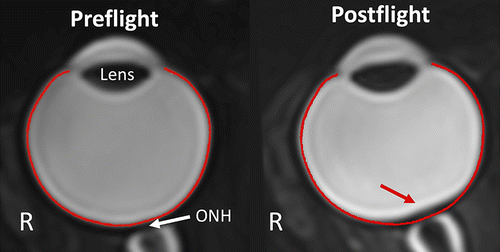
Cerebrospinal fluid (CSF) circulates through small spaces surrounding the brain and spinal cord, creating an intracranial pressure (May and Reddy 2020). The optic nerve sheath carries CSF to the eye through a narrow, dead-end pathway (Lee et al. 2020). Exiting CSF must travel back towards the brain along the same path it took to the eye, creating an unstable, non-uniform flow (Sheng et al. 2022). Because of its unique pathway, altered CSF flow can lead to many changes in vision and structure.
The exact cause of SANS is unknown, but disrupted CSF pressure gradients, from loss of gravity, are thought to play a main role (Sater et al. 2022). One leading theory is that vasculature swelling in microgravity environments reduces CSF drainage, potentially leading to increased intracranial pressure that transmits down the optic nerve sheath, impacting the eye (Lee et al. 2020). Another hypothesis is that CSF gets stuck within the optic nerve sheath due to poor flow in microgravity, locally increasing pressure. The role of the glymphatic system, along with factors such as elevated CO2 levels during spaceflight, may also contribute, suggesting that SANS is caused by a combination of factors, rather than one (Venegas 2024; Lee et al. 2020).
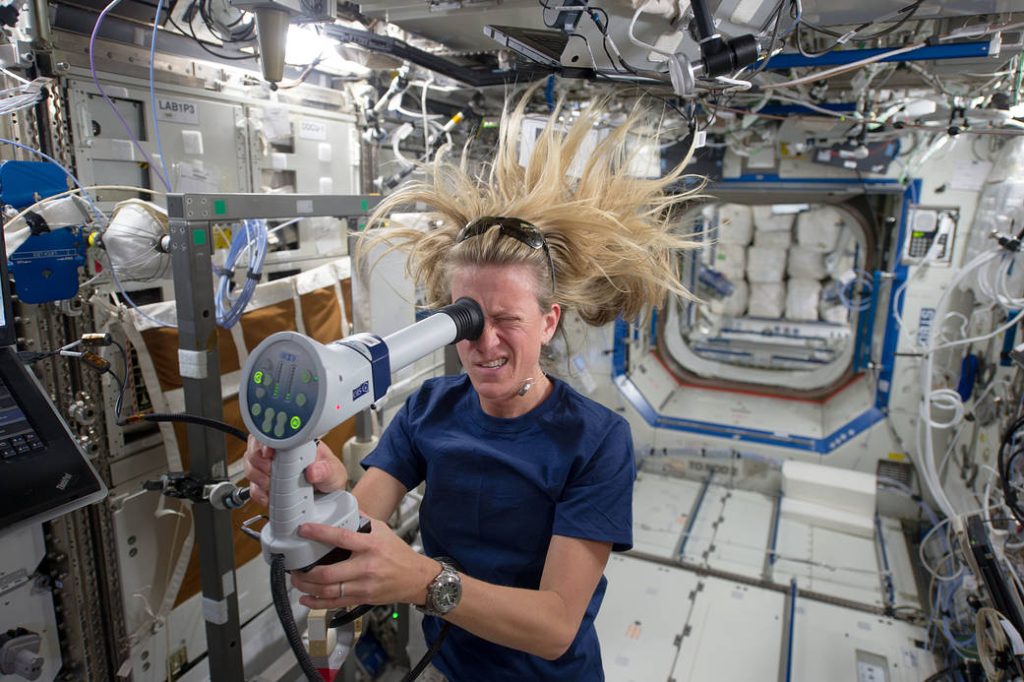
Since only about 12 astronauts are launched a year, studies in space are extremely limited (Lee et al. 2020). The Canadian Space Agency started an experiment in 2021 to research SANS both during and after flights, and it is expected to conclude late 2026 (Figure 2)(Canadian Space Agency 2022). Supplementally, Earth-based analogs are able to mimic microgravity fluid shifts, but are not perfect estimates (Sater et al. 2022).
Research on SANS has broader applications than LDSF. Parallel technology developments to the imaging being used by the Canadian Space Agency can be implemented in regions with low access to face-to-face healthcare (Ong et al. 2022). Improving our understanding of fluid redistribution also informs the treatment for many diseases here on Earth.
Understanding of SANS has advanced significantly since its first recognition in 2011, but many gaps remain. It is imperative that research continues not only for current and future spaceflight missions, with the expectation that trips will become longer and more frequent, but also for the numerous applications of the knowledge and technology here on Earth.
References
Brunstetter, TJ, SS Mason, Taiym Wf, CR Gibson, M Van Baalen, and W J Tarver. 2023. SPACEFLIGHT ASSOCIATED NEURO-OCULAR SYNDROME (SANS): 2023 CLINICAL UPDATE.
Canadian Space Agency. 2022. “SANSORI: Does Rigid Eye Structure Help Protect Astronauts’ Eyesight?” Canadian Space Agency, February 23. https://www.asc-csa.gc.ca/eng/sciences/sansori.asp.
Lee, Andrew G., Thomas H. Mader, C. Robert Gibson, et al. 2020. “Spaceflight Associated Neuro-Ocular Syndrome (SANS) and the Neuro-Ophthalmologic Effects of Microgravity: A Review and an Update.” Npj Microgravity 6 (1): 7. https://doi.org/10.1038/s41526-020-0097-9.
Mader, Thomas H., C. Robert Gibson, Anastas F. Pass, et al. 2011. “Optic Disc Edema, Globe Flattening, Choroidal Folds, and Hyperopic Shifts Observed in Astronauts after Long-Duration Space Flight.” Ophthalmology 118 (10): 2058–69. https://doi.org/10.1016/j.ophtha.2011.06.021.
May, Rosie, and Ugan Reddy. 2020. “Cerebrospinal Fluid and Its Physiology.” Anaesthesia & Intensive Care Medicine 21 (1): 60–61. https://doi.org/10.1016/j.mpaic.2019.10.017.
National Aeronautics and Space Administration. 2025. Risk of Spaceflight Associated Neuro-Ocular Syndrome (SANS) – NASA. Human Research Program. [Image]. https://www.nasa.gov/reference/risk-of-spaceflight-associated-neuro-ocular-syndrome-sans/.
Ong, Joshua, Alireza Tavakkoli, Nasif Zaman, et al. 2022. “Terrestrial Health Applications of Visual Assessment Technology and Machine Learning in Spaceflight Associated Neuro-Ocular Syndrome.” Npj Microgravity 8 (1): 37. https://doi.org/10.1038/s41526-022-00222-7.
Sater, Stuart H., Gabryel Conley Natividad, Akari J. Seiner, et al. 2022. “MRI-Based Quantification of Posterior Ocular Globe Flattening during 60 Days of Strict 6° Head-down Tilt Bed Rest with and without Daily Centrifugation.” Journal of Applied Physiology (Rockville, MD) 133 (6): 1349–55. Rockville, MD. https://doi.org/10.1152/japplphysiol.00082.2022.
Sheng, Jinqiao, Qi Li, Tingting Liu, and Xiaofei Wang. 2022. “Cerebrospinal Fluid Dynamics along the Optic Nerve.” Frontiers in Neurology 13 (August): 931523. https://doi.org/10.3389/fneur.2022.931523.
Venegas, Joshua M. 2024. “Spaceflight-Associated Neuro-Ocular Syndrome: Potential Etiologies and Connections to the Glymphatic System.” Journal of Neurophysiology 131 (5): 785–88. https://doi.org/10.1152/jn.00056.2024.
Comments
3 Responses to “The Eye Problem NASA Did Not See Coming”
Hi iSci! The start of LUE got me thinking about some ways that space may be affecting humans, and I have always found the anatomy of the eye interesting, so this topic drew me in. I also loved the connection to physics and the important role of pressure within the CSF system. I spent some time researching the broader applications of this research, which, like my IP explores ways that microgravity research can have many applications outside of space and influence many industries.
Hi Maya!
What a catchy title and fascinating read! You did such a good job tying in LUE, with physics, and human health/anatomy! here a few minor suggestions
P1S1: Adding a have before expected would improve flow and make the concern more current, not just in the 50s. Perhaps consider adding a citation to this sentence, i don’t know if the 1st half is common knowledge
P2S3: consider switching ‘though’ to ‘although’ as it might connect the two ideas better and improve flow
P3: consider expanding on what you mean by sensitive or dropping the adjective if u don’t have enough wordcount, your average reader might not know what sensitive non-uniform flow vs a regular non-uniform flow
Overall, great work and fantastic figures. I’m looking forward to reading the final post!
Happy editing!
Caroline
Thank you for the suggestions, Caroline. I have implemented the phrasing fixes into my post!
Maya