Imagine living a life where sensations as ordinary as the gentle touch of a loved one, a cold breeze or simply the feeling of clothes on your skin evokes pain. This is the reality for individuals with allodynia, a phenomenon which causes non-painful stimuli on the skin, to be perceived as pain. This phenomenon is observed in people with neuralgia, injuries, migraines, or individuals who take particular medications, though this can also as a result of unknown causes (He and Kim 2020).
Allodynia can present as one of 2 types: mechanical allodynia or thermal allodynia. Mechanical allodynia can be further classified as static allodynia, occurring upon still touch or dynamic allodynia, a result of touch with movement (Melvin et al. 2025). Although a clear mechanism is yet to be established, allodynia is likely related to the sensitization of the peripheral and central nervous system, as well as incorrect stimulation of pain pathways by neuronal fibres. The peripheral nerve fibres which contribute to this are type C, Aδ- and Aꞵ- fibres. These 3 fibres all detect and communicate different stimuli: Aꞵ- fibres detect light touch and pressure, type Aδ- fibres detect sharp pain, and Type C nerve fibres detect aching pain in addition to thermal stimuli (He and Kim 2020).
In healthy tissue, C and Aδ- fibres are nociceptive neurons and transmit pain signals using a neurotransmitter called calcitonin gene-related peptide (CGRP). In contrast, in allodynia, peripheral sensitization occurs, causing Aꞵ- fibres and Aδ- fibres to become more sensitive and have a lower threshold to become activated, resulting in more frequent firing (Figure 1). In addition to this, Aꞵ- fibres undergo a phenomenon called phenotype switching, where they begin to mimic C and Aδ- fibres by releasing CGRP, signaling pain instead of touch and pressure, as they are usually responsible for (Melvin et al. 2025).
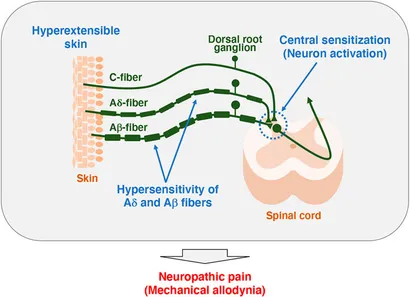
When coupled with the general hypersensitivity of these fibres, the phenotype switch of Aꞵ- fibres contributes to an excess of pain signaling neurotransmitters like CGRP in the spinal cord; this leads to a phenomenon that is closely linked called central sensitization. In central sensitization the abnormally large number of pain signals being received by the spinal cord drives its neurons into a state of hyperexcitability. Neuron hyperexcitability induces a series of effects in the spinal cord which feed into this general sensitization cycle; it drives larger responses from smaller synaptic inputs, reduces the effects of inhibitory neurotransmitters like GABA and glycine, activates NMDA receptors and triggers the release of pro-inflammatory cytokines by glial cells. Together, central and peripheral sensitization perpetuate and reinforce each other, resulting in the overall amplification of pain (Vardeh and Naranjo 2017; Melvin et al. 2025).
Allodynia and its mechanisms result from a combination of cascading effects which involve both the central and peripheral nervous system. These subtle changes in the body’s afferent pathway play a silent yet substantial role in one’s overall wellness and quality of life. For individuals with allodynia, simple daily comforts can be painful. This highlights the need for larger consideration of patient morbidity, especially for rare symptoms like allodynia, whose burden and impact can often go undetected.
References
He, Yusi, and Peggy Y. Kim. 2020. “Allodynia.” PubMed. Treasure Island (FL): StatPearls Publishing. 2020. https://www.ncbi.nlm.nih.gov/books/NBK537129/
Melvin, Brittany, Raven Wright, Alexandra McNally, and Dalia Elmofty. 2025. “Allodynia: A Review Article.” Current Pain and Headache Reports 29 (1). https://doi.org/10.1007/s11916-025-01370-7
Okuda-Ashitaka, Emiko, and Ken-ichi Matsumoto. 2023. “Tenascin-X as a Causal Gene for Classical-like Ehlers-Danlos Syndrome.” Frontiers in Genetics 14 (March). https://doi.org/10.3389/fgene.2023.1107787
Vardeh, Daniel, and Julian F. Naranjo. 2017. “Peripheral and Central Sensitization.” Pain Medicine, 15–17. https://doi.org/10.1007/978-3-319-43133-8_4
Comments
7 Responses to “The Pain of a Feather: Allodynia”
Hey iSci!
Allodynia is a symptom I’ve lived with since being diagnosed with chronic migraines and I realized pretty early on that what I was feeling wasn’t common, and that curiosity pushed me to learn more about it. I also noticed that this overlapped with quite a bit of content from our neuro class! I hope you enjoy reading my post, and do let me know if you have any editing suggestions. 🙂
Ann
Hi Ann,
Cool blog post! The content is very informative and your language and tone are very digestible to the audience. Some minor edits:
– In the last sentence of your third paragraph, you refer to “Type c nerve fibers” and I believe you continue to reference them as “C fibers” throughout the rest of the writing. Consider capitalizing “C” when you first refer to it.
– Consider moving your Figure 1 to after your third paragraph where you first refer to it to improve readability.
– The citation at the end of your third paragraph does not need a space in between the brackets, e.g it should be: “(Melvin et al. 2025)”
Overall, I enjoyed this blog and keep up the good work 🙂
Asia.
Hey Asia!
I didn’t even notice that my figure was in the wrong spot! I’ve also noted all the other suggestions and applied them! Thanks for the feedback.
Ann
Hi Ann, I really enjoyed your blog post! I thought it was extremely well written and as such my comments are very nit picky as it was hard to find flaws in the writing.
A couple suggestions I have include:
-Consider rewording your first sentence in paragraph 4 to break it into two sentences instead of having a semi colon. Also I think that you could explicitly say in the second part of the sentence what it is closely linked to e.g.: “this leads to a phenomenon that is closely linked (to _____) called central sensitization.”
-Also in P4 S2 I would consider rewording “In central sensitization the abnormally large number of pain signals being received by the spinal cord drives its neurons into hyperexcitability” into something like “In central sensitization the abnormally large number of pain signals being received by the spinal cord drives its neurons into a state of hyperexcitability”.
Overall great work and I am excited to read the final copy!
-Jaden
Hey Jaden!
Thanks for your edit suggestions. I’ve implemented them all :).
Ann
Hi Ann, this was a very interesting post, as I have never heard of this condition! I have a couple of suggestions to improve your writing:
– At the end of the first paragraph, you use the word “idiopathically”. This may be an unknown term for a lot of people, so I would suggest changing it to “by an unknown cause”.
– In the last sentence of paragraph two, I would suggest adding some commas. I would add them here:”… detect light, touch, and pressure, type…” and “detect sharp pain, and Type C…”
– In the same paragraph, you also used “fibres” twice instead of “fibers”, so make sure to switch those!
Great job again, I loved reading your post!
– Maya
Hey Maya!
Thank you for taking the time to read my post! All of your suggestions have been implemented :).
Ann