“It’s always that damn phone.” These devices, alongside many others, have become our most prized companions while simultaneously being major sources of anxiety, stress, and an endless overload of distractions. Ironically, a developing remedy to these issues, present in the problem itself, is an unconventional digital drug called binaural beats. Accessible through a simple pair of headphones and an audio file, this developing solution, although not yet fully proven, has shown promising results.
Binaural beats are a perceptual phenomenon that occurs upon the delivery of two sinusoidal tones with slightly varying frequencies, each to one ear, at a constant intensity (Seyedmohamad Mirmohamadi, Yaser Norozpour, and Shahram Zarrabian 2022; Garcia-Argibay, Santed, and Reales 2018). Binaural beats are delivered through headphones, which separate the two tones and their delivery to the target ear. As seen in Figure 1, these tones are combined by the brain through the process of binaural integration. Without this, these beats would remain unobservable in the stimuli (Seyedmohamad Mirmohamadi, Yaser Norozpour, and Shahram Zarrabian 2022).
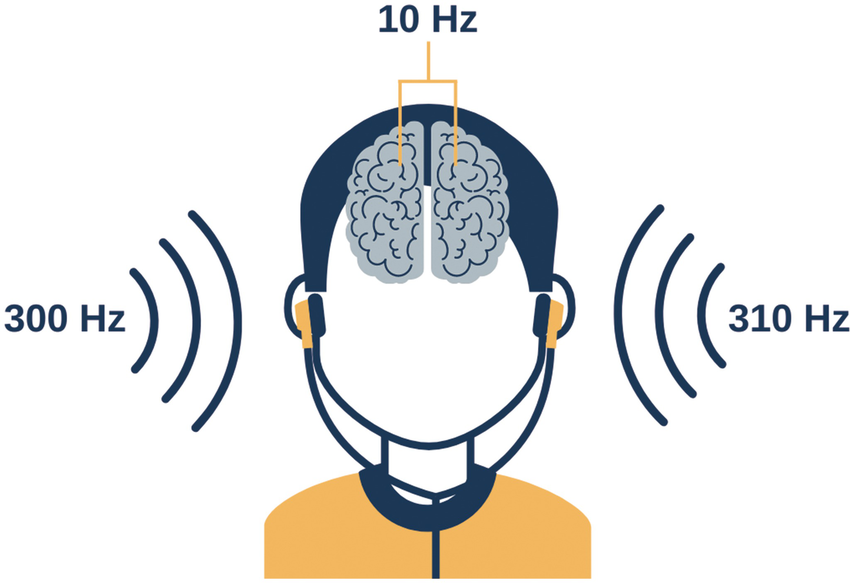
The novelty of binaural beats and their subjectivity lies in their method of interpretation through the peripheral and central nervous systems. Binaural beats invoke ascending auditory pathways, the brain stem, and the reticular formation (Garcia-Argibay, Santed, and Reales 2018) (Figure 2).
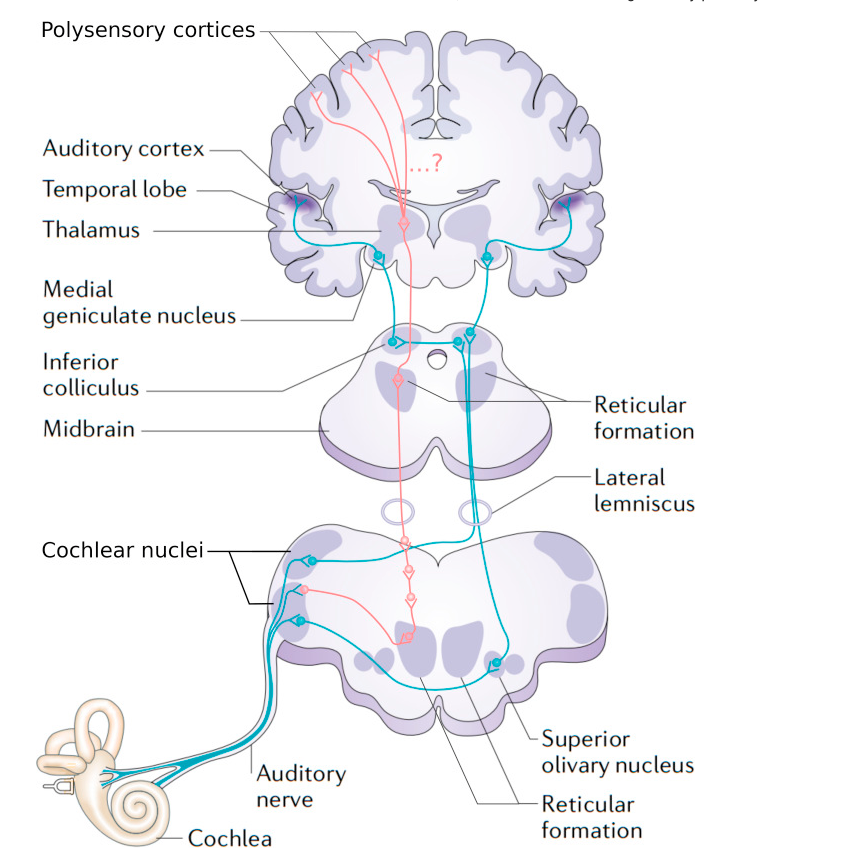
Binaural beats leverage the brain’s frequency following response property through the audiopsychological phenomenon of audio beat stimulation (Seyedmohamad Mirmohamadi, Yaser Norozpour, and Shahram Zarrabian 2022). Audio beat stimulation occurs when the brain’s electrocortical activity is influenced through the swaying of its neuronal oscillations by external stimuli; this drives the synchronization of the brain’s neuronal activity to partially align with the frequency of the stimulus (Basu and Banerjee 2022; Garcia-Argibay, Santed, and Reales 2018).
Binaural beats are speculated to impact the brains of listeners by inducing psychophysiological changes. Different frequency bands, or oscillations, are associated with certain states of consciousness, and it is theorized that binaural beats can invoke corresponding targeted effects on attention, cognition, and psychological states (Basu and Banerjee 2022). Several studies support the claim of psychophysiological changes resulting from exposure to binaural beats, including Jirakittayakorn and Wongsawat (2017) and Le Scouarnec et al. (2001), who recorded success in anxiety reduction. Alternatively, other studies have failed to demonstrate these effects, for instance, Crespo et al. (2013), who were unable to conclude benefits to attention and vigilance after exposure to binaural beats (Garcia-Argibay, Santed, and Reales 2018).
Although exposure to binaural beats reflects visible changes in brainwave patterns, the efficacy of these frequencies in inducing certain behaviours or therapeutic effects varies. Existing research remains divided on the ability of binaural beats to cause psychophysiological changes and explicitly influence cognition, anxiety, or concentration. Despite this, the existing preliminary findings are promising and suggest that with further studies, binaural beats may be capable of offering accessible relief as a therapeutic tool for all.
References
Basu, Sandhya, and Bidisha Banerjee. 2022. “Potential of Binaural Beats Intervention for Improving Memory and Attention: Insights from Meta-Analysis and Systematic Review.” Psychological Research 87 (July). https://doi.org/10.1007/s00426-022-01706-7.
Crespo, Adela, Manuel Recuero, Gerardo Galvez, and Adrián Begoña. 2013. “Effect of Binaural Stimulation on Attention and EEG.” Archives of Acoustics 38 (4): 517–28. https://doi.org/10.2478/aoa-2013-0061.
Darestani Farahani, Ehsan, Jan Wouters, and Astrid van Wieringen. 2019. “Contributions of Non-Primary Cortical Sources to Auditory Temporal Processing.” NeuroImage 191 (May): 303–14. https://doi.org/10.1016/j.neuroimage.2019.02.037.
Garcia-Argibay, Miguel, Miguel A. Santed, and José M. Reales. 2018. “Efficacy of Binaural Auditory Beats in Cognition, Anxiety, and Pain Perception: A Meta-Analysis.” Psychological Research 83 (2): 357–72. https://doi.org/10.1007/s00426-018-1066-8.
Jirakittayakorn, Nantawachara, and Yodchanan Wongsawat. 2017. “Brain Responses to a 6-Hz Binaural Beat: Effects on General Theta Rhythm and Frontal Midline Theta Activity.” Frontiers in Neuroscience 11 (June). https://doi.org/10.3389/fnins.2017.00365.
Le Scouarnec, R. P., R. M. Poirier, J. E. Owens, J. Gauthier, A. G. Taylor, and P. A. Foresman. 2001. “Use of Binaural Beat Tapes for Treatment of Anxiety: A Pilot Study of Tape Preference and Outcomes.” Alternative Therapies in Health and Medicine 7 (1): 58–63. https://pubmed.ncbi.nlm.nih.gov/11191043/.
Mosheshe, Liteboho Tlotliso, Janine C. Correia, and Nadine Rampf. 2024. “A Pilot Study Exploring the Effectiveness of Binaural Beats at Reducing Anxiety Associated with Cadaveric Dissection.” Anatomical Sciences Education, July. https://doi.org/10.1002/ase.2492.
Seyedmohamad Mirmohamadi, Yaser Norozpour, and Shahram Zarrabian. 2022. “A Review of Binaural Bates and the Brain.” Basic and Clinical Neuroscience Journal 15 (02): 133–46. https://doi.org/10.32598/bcn.2022.1406.2.
Sharma, Siddharth, Shreya Rewadkar, Harshada Pawar, Vaibhav Deokar, and Vina M. Lomte. 2017. “Survey on Binaural Beats and Background Music for Increased Focus and Relaxation.” 2017 International Conference on Emerging Trends & Innovation in ICT (ICEI), February. https://doi.org/10.1109/etiict.2017.7977018.
Comments
9 Responses to “Binaural Beats: The Beats That Beat Cognitive Overload”
Hi Ann!
Super interesting blog post! I especially liked how your intro segued into the rest of your post. A few suggestions I had:
– In paragraph 1, the word order reads slightly awkward, so I’d consider changing “Accessible through simply a pair of headphones and an audio file..” to “accessible simply through a pair of..” or “Accessible through a simple pair of…” to make the wording sound a bit more natural.
– When you reference Figure 1 in text, the semicolon after “Figure 1” disrupts the flow a bit, so I’d move “(Figure 1)” to the end of the sentence.
– The sentence “A large amount of literature supports the claim of..” is quite lengthy, so I’d suggest splitting it to make the contrast between supporting and conflicting studies clearer.
Overall, great work! I look forward to reading the final copy!
Bhavini
Hi Bhavini!
Thanks for reading and the suggestions! I have implemented the edits into my writing.
Ann
Hey iSci!
Binaural beats are something I have been listening to nonstop after hearing about them on a podcast recently. I’ve found them to be a game changer for my ability to focus and my memory, which is what inspired me to look into the science behind it, which is a lot of neuro as well as physics! I hope you enjoy reading my post, and please let me know if you have any editing suggestions, especially any suggestions that might help me cut down on my word count. 🙂
Ann
Hey Ann,
This was a very intriguing blog post, especially since I like learning anything and everything related to the brain. You definitely piqued my interest. Some suggestions:
– Reword the third sentence in the first paragraph to: “Ironically, a developing remedy to these issues is an unconventional digital drug called binaural beats, accessible through the problematic phone itself”
This makes it more clear how it is present in the problem itself, while also lessening the number of commas you use that make your sentence feel broken up.
– Reword the last sentence of the second paragraph to: “As seen in Figure 1, these tones are combined by the brain through the process of binaural integration. Without this, these beats would remain unobservable in the stimuli.”
– You abbreviate audio beat stimulation (ABS), but it only shows up twice. Abbreviations are more for when the term shows up repeatedly. In this case you can remove the abbreviation and write: “… of audio beat stimulation. This occurs when…”
Since you just ended the last sentence with “audio beat stimulation”, it is clear that “This” in the following sentence is referring to ABS without you needing to restate it.
Overall, amazing work!
Durezernab Berki
Hey Durezernab,
Thank you for taking the time to read my blog! I’ve taken them all into account.
Ann
Hi Ann,
This was a very interesting topic! I have never heard about binaural beats so it was cool to learn something new. Here are a few minor suggestions I have
– I believe any number less than 10 should be spelled out, so in P2S1, it should be “two sinusoidal tones”
– It would be great to specify what “promising results” you mean in P1S4 (like anxiety reduction or attention modulation)
– P5S3: Rather than saying “a large amount of literature” consider rephrasing to something like “several studies suggest” to avoid overgeneralization
– You mention that some studies support the claim while other studies fail. If word count allows, maybe give a brief explanation as to why this conflicting evidence occurs (maybe due to placebo effects or small sample sizes?)
– Considering that studies show conflicting evidence, avoid absolute claims like “binaural beats can offer accessible relief as a therapeutic tool for all.”as the effects of binaural beats seem very individual based and not suitable for everyone.
Overall, this was a great blog post. I look forward to your final edit.
Maybel
Hey Maybel,
Thanks for your suggestions! I’ve been able to implement all of them except the 4th one as, I’m unfortunately cutting very close to word count.
Thank you,
Ann
Hi Ann!
This topic is extremely relevant to modern society and the audience, so I was intrigued from the title alone. Framing binaural beats as a digital drug is a captivating outlook that pulls the reader in from the beginning. Some suggestions I had to enhance the piece are:
1. I really appreciated how you were able to include two figures (one scientific figure and a simpler figure) – it certainly added depth to the piece, and the figure captions are thorough/well-explained.
2. Consider working with sentence variation, especially in the concluding paragraph for example. Run-on sentences can be shortened into two separate sentences. For example, the last sentence of Figure 2’s caption can be split to read as “Unlike BBs, monaural beats are objective and observable in the sounds themselves. They are processed and perceived by the cochlea, and then move through the auditory pathway by reaching the brain stem and auditory cortex.”
3. Try to avoid constant repetition of the same word in proximity, such as “existing” in the last paragraph. The last sentence can omit the word and be rewritten to “despite this, preliminary findings are promising…”. This also makes the sentence more concise.
4. This is a stylistic choice, but consider starting with a general statement rather than a quote (you could paraphrase it) to decrease the informality of the hook. Both work though!
Great job overall, and I look forward to reading the final product.
Sincerely,
Richelle
Hey Richelle,
Thanks for taking the time to read my post! I’ve made most of the changes however I think I’ll be keeping the intro as is. I still really appreciate your input :).
Thank you
Ann