One of the most valuable resources a country can have is petroleum (oil), and it remains a highly important global commodity. Regions with large amounts of oil often experience political instability (Merrill & Orlando 2020; Abdelaziz et al. 2015). A notable example of this trend is the Middle East, which experiences frequent bouts of political instability, often driven by the high concentrations of oil reserves in the region. Globally, it contains 37% of the global supply of available oil, which is attributed to millions of years of geological processes (Abdelaziz et al. 2025; Beydoun 1986).
The Middle East contains numerous faults and tectonic structures, as well as landmasses formed during different geological periods (Figure 1). Together, these landmasses and sediment basins form the oil-rich sediments seen today (Beydoun 1995). A majority of the hydrocarbons are found within the reservoirs from predominantly the Permian Era to the Oligocene Epoch, from 252 to 23 million years ago (Beydoun 1995; Beydoun 1986)
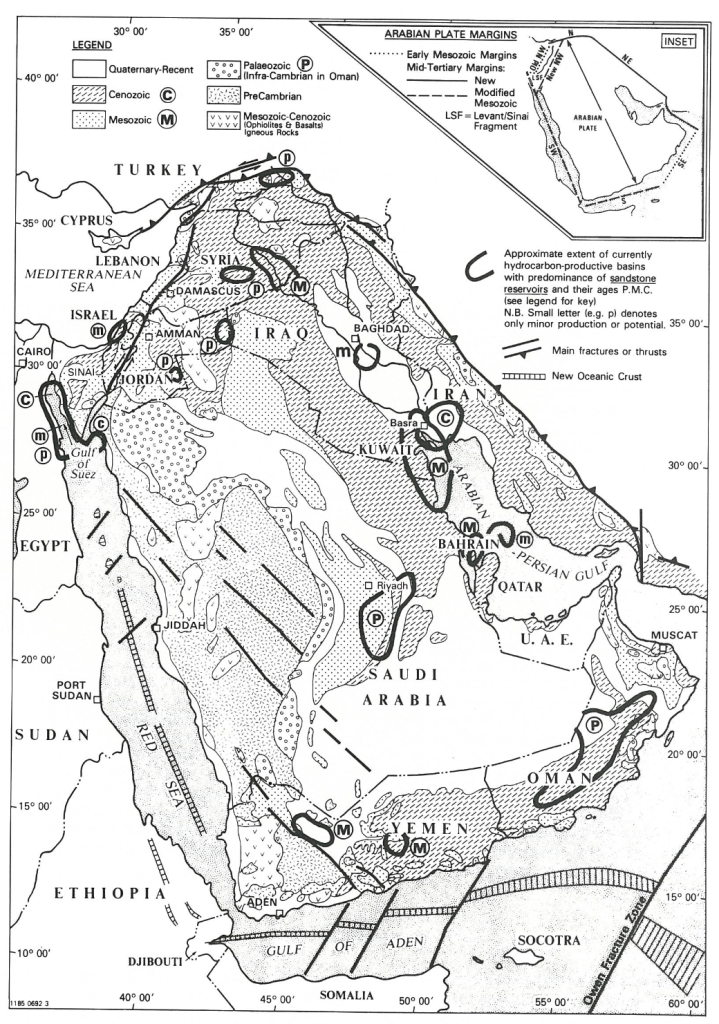
Figure 1:The scaffolding of various plates of the Middle East, from the Paleozoic Eon to today. The areas labelled P, M, and C represent hydrocarbon-productive basins from the Paleozoic, Mesozoic, and Cenozoic, respectively (Beydoun 1995).
The Middle East is covered with carbonate rocks with Silurian shales, which formed when the ancient Tethys Ocean covered the region. These shallow marine environments played a key role in preserving large amounts of organic material that would later form hydrocarbons (Xu et al. 2024). During the Silurian, there were large changes in sea levels, which caused the formation of extensive marine and deep-to-shallow shelf sedimentary environments. Planktonic organisms thrived during this time period, and the oxygen-rich photic zones within shallow waters promoted their development and eventual sedimentation into shales and mudstones(Beydoun 1995; Xu et al. 2024). Shales and mudstones are important for oil development and act as a source rock, able to store large amounts of organic debris (Slatt 2003). The large amount of planktonic organisms and their sedimentation within shales and mudstones is the reason for the high-quality hydrocarbons seen in the Middle East today (Slatt 2003; Beydoun 1995; Xu et al. 2024).
Once the organic material becomes buried under the ground, breakdown begins. Proteins are broken down into amino acids, and carbohydrates begin to break down into simpler sugars. They then begin to re-polymerize into less-soluble compounds, forming a heterogeneous mixture called kerogen (Bjørlykke 2015, 10-15). Kerogen is an accumulation of very large molecules, and when exposed to high temperatures (60 – 150 ℃), it begins to be converted into petroleum (Bjørlykke 2015, 10). Once petroleum forms, it migrates through surrounding rock, as it is less dense than water. It travels through porous rocks, such as carbonates, and eventually is trapped by a “cap” of less-permeable rock close to the surface (Figure 2) (Bjørlykke 2015, 10-15; Xu et al. 2024).
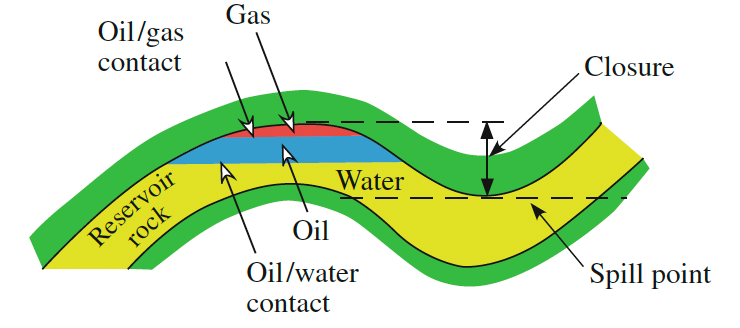
Figure 2: The accumulation of oil within reservoir rock through a structural trap. The oil and gas are trapped within the reservoir rock, often a carbonate or sandstone, and then trapped through a cap rock (Bjørlykke 2015, 15).
Due to the vast amounts of oil within the Arabian Gulf, it is subject to a phenomenon known as the resource curse. The resource curse occurs in countries rich with natural resources. As a result, they are often faced with increased political corruption and lower economic growth (Murshed 2019). Resource-rich countries can develop large power disparities between different socioeconomic groups. The people who are extracting the resource are not the people who receive the profit (Hakimian 2021). Instead, much of the wealth generated from oil production flows into large corporations and political elites, which leads to the exploitation of local workers and communities. The value of these resources are not being brought back to local economies, halting their growth and development (Hakimian 2021).
Although modern political instability is often looked at through a more recent lens, the roots of the conflict can be traced much farther back into Earth’s history. The plankton that once thrived in the Tethys Ocean gave rise to political instability millions of years later.
References:
Abdelaziz Eissa, Mohamed, Hisham Al Refai, and Georgios Chortareas. “Oil Dependency, Political Instability and the Stock Market: A Perspective from the Middle East and Africa.” Journal of Policy Modeling 47, no. 6 (2025): 1201–21. https://doi.org/10.1016/j.jpolmod.2025.09.009.
Beydoun, Z. R. “THE PETROLEUM RESOURCES OF THE MIDDLE EAST: A REVIEW.” Journal of Petroleum Geology 9, no. 1 (1986): 5–27. https://doi.org/10.1111/j.1747-5457.1986.tb00370.x.
Beydoun, Ziad R. “Productive Middle East Clastic Oil and Gas Reservoirs: Their Depositional Settings and Origins of Their Hydrocarbons.” In Sedimentary Facies Analysis, 1st ed., edited by A. Guy Plint. Wiley, 1995. https://doi.org/10.1002/9781444304091.ch14.
Bjørlykke, Knut, ed. Petroleum Geoscience: From Sedimentary Environments to Rock Physics. Springer Berlin Heidelberg, 2015. https://doi.org/10.1007/978-3-642-34132-8.
Hakimian, Hassan. The Routledge Handbook on the Middle East Economy. 1st ed. Edited by Hassan Hakimian. Routledge, 2021. https://doi.org/10.4324/9781315103969.
Merrill, Ryan K., and Anthony W. Orlando. “Oil at Risk: Political Violence and Accelerated Carbon Extraction in the Middle East and North Africa.” Energy Economics 92 (October 2020): 104935. https://doi.org/10.1016/j.eneco.2020.104935.
Murshed, Syed Mansoob. The Resource Curse. 1st ed. Agenda Publishing, 2018. https://doi.org/10.1017/9781911116509.
Slatt, Roger M. “Importance of Shales and Mudrocks in Oil and Gas Exploration and Reservoir Development.” In Siltstones, Mudstones and Shales, edited by Erik D. Scott, Arnold H. Bouma, and William R. Bryant. SEPM Society for Sedimentary Geology, 2003. https://doi.org/10.2110/sepmmisc.01.0015.
Xu, Enze, Yaning Wang, Shangfeng Zhang, et al. “An Analysis of Silurian Paleo–Tethys Hydrocarbon Source Rock Characteristics in North Africa, the Middle East, and South China.” Applied Sciences 14, no. 2 (2024): 663. https://doi.org/10.3390/app14020663.