Durian is a fruit commonly known for being so pungent and repulsive that it may induce nausea or vomiting; however, the odour may be pleasant, sweet and tropical to others. Olfactory or smell is the most influential of all the five senses, as it can deeply connect with emotions and memories. This can be attributed to how odour molecules bind to olfactory receptors, which are connected to neurons that directly send signals to the olfactory bulb. The olfactory bulb then sends signals to the olfactory cortex (identifies smell), amygdala (generates emotion) and the hippocampus (stores memories) (McDonough 2026).
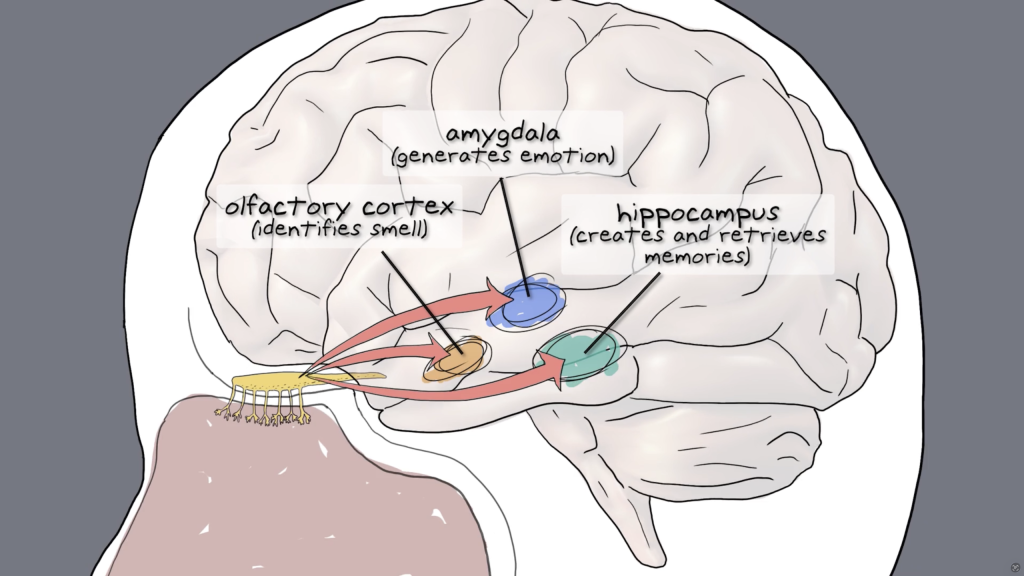
Figure 1. Smell signals travel from the olfactory receptors and bulb directly to the olfactory cortex (identifies the scent), amygdala (emotion), and hippocampus (memory) (McDonough 2026).
Information about the odour travels directly into brain regions that are key in generating emotion and storing memories, which can trigger recollections that can be both traumatic and pleasant. For instance, if a particular odour was important, the brain would store the emotion felt, which would cause a forgotten memory to be recalled. This phenomenon has led to reminiscence therapy, which aids individuals with memory loss (McDonough 2026).
Evolution Behind the Idiosyncratic Perception of Smell:
Smell is the oldest sense, as bacteria, which have preceded the existence of humans, exhibit physical responses towards specific airborne chemical signals. In addition, most non-human animals rely on smell to find food, locate mates, navigate the environment and detect danger. In humans, this evolutionary history is reflected in our genes. The genes that code for the thousands of olfactory receptors make about 1% of the human genome (Brandt and Huppert 2025). This same genetic complexity may explain why smell perception varies so much from person to person. With thousands of different receptors involved, even a small genetic variation can change which molecules a person detects, and how intensely they perceive them.
Cultural Reasons Behind the Idiosyncratic Perception of Smell:
Another reason why smell differs from person to person is because of cultural differences and environment. For example, some French-Canadians and French people were put in a test where they had to smell six different scents: anise, lavender, maple, wintergreen, rose, and strawberry. They found that French people rated wintergreen lower than French-Canadians, because most medicine in France had a similar smell (Hayward 2016). On the other hand, the scent was more commonly found in Canadian sweets, therefore receiving a higher rating from French-Canadian citizens. Additionally, it was also discovered that telling people the scents shrank the differences between results (Hayward 2016). This could mean that our reactions to smell aren’t purely based on sensory; they are built by the meaning and memories we’ve attached to a scent through our own upbringing and culture. However, we can’t ignore the molecules structure as there was a study that found that contain scents with the presence of sulfur were unpleasant, while larger and more complex molecules were more pleasant (Keller and Vosshall 2016).
References
Brandt, Thomas, and Doreen Huppert. 2025. “The Mysterious Sense of Smell: Evolution, Historical Perspectives, and Neurological Disorders.” PubMed Central. June 13, 2025. https://pmc.ncbi.nlm.nih.gov/articles/PMC12203381/.
Hayward, Shawn. 2016. “Olfactory Perception Influenced by Background and Semantic Information.” Newsroom. November 23, 2016. https://www.mcgill.ca/newsroom/channels/news/olfactory-perception-influenced-background-and-semantic-information-264301.
Keller, Andreas, and Leslie Vosshall. 2016. “Olfactory perception of chemically diverse molecules.” August 8, 2016. https://pmc.ncbi.nlm.nih.gov/articles/PMC4977894/.
McDonough, Molly. 2024. “The Connections Between Smell, Memory, and Health.” Harvard Medicine Magazine, 2024. https://magazine.hms.harvard.edu/articles/connections-between-smell-memory-and-health.


Leave a Reply
You must be logged in to post a comment.