Durian is a fruit commonly known for being so pungent and repulsive that it may induce nausea or vomiting; however, the odour may be pleasant, sweet and tropical to others. Olfactory or the sense of smell is the most influential of all the five senses, as it can deeply connect with emotions and memories. This can be attributed to how odour molecules bind to scent receptors, which are connected to neurons that directly send signals to the olfactory bulb. From there, signals to the olfactory cortex (identifies smell), amygdala (generates emotion) and the hippocampus (stores memories) (McDonough 2024) (see Figure 1).
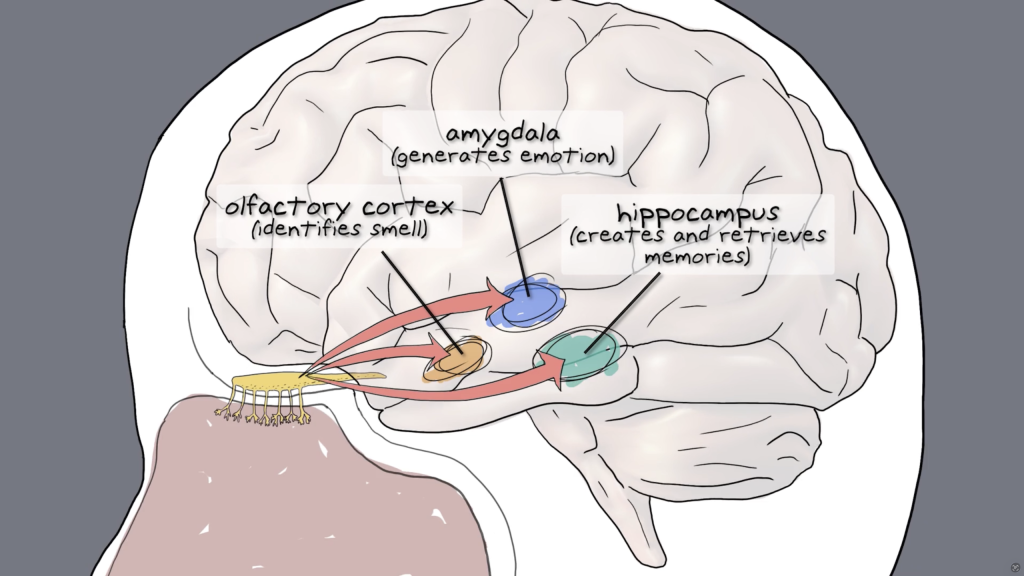
Figure 1. Smell signals travel from the olfactory receptors and bulb directly to the olfactory cortex (identifies the scent), amygdala (emotion), and hippocampus (memory) (McDonough 2024).
Information about the odour travels directly into brain regions that are key in generating emotion and storing memories, which can trigger recollections that can be both traumatic and pleasant. For instance, if a particular odour was important, the brain would store the emotion felt, which would cause a forgotten memory to be recalled. This phenomenon has led to reminiscence therapy, which aids individuals with memory loss (McDonough 2024). This suggests that the same scent is idiosyncratic, depending on the individual’s experience and association with it.
Evolution Behind the Idiosyncratic Perception of Smell:
Smell is the oldest sense, as bacteria, which have preceded the existence of humans, exhibit physical responses towards specific airborne chemical signals. In addition, most non-human animals rely on smell to find food, locate mates, navigate the environment and detect danger. In humans, this evolutionary history is reflected in our genes. The genes that code for the thousands of olfactory receptors make about 1% of the human genome (Brandt and Huppert 2025). This same genetic complexity may explain why smell perception varies so much from person to person. With thousands of different receptors involved, even a small genetic variation can change which molecules a person detects, and how intensely they perceive them.
Cultural Reasons Behind the Idiosyncratic Perception of Smell:
Another reason why smell differs from person to person is because of cultural differences and environment. For example, some French-Canadians and French people were put in a test where they had to smell six different scents: anise, lavender, maple, wintergreen, rose, and strawberry. They found that French people rated wintergreen lower than French-Canadians, because most medicine in France had a similar smell. On the other hand, the scent was more commonly found in Canadian sweets, therefore receiving a higher rating from French-Canadian citizens. Additionally, it was also discovered that telling people the scents shrank the differences between results (Hayward 2016). This could mean that our reactions to smell aren’t purely based on sensory; they are built by the meaning and memories we’ve attached to a scent through our own upbringing and culture. Still, molecular structure matters, as one study found that sulphur-containing scents were unpleasant, while larger, more complex molecules were highly delightful (Keller and Vosshall 2016). While molecular structures influence how pleasant a scent may be, culture and experience ultimately determine its significance to a person.
Durian’s odour is never perceived the same because the scent is so deeply linked to memory and emotions and shaped by both genetic makeup and cultural upbringing; each individual’s perception of the scent holds a different meaning.
References
Brandt, Thomas, and Doreen Huppert. 2025. “The Mysterious Sense of Smell: Evolution, Historical Perspectives, and Neurological Disorders.” PubMed Central. June 13, 2025. https://doi.org/10.3389/fnhum.2025.1588935
Hayward, Shawn. 2016. “Olfactory Perception Influenced by Background and Semantic Information.” Newsroom. November 23, 2016. https://www.mcgill.ca/newsroom/channels/news/olfactory-perception-influenced-background-and-semantic-information-264301.
Keller, Andreas, and Leslie Vosshall. 2016. “Olfactory perception of chemically diverse molecules.” August 8, 2016. https://doi.org/10.1186/s12868-016-0287-2
McDonough, Molly. 2024. “The Connections Between Smell, Memory, and Health.” Harvard Medicine Magazine, 2024. https://magazine.hms.harvard.edu/articles/connections-between-smell-memory-and-health
Comments
13 Responses to “Why We Smell the World Differently: Biology, Memory, and Culture”
Hi iSci,
This blog is about how we perceive smell differently and why this happens from an evolutionary and cultural perspective. In this post, I look at how scent is connected to memory, emotions, genes(evolution), upbringing and a little about how chemical structures affects the scent of the molecule. During Chad’s lecture about perspectives, I got curious about why two people can smell the exact same thing and have completely different reactions. Some people could find certain smells pleasant, while others find the same smell repulsive.
Thank you for reading and I appreciate any feedback you have!
Hi Troy,
Good job on your blog post! I am very interested in memory, and I thought it was very interesting to read about how smell can influence it. I have a few suggestions:
– The figure caption should be centred.
– Reference your figure in your text by using (Figure 1) or “as seen in Figure 1.”
– I really like how you are incorporating many different science concepts; however, instead of separating your post into 3 different topics (memory, evolution, and culture), maybe relate them all with one main idea. Your main idea could be how smell aids memory, and then explain this through evolution and culture. This would allow you to format your blog with an introductory paragraph and body paragraphs that further explain your idea by going deeper with specific evidence.
Overall, it was very well written, and I look forward to reading the final copy!
– Ava
Hi Ava,
Thank you for your suggestions, I’ve fixed the first two issues you pointed out and I’ll work on the last suggestion you had for me.
Much thanks,
Troy
Hi Troy
Great job on your blog post, I found it to be a very interesting read! Here are a few pieces of feedback:
– Make sure you use the DOI link given in journals you use, for example you first reference has a DOI
– P4: Typically if two consecutive sentences use the same source you wouldn’t need to add the intext twice
– I would recommend adding a conclusion paragraph separate from your information to wrap up your points and leave the readers with a thinking point or last thought.
Overall, well done! Happy editing!
Maya Kumar
Hi Maya,
Thank you for your suggestion, I’ve incorporated the DOI links and removed one of the citations in the consecutive sentences. I’ve added a concluding sentence opposed to a paragraph because I don’t think I have enough words to do so.
Much thanks,
Troy
Hi Troy!
I really enjoyed your blog post on the oldest sense, smell!
A suggestion I would make is to reduce the amount of times you say “olfactory” in paragraph 1. For example, in P1S3 you could replace “olfactory receptors” with “sent receptors”. You could also rephrase P1S4 by writing, “From there, signals are sent to the olfactory cortex (identifies smell), amygdala (generates emotion) and the hippocampus (stores memories) (McDonough 2026).” This would reduce the repetition in this paragraph making it stronger overall.
Great work and very creative topic!! Looking forward to reading your finished product!
Best,
Emma
Hi Emma,
Thank you for your suggestion, I incorporated all of your feedback since I fully agree with what you mentioned.
Much thanks,
Troy
Hi Troy!
I really enjoyed reading this blog post, it is a very interesting topic, and found it very engaging! I also liked how it was organized. Here are a few things I noticed to strengthen this post:
– Make sure the DOI is included in the citation, if possible
– Mentioning your figure somewehere in your writing
Overall it is an amazing blog post, and I can’t wait to read the final version!
Best,
Tsippora
Hi Tsippora,
Thank you for the information, I have included the DOI into my citation where it is possible and added the mention to my figure in paragraph 1
Much thanks,
Troy Lin
Hey Troy
Your explanation of how smell differs across individuals is surely intriguing! The structure of your post flows nicely. Nevertheless, I have a few suggestions to help polish this post.
– In paragraph 1, rephrase “Olfactory or smell is the most influential of all the five senses…” to “Olfaction, or sense of smell, is…” for better grammar and flow.
– In paragraph 4, ensure the word “molecule” in the last sentence contains an apostrophe. It should be “molecule’s structure” or “molecular structure” instead of “molecules structure”
– Your last sentence containing the study that mentions the role of molecular structure in determining scent feels a bit abrupt or out of place considering it is the ending sentence. While it introduces a great counterexample, consider adding another sentence beyond to tie the last paragraph together and provide a clear conclusion
– Your citation for McDonough is mismatched, while the in-text citation in your first paragraph, second paragraph, and figure caption says 2026, in your references it is listed as 2024 otherwise
Overall this was a really well-written blog covering a unique topic, hope you enjoy editing!
With love,
Brand
Hi Brand,
Thank you for your suggestion, I’ve incorporated your feedback.
Much thanks,
Troy
Hi Troy!
I loved your blog post! I thought it was a very interesting concept of scents being percieved differently depending on the person. I feel like we often discuss sight and how colour might be different for everyone, but I rarely hear about scents being unique experiences for people.
I don’t have many suggestions to input for your blog post, but if I may nitpick a little…
It might be too strong a statement to say outright that smell is the most influential as it is more subjective than it is objective fact. Maybe consider replacing the statement so you aren’t claiming anything that may not be true.
The ending of your blog post seems a bit confusing? I think it would work better if the scent of durian being different to people was proposed as a question, and the conclusion sought to answer the question.
All in all though, it was a great post! I’m excited to see the final draft.
Best,
Kimi Wong
Hi Kimi,
Thank you for your suggestion, but I don’t believe that smell being the most influential is more subjective. As for your last suggestion I did answer the question as I stated “each individual’s perception of the scent holds a different meaning”.
Thank you for your suggestions,
Troy Lin