How does a species without spoken language organize thousands of individuals into a highly specialized and productive society? The caste system among leafcutter ants seems almost too neat, with thousands of workers dividing labour among cutting leaves, caring for broods, tending the fungus garden, foraging, and defending the nest. Their social system is a decentralized “superorganism” where an ant’s role can be understood through developmental biology, chemistry, and physics.
The first part of the answer is established before an ant leaves the nest. In one ant species, Acromyrmex echinatior, researchers found that when large workers were removed, larvae became more likely to develop into large-worker phenotypes, suggesting that the colony’s existing workforce influences the next generation (Hughes and Boomsma 2007). Furthermore, in another species, Atta vollenweideri, development also determines what a worker can physically do. Newly emerged workers produce less than 10 mN (millinewtons) of bite force, while mature foragers produce around 100 mN, making young workers physically incapable of leaf-cutting (Püffel et al. 2023).
However, the caste system is not simply dependent on physical traits; the colony also needs a way to detect what is happening around it and respond accordingly. Leafcutter ants use stridulation, rubbing body parts together to produce vibrations that travel through the substrate. To complete this action, they possess a specialized structure on their abdomen composed of a sharp scraper, known as the plectrum, and a finely ridged file. This anatomy exemplifies stick-slip friction, the exact same mechanical phenomenon that allows a violin bow to create sound from a string. For example, in Atta sexdens, ants can locate the source of a vibration by comparing tiny differences in when the signal reaches their legs (Hager et al. 2017), allowing them to respond to its source.
To add to this, Hager, Kirchner, and Kirchner found that an alarm chemical could alter how A. sexdens responded to vibrations (2017). A signal is not a mere translation into a fixed response, such as “vibration = complete task X”. Instead, the meaning of a signal can depend on other information that the ant is receiving at the same time. Ants are able to detect extremely similar hydrocarbons on the cuticle of other ants, including molecules that are extremely similar but differ in subtle structural features. Sharma et al. found that Camponotus floridanus could even distinguish enantiomers or “mirror molecules” of a candidate queen pheromone (2015). This demonstrates that ants can discriminate between closely related molecular signals and respond differently to each.
These signals do not produce the same response in every worker. Instead, their effects can differ between individuals according to response-threshold models. Notably, the same stimulus may cause one worker to respond while another remains inactive until the conditions change, meaning task allocation can emerge from many individual responses. (Beshers and Fewell 2001). Likewise, certain biological mechanisms can make a particular behavior more or less likely in an individual ant. In Atta cephalotes, the neuropeptides Neuroparsin-A (NPA) and Crustacean cardioactive peptide (CCAP) were associated with different worker behaviors.
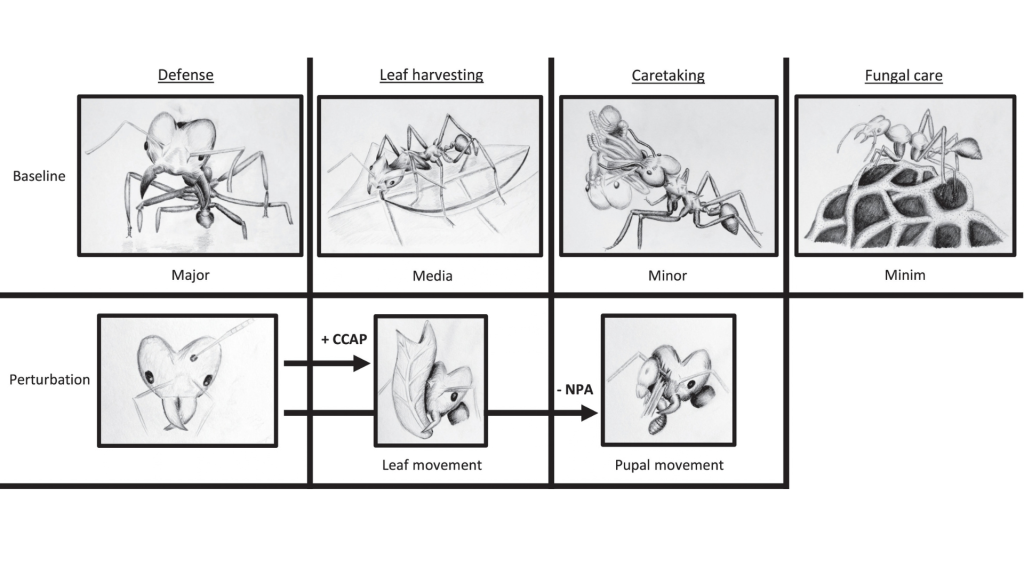
Ultimately, morphological development determines what an ant is equipped to do, chemical and physical signals are used to facilitate communication, and response thresholds and internal biological mechanisms guide behavior.
References
Beshers, Samuel N., and Jennifer H. Fewell. 2001. “M ODELS of D IVISION of L ABOR in S OCIAL I NSECTS.” Annual Review of Entomology 46 (1): 413–40. https://doi.org/10.1146/annurev.ento.46.1.413.
Gilbert, Michael B., Karl M. Glastad, Maxxum Fioriti, et al. 2025. “Neuropeptides Specify and Reprogram Division of Labor in the Leafcutter Ant Atta Cephalotes.” Cell 188 (15): 3974–91.e21. https://doi.org/10.1016/j.cell.2025.05.023.
Hager, Felix A., Lea Kirchner, and Wolfgang H. Kirchner. 2017. “Directional Vibration Sensing in the Leafcutter Ant Atta Sexdens.” Biol Open 6 (12): 1949–52. https://doi.org/10.1242/bio.029587.
Hughes, William O. H., and Jacobus J Boomsma. 2007. “Genetic Polymorphism in Leaf-Cutting Ants Is Phenotypically Plastic.” Proceedings. Biological Sciences (England) 274 (1618): 1625–30. PubMed Central. https://doi.org/10.1098/rspb.2007.0347.
Püffel, Frederik, Lara Meyer, Natalie Imirzian, Flavio Roces, Richard Johnston, and David Labonte. 2023. “Developmental Biomechanics and Age Polyethism in Leaf-Cutter Ants.” Proc. R. Soc. B 290 (2000): 20230355. https://doi.org/10.1098/rspb.2023.0355.
Sharma, Kavita R., Brittany L. Enzmann, Yvonne Schmidt, et al. 2015. “Cuticular Hydrocarbon Pheromones for Social Behavior and Their Coding in the Ant Antenna.” Cell Reports 12 (8): 1261–71. https://doi.org/10.1016/j.celrep.2015.07.031.
Comments
9 Responses to “Caste in Point: What Determines an Ant’s Role?”
Hey iSci!
I became interested in this topic after the introduction to our lecture on biological organization, which got me thinking about how these “hierarchies” actually emerge in the natural world, including how processes at the individual level can contribute to building much larger, complex systems. Leafcutter ants provide an interesting example of this relationship because the behaviour of individual ants ultimately contributes to the organization of the entire colony. This topic also allowed me to bring together multiple components, including chemistry, physics, and behavioural and developmental biology.
Looking forward to hearing your feedback!
Hey Jhaanvi!
Great work in explaining the hierarchies within ants; I really liked your use of primary research! Some suggestions I have are:
– Maybe elaborate on what the units “mN” refer to in parentheses, just so that the reader can understand what measurement is being used.
– When you mention “Acromyrmex echinatior” and “Atta vollenweideri”, it’d be beneficial for you to mention that these are ant species, as sometimes the reader might be confused to what you are referring to.
– When talking about stridulation, you can make a clearer link to how this mechanism connects to the colony.
Overall, it was a great read!
– Swetha S
Hi Swetha! Thank you for your thoughtful feedback and suggestions! I have clarified the units and identified the ant species for the reader. I also added a sentence strengthening the connection between stridulation and colony communication. I really appreciate your feedback!
Hey Jhaanvi,
Great blog post, I really enjoyed reading it! I especially like your title – very witty. Here are a couple of suggestions that will make your post even better:
(1) P2S2&S3: What are Acromyrmex echinatior and Atta vollenweideri? In a blog post, considering your vast audience, it is important to explain any terms that are not common knowledge.
(2) P5S3: What are “the neuropeptides NPA and CCAP”? When using acronym you need to use the full name first and refer to the acronym in brackets.
(3) P6S1: Awkward phrasing – did you mean to write ‘productivity’ instead of “productive”?
Once again, good job – cannot wait to read the final iteration.
Happy editing,
Farwa 🙂
Hi Farwa! Thank you so much for your feedback and for pointing out these areas! I have clarified the ant species, introduced the full names of the neuropeptides before using their abbreviations, and revised the phrasing around productivity in the final paragraph. I’m glad you enjoyed the title!
Hi Jhaanvi,
This was a very interesting and informative topic! Here are some minor suggestions I have:
– I believe the chicago author date style in-text citation for 3 or more authors is just the first author et al. so the citation in P3 should be (Hager et al. 2017).
– It looks like your blog is slightly over the maximum word count of 500. One way you could cut down a little is to explain more about the neuropeptides NPA and CCAP within the figure caption as it does not contribute to word count.
– In the sentence, “while adding NPA to Minor workers reduced brood care” change to “minor”. Also, make sure you write the full name of the neuropeptides before using the abbreviations.
Overall, this was a great blog post! Happy editing!
Maybel
Hi Maybel! Thank you for the helpful suggestions! I have corrected the citation, made sure the post is within the word limit, and clarified the neuropeptide names and capitalization. I really appreciate you catching these details!
Hi Jhaanvi,
Good post! It was interesting to learn that the way ants communicate is highly contextual, which gives us a more in-depth understanding of these insects. I have a few suggestions for your post:
– P3, you mention the use of vibrations in ants and explain the anatomy of this seemingly important function, but you don’t further explain its use. It seems very interesting, and if you have the wordcount, I would at least add a sentence about how it might be used to communicate.
– Generally, italicize all of the species names that you mention. This is more of a formatting suggestion, but it’s important to differentiate species amongst the rest of your text.
Hi Mitchell! Thank you for the feedback! I have added a bit more explanation about how vibrations are used for communication when discussing stridulation. I have also made sure all species names are italicized. I appreciate the suggestions!