Amongst the great many techniques and strategies implemented by farmers over the millennia, the use of monocultures has become highly popular since the rise of industrial farming. At the large scale outputs required by the machine of modern society, the efficiency of growing one type of crop over large swathes of land is necessary to lighten the logistical load of planting, crop management, and harvest. Of course, this type of strategy is highly unsustainable as it not only strains the soil of nutrients (thus requiring fertilization) but also creates ecological wastelands of low biodiversity (Wei et al. 2022). Therefore, in order to pursue more environmentally friendly and mutually beneficial farming techniques, we can look to the ancient strategy of rice-fish coculture as an example of environmentally sensitive agriculture.
Combining rice and fish in agriculture is an ancient practice originating from Southeast Asia where rice farming is most common (Samaddar et al. 2025). The system revolves around using the rice paddy as an artificial wetland where both the biome’s plants and the organisms that live within it can be harvested. This type of farming therefore is typically low in pesticides and fertilizers, instead leveraging the entire ecosystem and associated food webs to provide the benefits (Lee et al. 2026). Rice paddy fields that include fish also encourage the presence of other wetland organisms like birds and beneficial invertebrates (eg. worms, predatory insects, benthic detritivores), helping create a self-sustaining biome that has a wealth of benefits to the health of the plant (França et al. 2024; Selland et al. 2026). Both the fish and beneficial wetland organisms grant the the crops a built-in pest management system, even against non-predated pest insects such as the rice planthopper, whose populations were reduced by fish knocking them into the water when swimming by (Li et al. 2025; Xie et al. 2011).
The inclusion of fish is also purported to increase nutrient availability to the desired target, which is the rice plants. Although current research is inconclusive about whether the waste from fish actively fertilizes the crops, it has been noted that leftover fish feed acts as a nitrogen source, fertilizing the water; nutrients that would usually be utilized by growing invertebrates or rapidly-growing plants are recycled back into the system by fish through predation, thus resulting in nutrient cycling to the rice crops and protection from being choked out by weeds (Lie et al. 2025; Tsuruta et al. 2011; Xie et al. 2011). This setup is visualized by Figure 1.
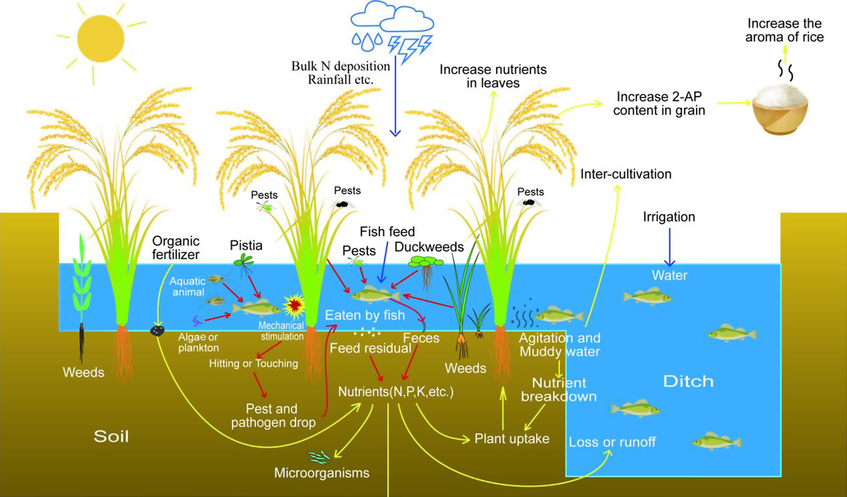
The boons provided by the combined effect of using fish as both a biological control agent and a source of fertilizer cannot be understated, especially with such low maintenance. This combined with the food security and disease management benefits strongly cements rice-fish coculture as a shining example for eco-friendly agriculture.
Works cited
França, Jaciara de Andrade, Anderson Oliveira Latini, Katharina Stein, Mauri Aparecido Barbosa, Gabriela Soares Santos Araújo, and Ana Clara Pimenta Pereira. 2024. “Enhancing Rice Yield in Paddy Fields through Beneficial Organisms.” Journal for Nature Conservation 77 (January): 126544. https://doi.org/10.1016/j.jnc.2023.126544.
Lee, Byung-Mo, Myung-Hyun Kim, Soon-kun Choi, Jinu Eo, and Sang-Min Jun. 2026. “Fish Assemblages Distinguish Eco-Friendly from Conventional Rice Paddies Through Abundance and Biomass Rather than Diversity.” Biology15 (16): 1411. https://doi.org/10.3390/biology15161411.
Li, Shuang-Xi, Jian Jiang, Wei-Guang Lv, et al. 2025. “Rice-Fish Co-Culture Promotes Multiple Ecosystem Services Supporting Increased Yields.” Agriculture, Ecosystems & Environment 381 (April): 109417. https://doi.org/10.1016/j.agee.2024.109417.
Samaddar, Ayan, Dani Kacha, Anilava Kaviraj, Sarah Freed, Arun Padiyar Panemangalore, and Subrata Saha. 2025. “Rice-Fish Coculture: Enhancing Resource Management and Food Security.” Aquaculture 595 (January): 741476. https://doi.org/10.1016/j.aquaculture.2024.741476.
Selland, Emily K., Nicolas Jouanard, Amadou Guisse, et al. 2026. “Rice–Fish Co-Culturing Reduces Schistosomiasis Risk and Increases Yields and Incomes.” Nature Sustainability 9 (7): 1027–38. https://doi.org/10.1038/s41893-026-01833-8.
Tsuruta, Tetsuya, Motoyoshi Yamaguchi, Shin-ichiro Abe, and Kei’ichiro Iguchi. 2011. “Effect of Fish in Rice-Fish Culture on the Rice Yield.” Fisheries Science 77 (1): 95–106. https://doi.org/10.1007/s12562-010-0299-2.
Wang, Qi, Mei-juan Li, Jia-en Zhang, et al. 2023. “Suitable Stocking Density of Fish in Paddy Field Contributes Positively to 2-Acetyl-1-Pyrroline Synthesis in Grain and Improves Rice Quality.” Journal of the Science of Food and Agriculture 103 (10): 5126–37. https://doi.org/10.1002/jsfa.12597.
Wei, Zhanxi, Hao Wang, Chao Ma, et al. 2022. “Unraveling the Impact of Long-Term Rice Monoculture Practice on Soil Fertility in a Rice-Planting Meadow Soil: A Perspective from Microbial Biomass and Carbon Metabolic Rate.” Microorganisms 10 (11): 2153. https://doi.org/10.3390/microorganisms10112153.
Xie, Jian, Liangliang Hu, Jianjun Tang, et al. 2011. “Ecological Mechanisms Underlying the Sustainability of the Agricultural Heritage Rice–Fish Coculture System.” Proceedings of the National Academy of Sciences 108 (50): E1381–87. https://doi.org/10.1073/pnas.1111043108.

Leave a Reply
You must be logged in to post a comment.