All good things in life must come to an end. Sometimes it is expected, like an organism reaching the end of its life, and sometimes it is less predictable, like the meteor that hit the dinosaurs. Extinction is a natural part of Earth’s history, and over billions of years, countless species have disappeared from the planet entirely (Jebari and Sandberg 2022). Once a species goes extinct, most generally consider it gone for good. But what if extinction didn’t have to be the final chapter? With recent advances in genomics and gene-editing technology, scientists are exploring whether some extinct species could one day be brought back to life (Lin et al. 2022).
But how on Earth could scientists bring back something that has been extinct for thousands, or even millions of years? Well, the key lies in the genetic information that was preserved within the remains of extinct species. Scientists can extract fragments of ancient DNA from these remains and sequence them to reconstruct as much of the extinct species’ genome as possible (Lin et al. 2022). This genome can be compared with that of a closely related living species, allowing researchers to identify genetic differences that may be associated with traits characteristic of the extinct species. Researchers can then modify these specific regions in cells of the living species using gene-editing technologies such as CRISPR-Cas9 to potentially produce an organism with selected traits of its extinct relative (Turner et al. 2026). Figure 1 illustrates the core stages of the de-extinction process for mammalian species.
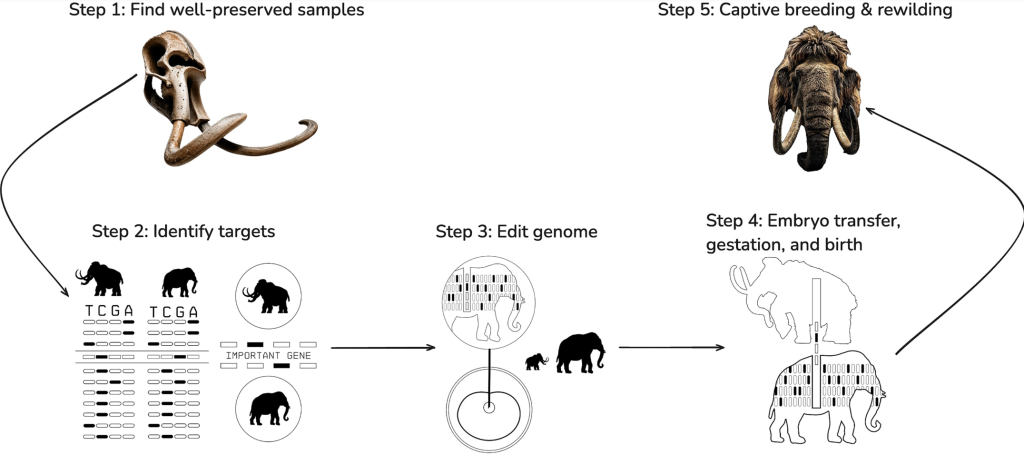
A 2022 study tested the feasibility of this approach by using the extinct Christmas Island rat (Rattus macleari) as an example. In the study, researchers re-sequenced DNA from ancient preserved remains and found that, even with high-quality, comprehensive sequencing, 4.85% of the Christmas Island rat’s genome could not be recovered when compared with the closely related Norway brown rat. Furthermore, the missing regions were not random; genes involved in immune function and smell were particularly affected. This suggests that even a genetically engineered version of an extinct species is not an identical replication, and could differ from the original in many different ways (Lin et al. 2022).
De-extinction could also have consequences beyond the individual organism. Changes in genes involved in important traits could affect how a recreated organism interacts with its environment, other species, or potential diseases. It is therefore also important to consider how these organisms could function within modern ecosystems, and whether their reintroduction could have effects that scientists cannot currently predict (Wienhues et al. 2023).
Extinction may no longer be as definite as it once seemed, but bringing an extinct species back is far more complicated than simply recovering its DNA. As technology continues to advance, scientists may become more capable of replicating a species’ genome, but a genome alone cannot perfectly recreate everything that made a species what it was. De-extinction therefore raises the question: if a species cannot be perfectly replicated to what it once was, have we truly reversed its extinction?
References
Jebari, Karim, and Anders Sandberg. 2022. “Ecocentrism and Biosphere Life Extension.” Science and Engineering Ethics 28 (6): 46. https://doi.org/10.1007/s11948-022-00404-2.
Lin, Jianqing, et al. 2022. “Probing the Genomic Limits of De-Extinction in the Christmas Island Rat.” Current Biology 32 (7): 1650–1656.e3. https://doi.org/10.1016/j.cub.2022.02.027.
Turner, Stephen D., et al. 2026. “De-extinction Technology and Its Application to Conservation.” Journal of Heredity 117 (5): 959–974. https://doi.org/10.1093/jhered/esaf069.
Wienhues, Anna, Patrik Baard, Alfonso Donoso, and Markku Oksanen. 2023. “The Ethics of Species Extinctions.” Environmental Values 1: e23. https://doi.org/10.1017/ext.2023.21.
Comments
11 Responses to “De-Extinction: Species Back, Tell a Friend”
Hi Gohar,
This was a super fascinating and engaging topic! It’s very interesting to see how scientists can attempt to reconstruct the genome of extinct species.
I have a few small suggestions:
-P1S2 I believe both clauses before and after a semicolon need to be able to stand as their own complete sentence. “like the meteor that hit the dinosaurs” is not a complete sentence, so perhaps a comma would work better here.
-P2S1 Ellipses generally have three periods.
-P3S2 Perhaps consider replacing “even with high-quality sequencing with large amounts of coverage” with something like “even with high-quality, high-coverage/comprehensive sequencing” to eliminate the repeating “with”.
-P4S2 Perhaps consider replacing “how a recreated organism interacts with its environment, other species or with potential diseases” with something like “how a recreated organism interacts with its environment, other species, or potential diseases” to eliminate the repeating “with”.
-P4S3 A period is missing at the end of the sentence, after the (Wienhues et al. 2023) citation.
I really enjoyed reading your article hope to see more posts from you in the future!
Best,
Jerry Wu
Hi Jerry,
Thank you for your suggestions – I’ve applied them as necessary. I’m glad you enjoyed reading!
Gohar
Hi Gohar,
This was a super interesting read about de-extinction, as one of the “most” that “generally consider them [species] gone for good”, it is fun to see how modern technologies can reverse that.
I did have some suggestions I would like to point out though:
– In paragraph 2, sentences 4 and 5 both contain the phrase “can then” near the beginning: “This genome can then […]. Researchers can then […]”. It is a little awkward having the 2 sentences start in a near identical way in my opinion.
– Aside from this, I think some figures can also help the reader better understand what is going on.
Overall great article, looks like maybe Jurassic Park isn’t so far away afterall!
Daniel Cao
Hey Daniel,
Thank you for your suggestions, I’ve applied them to my post as needed. I’m really glad you enjoyed reading! 🙂
– Gohar
Hi Gohar,
This is such an interesting topic and I love how you included a paragraph considering the potential impacts of de-extinction on modern ecosystems. Here are a few suggestions I had for your edits:
– Consider adding a figure to your post. (For example, an illustration of the Christmas Island rat along with a picture of the Norway brown rat)
– Paragraph 4 sentence 1 could be rephrased to “De-extinction could also have consequences beyond the individual organism.”
– I recommend hyperlinking your DOIs in your reference list as this makes it easier for readers to access the sources you used.
– Don’t forget to add your own comment to explain why you chose this topic!
Overall, great blog post and good luck with your edits!
Kristen
Hi Kristen,
I’m glad you enjoyed reading! I’ve applied your comments as needed – thank you for the wonderful suggestions 🙂
– Gohar
Hi Gohar!
I just wanted to quickly remind you not to forget to add a comment explaining why you chose this topic 🙂
– Clara
Hey Clara!
Thanks for giving me a heads up! I’ve left a comment now 🙂
– Gohar
Hey there Gohar!
This was a great read! Awesome topic for you first blog of the semester, interesting concept to bring back extinct species kinda like jurassic park!
Your formatting seems great however it may serve to be beneficial to add in a figure to help convey your point. Perhaps a figure from the journal article where you got your statistics from.
Best,
Alisha
Hey Alisha!
I’m glad you enjoyed reading! I’ve gone ahead and added a figure. Thanks for your comment 🙂
– Gohar
Hey iSci!
A lot of what we focus on in PAIx is how different species (including humans!) interact with and impact the ecosystems around them. I was also thinking about HotE and how extinction is such a huge part of Earth’s history when I began to explore the topic of de-extinction. It’s a pretty extreme example of humans actively trying to change the environment and biodiversity around us, and I thought it was interesting to think about how species that can theoretically be brought back would interact with a very different, more modern environment. Hope you enjoyed reading!
– Gohar