If you were to visit a doctor and leave with one more disease than you walked in with, you’d probably sue, right? Nobel Prize winner, Julius Wagner-Jauregg, presented the opportunity to pose this question to patients he was treating with an infectious disease. Before antibiotics could transform the treatment of infection, physicians of the past would sometimes use one disease to combat another. This approach to medicine brought upon us malariotherapy, the deliberate infection of patients with malaria.
Syphilis, the multistage STI, is caused by a heat-sensitive bacteria called, Treponema pallidum. Malariotherapy came about as a treatment for neurosyphilis, a severe form of untreated syphilis that causes complications in the nervous system and produces cognitive, psychiatric, and motor impairment (CDC 2025). This manifestation of late syphilis, also called general paresis of the insane (GPI), was essentially fatal until 1917, when Austrian psychiatrist Julius Wagner-Jauregg began deliberate infection with Plasmodium (Figure 1), the bacteria responsible for malaria. It was utilized to generate recurrent high fevers to terminate the treponema pallidum, then followed by quinine to cure the malaria, and further treatments to cure the syphilis (Arrow KJ et al. 2004).
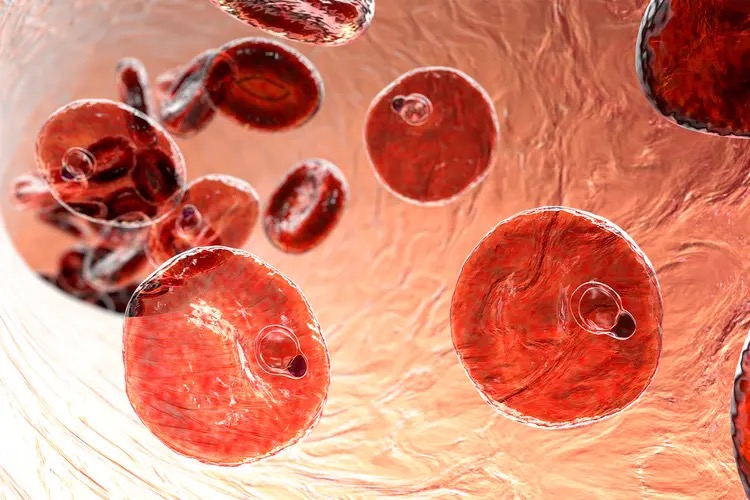
It was an idea that had long been written about in historical literature, now referred to as “fever therapy,” but Wagner-Jauregg began reporting actual results to his experiments. 50 of his more than 200 patients with GPI treated with malaria recovered enough to go back to work (Tsay, C. J., 2013). His 1927 Nobel lecture presents the discovery as the outcome of a long research programme, moving from simple observations of spontaneous remission after a fever to actual experiments with tuberculin, vaccines, and, finally, malaria (Wagner-Jauregg,J., 1927).
The intellectual importance of malariotherapy is easy to miss if judged solely by its mechanisms. It was not simply an attempt to “burn out” an infection by a mad scientist. It also challenged notions in psychiatry by demonstrating that at least some apparently psychiatric infections had identifiable biological causes and could respond to physical intervention. Historical analyses suggests that malariotherapy helped strengthen biological psychiatry and influenced the later development of psychopharmacology (Tsay, C. J., 2013). This treatment also depended on a much larger pharmacological system than just a high fever: the inclusion of quinine and other agents to cure syphilis convolutes malaria treatment and connects it to infectious disease, drug discovery, psychiatry, and medicine rather than just one specialty.
However, therapeutic novelty does not equal ethical legitimacy. Malariotherapy offered a route out of an otherwise fatal illness, but its “active ingredient” was a dangerous infection. Wagner-Jauregg mentions temperatures reaching 40-42°C and the possibility of death (Wagner-Jauregg,J., 1927). The problem was intensified by patient vulnerability, as many were institutionalised psychiatric patients whose capacity to understand or refuse treatment may have been compromised. The absence of modern research ethics committees meant that the people bearing the greatest risk to scientific development often had the least power to negotiate it.
The legacy of malariotherapy is therefore double-edged. It illustrates how observations can generate transformative hypotheses, but also how institutional authority can convert a risky experiment into accepted practice. For scientists, the lesson is not that historical clinicians were simply irrational or immoral, but that desperate innovation inadvertently coexists with exploitation. Ethical review isn’t an obstacle added after discovery; it is a part of what makes science trustworthy to the public.
Resources
Centers for Disease Control and Prevention. 2025. “About Syphilis.” Updated January 30, 2025. Accessed September 28, 2026. https://www.cdc.gov/syphilis/about/index.html
Arrow KJ, Panosian C, Gelband H, et al. 2007. “A Brief History of Malaria.” In Saving Lives, Buying Time: Economics of Malaria Drugs in an Age of Resistance. National Research Council. Accessed September 28, 2026. https://www.ncbi.nlm.nih.gov/books/NBK215638/
Tsay, Cynthia J. 2013. “Julius Wagner-Jauregg and the Legacy of Malarial Therapy for the Treatment of General Paresis of the Insane.” Yale Journal of Biology and Medicine 86 (2): 245-254. Accessed September 28, 2026. https://pmc.ncbi.nlm.nih.gov/articles/PMC3670443/
Wagner-Jauregg, Julius. 1927. “The Treatment of Dementia Paralytica by Malaria Inoculation.” Nobel Prize lecture, December 13, 1927. The Nobel Prize. Accessed September 28, 2026. https://www.nobelprize.org/prizes/medicine/1927/wagner-jauregg/lecture/


Leave a Reply
You must be logged in to post a comment.