From the smallest bacteria to the blue whale every organism on earth has evolved. Evolution shapes our reality today, allowing humans to adapt, innovate, and thrive in a constantly changing environment. It is the driving force behind the diversity of life, influencing not only physical traits but also behaviors, survival strategies, and societal structures. Evolution has undoubtedly changed the physiology of our brain, as our brain got larger and more complex helping us store and process more information. (Verendeev, et.al, 2017)
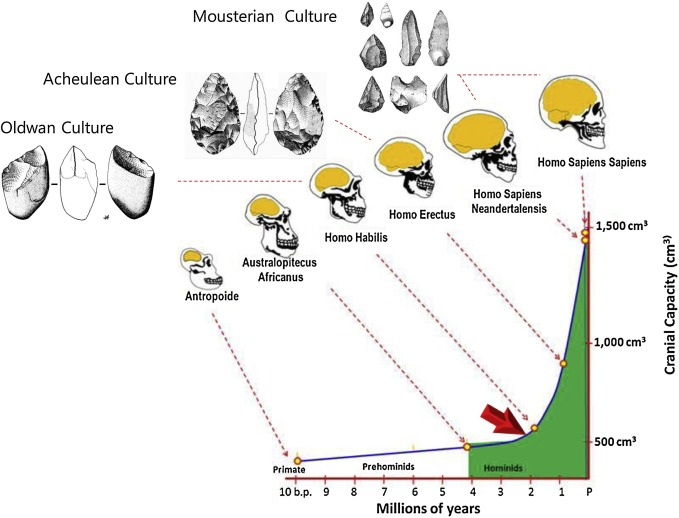
Figure 1: Figure showing transition of cranial capacity in cm3 along the evolutionary process of various ancestral pre-hominids and hominids as a function of time which is given in millions of years. The graph shows illustrations of skulls and brains, depicting the increase in size and complexity as time increases. The image further depicts the acceleration of brain expansion when Homo Habilis started manufacturing and using stone tools. (Bretas, et.al, 2019)
However this gives rise to the question; since evolution impacted the physical brain, did it also impact the mind, and more specifically mental health as well? In order to understand how evolution impacts mental illness and our susceptibility to it we must look at genetics first. Studies have shown that disorders such as autism, schizophrenia, bipolar disorder and depression are caused due to variations in certain genes. For instance if variation is found in genes that code for the cellular machinery that helps regulate the flow of calcium into neurons then it affects the brain’s circuitry involved in emotion, thinking, attention and memory leading to several disorders. (Lancet, 2013)
Since it’s been established that mental health can be linked to genetic variation, one could take a look at evolution and see how processes such as natural selection affect the mental health illness we see so prominently in our society today.
Natural selection, a popular theory proposed by Charles Darwin and Alfred Ruseel Wallace, is the basis of evolution. Natural selection suggests that organisms that are more adapted to their environment are more likely to survive and pass on the genes that aid their success. (Osterloff, 2019) However it is a misconception that natural selection leads to perfectly designed traits. In fact, natural selection responds to trade-offs to find the best compromise for the propagation of genetic material. This ideology backs up many theories that identify why mental illness, or at least disorders caused by genetics, were not eradicated.
One theory is the heterozygote advantage, this is where the heterozygote at a locus with two alleles has a higher fitness than the two homozygotes. (Charlesworth, 2013). An example of this is sickle cell anemia. Individuals who are homozygous for the more common allele at the b-hemoglobin locus are susceptible to malaria, whereas those homozygous for the less common allele (aa) are more likely to die from sickle cell anemia. However, heterozygotes (Aa) have the best of both worlds: they do not develop anemia, and they are much more likely to survive a malarial infection. This theory can be applied to mental health as well, where genetic evidence suggests that there may also have been benefits to alleles that increase risk for schizophrenia, such as higher IQ, increased creativity, and improved mathematical reasoning.(Durisko, et.al, 2016)
Another theory is known as antagonistic pleiotropy, where an allele increases the fitness payoffs of one trait but reduces the fitness payoffs of another trait. For example, an allele might increase fertility but decrease longevity (Mitterldorf, 2019). Researchers hypothesized that susceptibility alleles, which are genetic variants of genes involved in the predisposition to a complex disease (Durisko, 2016) underlying bipolar disorder and schizophrenia have two effects: one, to increase creativity, but the second, to increase the risk for the mental disorder. These susceptibility alleles are thought to persist because their negative fitness effects from mental disorder risk are precisely offset by their benefits from creativity
The last theory that is often discussed by researchers is negative frequency-dependent selection. This theory states that alleles’ fitness increases as they become rarer. Imagine for instance if males outnumber females, then a mutation increasing the probability of having daughters would be positively selected, and would spread in the population until females began to outnumber males, in which case selection would begin to favor having sons. This theory can be applied to a few mental disorders such as psychopathy. Proposed by Mealey in 1995 the idea suggests that psychopathy when found at low base rates in society brings high fitness as psychopathic traits take advantage of others in society, using deceit and manipulation to benefit themselves. However if psychopathy were common in society people would start to recognize their traits more easily, because of increased anti-cheater vigilance in the population making the genetic variation less rewarding at higher frequencies. (Keller, et.al, 2006)
While there are several theories as to why evolution supported the passing down of mental illness it is important that we continue to study the relationship between evolution and mental health as it gives up a new perspective, one that can generate hypotheses and guide research, eventually leading to better treatment strategies, and shed light on the etiology of mental illness.
Citations:
Bretas, Rafael Vieira, Yumiko Yamazaki, and Atsushi Iriki. 2019. “Phase Transitions of Brain Evolution That Produced Human Language and Beyond.” Neuroscience Research 161 (10.1016/j.neures.2019.11.010). https://doi.org/10.1016/j.neures.2019.11.010.
Durisko, Zachary, Benoit H. Mulsant, Kwame McKenzie, and Paul W. Andrews. 2016. “Using Evolutionary Theory to Guide Mental Health Research.” The Canadian Journal of Psychiatry 61 (3): 159–65. https://doi.org/10.1177/0706743716632517.
Keller, Matthew, and Geoffrey Miller. 2006. “Login to Access Library E-Resources.” BEHAVIORAL and BRAIN SCIENCES. 2006. https://journals-scholarsportal-info.libaccess.lib.mcmaster.ca/pdf/0140525x/v29i0004/385_rtpochwegmwb.xml_en.
Mitteldorf, J. 2019. “What Is Antagonistic Pleiotropy?” Biochemistry (Moscow) 84 (12-13): 1458–68. https://doi.org/10.1134/s0006297919120058.
National Institutes of Health. 2013. “Common Genetic Factors Found in 5 Mental Disorders.” National Institutes of Health. March 18, 2013. https://www.nih.gov/news-events/nih-research-matters/common-genetic-factors-found-5-mental-disorders.
Osterloff, Emily. 2019. “What Is Natural Selection?” Natural History Museum. 2019. https://www.nhm.ac.uk/discover/what-is-natural-selection.html.
Singh, R.S., and R.J. Kulathinal. 2013. “Heterozygote Advantage – an Overview | ScienceDirect Topics.” Sciencedirect.com. 2013. https://www.sciencedirect.com/topics/medicine-and-dentistry/heterozygote-advantage.
Verendeev, Andrey, and Chet C Sherwood. 2017. “Human Brain Evolution.” Current Opinion in Behavioral Sciences 16 (10.1016/j.cobeha.2017.02.003): 41–45. https://doi.org/10.1016/j.cobeha.2017.02.003.
Evolution shapes our reality, allowing humans to adapt, innovate, and thrive in a constantly changing environment. It influences physical traits, behaviors, survival strategies, and societal structures. Our brain’s physiology has evolved, becoming larger and more complex, enabling more information storage and processing as shown in the image below:
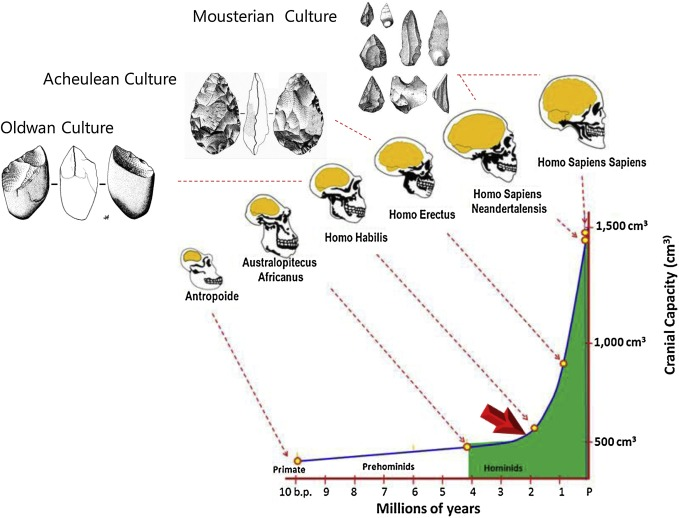
Figure 1: Figure showing transition of cranial capacity in cm3 along the evolutionary process of various ancestral pre-hominids and hominids as a function of time which is given in millions of years. The graph shows illustrations of skulls and brains, depicting the increase in size and complexity as time increases. The image further depicts the acceleration of brain expansion when Homo Habilis started manufacturing and using stone tools. (Bretas, et.al, 2019)
However this gives rise to the question; since evolution impacted the physical brain, did it also impact the mind, and more specifically mental health as well? In order to understand how evolution impacts mental illness and our susceptibility to it we must look at genetics first. Studies have shown that disorders such as autism, schizophrenia, bipolar disorder and depression are caused due to variations in certain genes. For instance, if variation is found in genes that code for the cellular machinery that helps regulate the flow of calcium into neurons then it affects the brain’s circuitry involved in emotion, thinking, attention and memory leading to several disorders. (Lancet, 2013)
Since it’s been established that mental health can be linked to genetic variation, one could take a look at evolution and see how processes such as natural selection affect the mental health illness we see so prominently in our society today. Natural selection, a popular theory proposed by Charles Darwin and Alfred Russel Wallace, is the basis of evolution. Natural selection suggests that organisms that are more adapted to their environment are more likely to survive and pass on the genes that aid their success. (Osterloff, 2019). However it is a misconception that natural selection leads to perfectly designed traits. In fact, natural selection responds to trade-offs to find the best compromise for the propagation of genetic material. This ideology backs up many theories that identify why mental illness, or at least disorders caused by genetics, were not eradicated.
One theory is known as antagonistic pleiotropy, where an allele increases the fitness payoffs of one trait but reduces the fitness payoffs of another trait. For example, an allele might increase fertility but decrease longevity (Mitterldorf, 2019). Researchers hypothesized that susceptibility alleles, which are genetic variants of genes involved in the predisposition to a complex disease (Collins, 2020) underlying bipolar disorder and schizophrenia have two effects: one, to increase creativity, but the second, to increase the risk for the mental disorder. These susceptibility alleles are thought to persist because their negative fitness effects from mental disorder risk are precisely offset by their benefits from creativity
The last theory that is often discussed by researchers is negative frequency-dependent selection. This theory states that alleles’ fitness increases as they become rarer. Imagine for instance if males outnumber females, then a mutation increasing the probability of having daughters would be positively selected, and would spread in the population until females began to outnumber males, in which case selection would begin to favor having sons. This theory can be applied to a few mental disorders such as psychopathy. Proposed by Mealey in 1995 the idea suggests that psychopathy when found at low base rates in society brings high fitness as psychopathic traits take advantage of others in society, using deceit and manipulation to benefit themselves. However if psychopathy were common in society people would start to recognize their traits more easily, because of increased anti-cheater vigilance in the population making the genetic variation less rewarding at higher frequencies. (Keller, et.al, 2006)
While there are several theories as to why evolution supported the passing down of mental illness it is important that we continue to study the relationship between evolution and mental health as it gives up a new perspective, one that can generate hypotheses and guide research, eventually leading to better treatment strategies, and shed light on the etiology of mental illness.
Citations:
Bretas, Rafael Vieira, Yumiko Yamazaki, and Atsushi Iriki. 2019. “Phase Transitions of Brain Evolution That Produced Human Language and Beyond.” Neuroscience Research 161 (10.1016/j.neures.2019.11.010). https://doi.org/10.1016/j.neures.2019.11.010.
Durisko, Zachary, Benoit H. Mulsant, Kwame McKenzie, and Paul W. Andrews. 2016. “Using Evolutionary Theory to Guide Mental Health Research.” The Canadian Journal of Psychiatry 61 (3): 159–65. https://doi.org/10.1177/0706743716632517.
Keller, Matthew, and Geoffrey Miller. 2006. “Login to Access Library E-Resources.” BEHAVIORAL and BRAIN SCIENCES. 2006. https://journals-scholarsportal-info.libaccess.lib.mcmaster.ca/pdf/0140525x/v29i0004/385_rtpochwegmwb.xml_en.
Mitteldorf, J. 2019. “What Is Antagonistic Pleiotropy?” Biochemistry (Moscow) 84 (12-13): 1458–68. https://doi.org/10.1134/s0006297919120058.
National Institutes of Health. 2013. “Common Genetic Factors Found in 5 Mental Disorders.” National Institutes of Health. March 18, 2013. https://www.nih.gov/news-events/nih-research-matters/common-genetic-factors-found-5-mental-disorders.
Osterloff, Emily. 2019. “What Is Natural Selection?” Natural History Museum. 2019. https://www.nhm.ac.uk/discover/what-is-natural-selection.html.
Singh, R.S., and R.J. Kulathinal. 2013. “Heterozygote Advantage – an Overview | ScienceDirect Topics.” Sciencedirect.com. 2013. https://www.sciencedirect.com/topics/medicine-and-dentistry/heterozygote-advantage.
Verendeev, Andrey, and Chet C Sherwood. 2017. “Human Brain Evolution.” Current Opinion in Behavioral Sciences 16 (10.1016/j.cobeha.2017.02.003): 41–45. https://doi.org/10.1016/j.cobeha.2017.02.003.


Leave a Reply
You must be logged in to post a comment.