When you picture a surgeon, you probably don’t imagine one that’s barely a centimetre long, with six legs and a pair of antennae and yet in 2024 researchers found that Florida carpenter ants amputate the infected legs of their nestmates to save their lives. This makes them the first non-human animals to use amputation to treat a wound. The team, led by Erik Frank, injured ant’s legs in the lab and infected some wounds with bacteria. As observed, nestmates first licked the wound clean. What came next depended on where the “patient” was injured (Frank et al. 2024).
Wounds high on the leg, at the femur were amputated in 75-80% of the cases. Nestmates bit the leg off at the hip joint, a process taking at least 40 minutes. Wounds lower down at the tibia were never amputated, only cleaned, as can be seen in Figure 1.
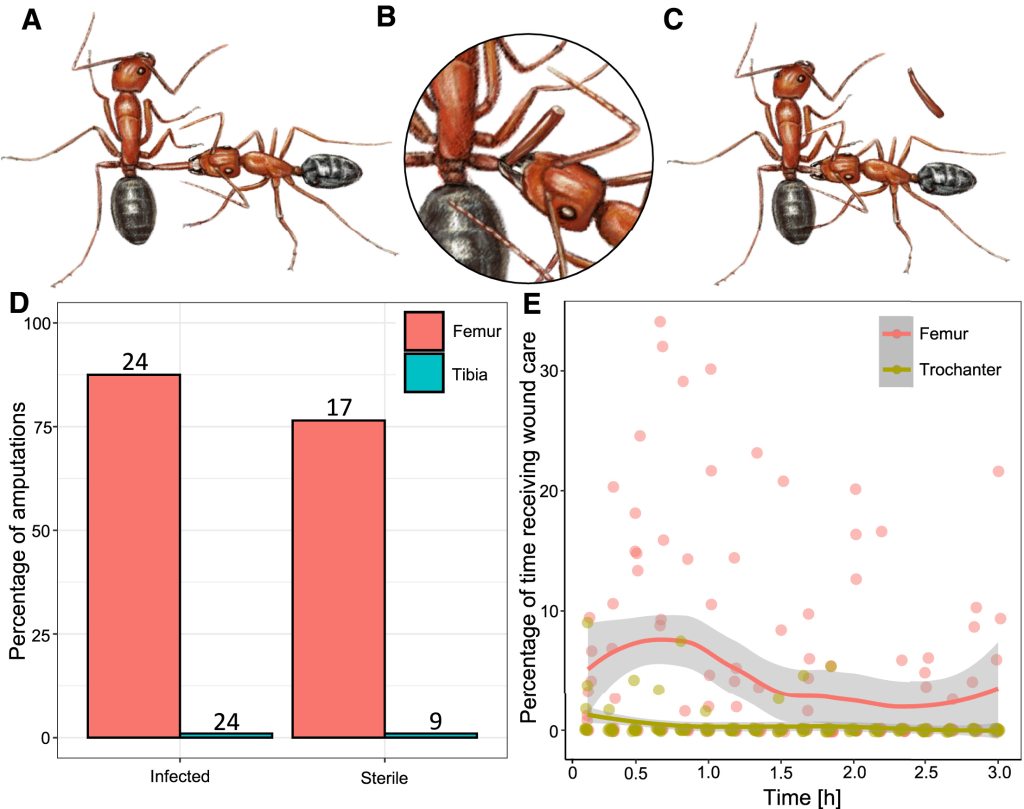
Figure 1. Florida carpenter ants decide whether to amputate based on where the leg is injured. (A–C) Illustration of an amputation. A nestmate cleans the injured leg (A), bites at the base of the leg where it joins the body (B), and severs it completely (C). (D) Percentage of injured ants that had their legs amputated by nestmates. Femur injuries were amputated in most cases, whether the wound was infected or sterile. Tibia injuries were never amputated. Numbers above the bars show how many ants were tested. (E) Percentage of time injured ants received wound care from nestmates during the 3 hours after injury. Ants with femur injuries (pink) received more care than ants whose leg had already been amputated (yellow, trochanter wound). Lines show the overall trend, and grey shading shows the confidence interval (Frank et al. 2024)
The reason behind this difference is that the femur is packed with muscle that helps pump hemolymph (insect blood). This means that injuries at the femur move bacteria into the body more slowly, giving nestmates time to amputate before the infection spreads (Bruns et al. 2025). A tibia wound results in a faster spreading infection, one that a 40-minute surgery can’t beat, so cleaning is the better option (Frank et al. 2024)
Carpenter ants aren’t the only medics; further research revealed that African Matabele ants raid termite mounds and because of this termite soldier often bite their legs off. Injured ants call for help with a chemical signal and nestmates carry them home (Nowbahari et al. 2009). Inside the nest, the nestmates lick the wound. Without this care, 80% of injured ants died within a day; however out of the ants who did receive care only 10% died. (Frank et al. 2017). Matabele ants go one step further: they apply antibiotics. They secrete antimicrobial compounds from a gland on their thorax onto infected wounds, cutting deaths by about 90% (Frank et al. 2023).
Natural selection has built a remarkably precise triage system: clean some wounds, amputate others and, in the case of Matabele ants, apply antibiotics. That system could matter for us too. The bacterium behind deadly ant wound infections, Pseudomonas aeruginosa, is also a major cause of hospital infections in humans, and many strains now resist antibiotics (Qin et al. 2022). The compounds ants use against it could be a starting point for new drugs.
Ant medicine has only been studied closely in a handful of species, so there is likely much more to discover. The next time you see an ant missing a leg, it might not be a casualty. It might be a survivor.
References:
Bruns, C., Bekas, V., Labisch, S., & Dirks, J.-H. (2025, July 15). Cuticular microstructure of the locust femur-tibia joint. Biology open. https://pmc.ncbi.nlm.nih.gov/articles/PMC12352281/
Frank, E., Buffat, D., Liberti, J., Aibekova, L., Economo, E., & Keller, L. (2024, July 2). Wound-dependent leg amputations to combat infections in an ant society. ScienceDirect. https://www.sciencedirect.com/science/article/pii/S0960982224008054
Frank, E., Schmitt, T., Hovestadt, T., Mittesser, O., & Linernmair, K. (2017, April 12). Saving the injured: Rescue behavior in the termite-hunting ant megaponera analis | science advances. ScienceAdvances. https://www.science.org/doi/10.1126/sciadv.1602187
Frank, E., Wehrhahn, M., & Linsenmair, K. E. (2018). Wound treatment and selective help in a termite-hunting ant | proceedings B | the royal society. The Royal Society Publishing. https://royalsocietypublishing.org/rspb/article/285/1872/20172457/84651/Wound-treatment-and-selective-help-in-a-termite
Frank, Erik. T., Kesner, L., Liberti, J., Helleu, Q., LeBoeuf, A. C., Dascalu, A., Sponsler, D. B., Azuma, F., Economo, E. P., Waridel, P., Engel, P., Schmitt, T., & Keller, L. (2023, December 29). Targeted treatment of injured nestmates with antimicrobial compounds in an ant society. Nature News. https://www.nature.com/articles/s41467-023-43885-w
Nowbahari, E., Scohier, A., Durand, J.-L., & Hollis, K. L. (2009, August 12). Ants, Cataglyphis Cursor, use precisely directed rescue behavior to free entrapped relatives. PLOS ONE. https://journals.plos.org/plosone/article?id=10.1371%2Fjournal.pone.0006573
Qin, S., Xiao, W., Zhou, C., Pu, Q., Deng, X., Lan, L., Liang, H., Song, X., & Wu, M. (2022, June 25). Pseudomonas aeruginosa: Pathogenesis, virulence factors, antibiotic resistance, interaction with host, technology advances and emerging therapeutics. Nature News. https://www.nature.com/articles/s41392-022-01056-1
Comments
34 Responses to “Paging Dr. Ant, It’s an Emergency ”
Hi! I enjoyed reading you blog post, it was very insightful!
Here are some small fixes to consider when editing your post:
– It looks like you accidentally pasted your blog twice, delete the second copy.
– I believe that in Chicago 18, the references should be titled “Bibliography” rather than just citations
– Don’t forget to write a comment linking your post to content covered in iSci!
– P1S3, consider rewording this sentence to something like “Evolution has increased the size and complexity of the human brain, undoubtedly changing its physiology, and allowing us to store and process more information,” I feel that this helps with the wordiness
– In-text citations are typically in your sentence, so the period should be placed *after* them
Happy editing!
Hafsah S
Hi Tvara, after looking into it more, the citations should actually be titled “References” and maybe consider bolding the font to make it stand out.
Thank you so much for you feedback
Hi Tvara!
This was an interesting post, and I thought you did a really good job! The figure was really well chosen, and I liked how you explained the different theories. I thought it was especially cool how you talked about psychopathy and why certain traits of that may stay in a population.
One thing that I think could possibly fit a little better is the organization and flow between different topics. Maybe a more clear connection between some of the theories would make them easier to follow?
Overall this was a great post, and I really enjoyed it! Its an extremely cool topic.
Sydney
Thank you so much for you feedback
Hey Tvara,
I loved your connection between our evolution and mental health; it was a very interesting read and well connected to our Life Science and Psychology lectures so far! You may want to add a brief comment in the comment section on how you personally connected your blog post to material learnt in class so everyone is able to know your connection off the bat. Also, I feel that you may need to cut down the word count, as it is very much over the limit of 550. I also believe you accidentally copy-pasted the blog twice, which is an easy fix. Also, for your figures, you can add a section to make the text smaller, bolder, and in italics; also leave a space between the text and the rest of the paragraph so the figure subtitle is easily decipherable from the main body of text. Not only that, but your citations should go before the period that ends a sentence. One such example is in Paragraph 1, in the last sentence “…helping us store and process more information. (Verendeev et al. al, 2017).”, I believe it would be most correct if formatted like “…helping us store and process more information (Verendeev et al. al, 2017).” instead, which can be applied to how you do your citations throughout! I also think it would be better if you explicitly stated the connection between certain theories and how they may affect mental health in the population. One of such examples, is when you are discussing negative frequency-dependent selection; you say that an allele’s fitness increases as it becomes rarer, inducing more or less of a certain sex when frequency is down. Then you immediately segue into talking about psychopathy, rather than why it is related to this theory. It leaves the reader guessing on what the exact correlation between the two points is, currently I am assuming it means that males are statistically more likely to be psychopaths hence the increased number of male alleles, but I am not sure. Other than that, happy editing!
-Aanya
Thank you so much for you feedback
Hi Tvara,
What an interesting post! I enjoyed reading about the possible connection of evolution and mental health disorders, as well as the potential explanation with genetic variation and expression. I just have a few comments for you:
– It seems you accidentally added your text twice. You should delete the copy.
– For your references, you should introduce them with a Header and there is no need for a colon
– You might want to review some of your references as they don’t all seem to be cited correctly as per the Chicago 18th edition author-date style. Specifically, your first citation has the DOI repeated twice. In addition, your third citation has a DOI available, and papers with DOIs should be cited using them.
– Make sure you reference your figure in your text. I see you have that for one of the versions of your post, so just make sure you keep that in.
– For your figure caption there is no need to state “Figure showing…” as you already have “Figure 1:”. Right now, it sounds a bit redundant.
– Some of your in-text citations are after the period of your sentence; make sure they come before it.
– Right now, your last paragraph reads a bit too long. Perhaps you should consider breaking that sentence into two.
Good luck with your editing!
Best,
Carolinna
Thank you so much for you feedback
Hi Tvara,
Wonderful job with your blog post. I love to see blog posts highlighting mental health, as this is a rising scientific field of study! I have a few suggestions:
P1S1: Add a comma between “whale” and “every” to help with readability!
P1S2: This sentence is slightly unclear. Evolution does shape our reality in that traits we have now are a result of evolution, but it doesn’t actively allow us to adapt since the timescales of evolution are so large. I would change the wording of this phrase to reflect this.
Figure 1: I would mention figure 1 in the text before inserting it so readers know why this figure is appearing. Also, remember to italicize your figure caption to differentiate it from the rest of the text!
P2S1: You don’t need to add as well onto the end of this sentence – removing it may improve flow.
P2S3: Add a comma between “to it” and “we must” to separate the parts of the sentence.
P3S5: This sentence is a bit confusing — at first glance, I took it to mean that higher IQ and increased creativity were risk factors for schizophrenia. You make want to reorder this sentence to increase clarity.
References: You don’t need a comma between author and date for your in-text citations. Also, I would rename the “citations” section to “References”, and make the font bigger to separate this section from the text.
Note: Not sure if this is just an error on my end, but to me it looks like you copied your draft into synopsis twice in this post . If this is a glitch with my computer, disregard.
Once again, great post! You did a great job covering this topic comprehensively, and I look forward to reading the final draft 🙂
– Clara
Thank you so much for you feedback
Hi Tvara,
I liked how you connected evolutionary mechanisms to why susceptibility to mental illness may persist. I have a few suggestions for edits:
– I would reframe the sentence saying disorders like schizophrenia, bipolar disorder, and depression are caused by variations in certain genes, since these disorders can be influenced by many genetic and environmental factors
– The examples of heterozygote advantage and antagonistic pleiotropy are interesting, but you could make the transition from sickle cell anemia to mental health a little clearer so the connection feels less abrupt
– Maybe add commas after However’s and change “mental health illness” to “mental illness”
Overall, really interesting topic. Good luck on your final draft!
Veer
Thank you so much for you feedback
Hi Tvara,
Great post! The psychopathy example was my favourite part since it shows how a trait can be beneficial only when it’s rare.
Two things I noticed:
A couple of your in-text citations don’t match your reference list. “(Lancet, 2013)” lines up with the NIH source, and Mealey 1995 is mentioned in the text but isn’t listed at the end.
Your heterozygote advantage paragraph with the sickle cell example only appears in the first copy of the post, so make sure you keep that version when you delete the duplicate.
Good luck with the final draft!
Gurdit
Thank you so much for you feedback
Hi Tvara
Great job on your first blog post! I found your selected topic fascinating and you inspired me to explore the connections between mental health and evolution further!
Just a few suggestions for improvement:
– P1S1: A comma after “blue whale” would improve the flow of the sentence.
– P1S4: This sentence is a bit confusing as
– P1: Your figure should be referenced in your text!
– Figure 1: Your figure caption should be a smaller font and also italicized. Additionally, species names like Homo habilis should be italicized.
P2S1: Use a colon (:) after “…question,” instead of a semi-colon.
P2S3: The phrase “studies have shown” is unprofessional in scientific writing; if you are referencing studies you must use specific data and cite them.
P2S3-S4: You mention variation in “certain genes” and go on to describe a possible purpose, however, you do not mention specific genes. I would expand on what gene variation is actually responsible for affecting the brain as you mention.
P5S1: Consider breaking this sentence up as follows: “One theory is the heterozygote advantage. This is where the heterozygote at a locus with two alleles has a higher fitness than the two homozygotes.”
Overall, you did an awesome job writing your first blog post! I look forward to seeing what you write in the future! Happy editing!
– Natalie 🙂
Thank you so much for you feedback
Hi Tvara,
Great post, and clearly very thorough research. I thought you used analogies well, especially the sickle cell and sex-ratio examples, which gave readers something familiar to anchor the evolutionary ideas before applying them to mental illness.
Some comments/suggestions:
– A few statements overstate the role of genetics. For example, “caused due to variations in certain genes” implies single-gene causation, when these disorders are polygenic and also shaped by environment. It may also be worth double-checking the “higher IQ” claim, since schizophrenia genetic risk is generally linked to lower cognitive performance.
– The schizophrenia “benefits” described under heterozygote advantage are closer to pleiotropy, so the first two theories blur together. The schizophrenia example doesn’t show that carrying one copy of a risk allele is better than carrying none or two, which is what defines heterozygote advantage, so it reads more like pleiotropy.
– The intro is a bit generic and frames evolution as goal-directed (“allowing humans to… thrive”). Opening with the core question sooner would strengthen it.
Once again, solid post.
Best of luck with the edits,
Luca
Thank you so much for you feedback
Hi Tvara,
I found the topic you chose to be very interesting!
I only have a couple suggestions for you.
-In the last sentence of paragraph 8 you mention “anti-cheater vigilance.” Since this is not previously explained it might be nice to give a brief definition of what this means.
-Additionally, I would suggest making your citations a header so it is more easily distinguished from the rest of the post and calling it references instead of citations
-Lastly, it might be helpful to hyperlink your sources, if possible, so that anybody wanting to read more into papers you have referenced would have an easier time doing so.
Overall this blog was very well thought out and a great read!
Sydney
Thank you so much for you feedback
Hello Tvara,
This was a very interesting post to read! I found it very interesting how you were able to combine various evolutionary processes with mental health conditions. I just have a few suggestions for your final draft.
1. Make sure to add a comment explaining what inspired you to make this post and which course content you are basing this post on.
2. Within your first sentence, I believe you should include a comma between “whale” and “every”, as they are two different clauses. There are also a few other run-on sentences within your work, so I would make sure to double-check that you add commas and semicolons where necessary.
3. It would be interesting if, within your conclusion, you give an example of how studying the evolutionary origins of mental illness has helped to progress our understanding of them further.
Happy editing,
Griffin Suk 🙂
Thank you so much for you feedback
Hi Tvara,
You have a great hook. I really enjoy reading you blog post. Your blog post is thought provoking and it has made me begin to wonder the origin of mental health issues. I have learnt that evolution explains why mental health issues persist. From another perspective, if evolution favors reproductive success, why should the human, shaped by evolution, be psychologically well at all? Can humans become a reproductive machine like in the Handmaid’s tale?
Another small a small suggestions:
In paragraph two, you mentioned “Studies have shown that disorders… are caused due to variation in certain genes.”. This is misleading, as it seems like you are suggesting a singular gene is responsible for the entire disorder. According to my background knowledge, this is extremely rare. Most psychological disorders arise from the interaction between multiple intertwining genes. I think it would be better to rephrase this sentence.
Best Regards,
Edgar
Thank you so much for you feedback
Hi Tvara,
Amazing work! I really loved how you integrated/utilized evolutionary concepts to explain why certain mental illnesses may occur. I have a few minor suggestions:
1. Format your figure caption as an actual caption. This can be done by clicking on the figure and pressing “insert figure caption.”
2. Your blog post is quite lengthy (>700 words), I would recommend removing some of the examples that you utilize to explain the evolutionary concepts. For instance, the malaria example of heterozygote advantage takes quite a lot of words to explain when you could just say that “A heterozygote, an organism that has two different alleles for a given gene, is more fit than its homozygous comparators.”
3. In Chicago 18th in-text citations, there is no comma between the date and authors e.g. (Author date). Please remove the commas between these two articles in your in-text-citations.
Overall great job!
– Vani
Thank you so much for you feedback!
Hey Tvara,
This blog post looks was really interesting. I do have a few notes however.
It does not appear that you mentioned your figure in text, so you should make sure to reference it at some point.
In many of your paragraphs you appear to only have a single citation at the end. If the entire paragraph is referring to that citation I would suggest putting it at the end of the first sentence instead. Additionally, a number of your citations are outside of sentences, when they should be between the final word and the period.
Finally, you appear to have copied your blog post a second time after your citations, so that should probably be deleted.
Overall this was a really well written blog post.
Sincerely,
Zachary
Thank you so much for you feedback!
Hi iSCi,
When I came across the 2024 study on Florida carpenter ants, I was surprised that an animal other than humans could amputate a limb to save a life, and that the ants could tell which injuries needed it. As I read more, I found a whole small field of research on how ants treat their injured, from rescue to wound cleaning to antibiotics. What interested me most was how evolution produced something so similar to human medicine, and how studying it could help with real problems like antibiotic resistance. I hope this post makes you look at the ants on the sidewalk a little differently!
-Tvara
Hi Tvara,
This was a really interesting blog post!! Thanks for writing about it, I definitely learned a lot about carpenter ants and I would’ve never known otherwise! Here are a couple small suggestions:
– When you use “et. al”, the period should be after the al, not the et. It’ll look like this when corrected: “et al.”
– When you said “Carpenter ants aren’t the only medics, further research” this is a comma splice, so I would suggest splitting up this idea with a period/semicolon or rewording the sentence.
Overall, this was a great article! Happy editing 🙂
Sincerely,
Emma
Thank you so much for you feedback!
Hi Tvara,
Great topic! I love how you connected so many relevant topics from multiple science fields like antimicrobials and natural selection.
Some feedback:
– Your whole blog post challenges human bias and perspective, as we typically think of ourselves as the only species on earth who can perform complex surgeries and amputations. I do think that leaning into that challenging human bias lens would be an insightful addition.
– The first sentence is a bit long, you could put a period before “(and) yet…” to avoid a run-on sentence.
– In addition, the first mention of the researchers discovering your phenomenon in 2024 in paragraph should probably be cited.
– In paragraph 4 sentence 1 “Carpenter ants aren’t the only medics;”, it could be beneficial to add “ant” before medic to make the sentence clearer.
– In your references, your link should either be a DOI link (accessed via the PDF file on whatever website you’re using), another type of permanent link, or no link at all in accordance with what Alex and Sarah have said.
Your blog post is shaping up very well and I’m excited to see what the final draft is like!
Nima
Hi,
Quite an intriguing topic you’ve written about, Tvara. I always knew ants, although tiny, were mighty creatures. So, I’m happy that your blog post has introduced me to another fascinating mechanism of theirs. A few details I noticed, however, when reading:
“When you picture a surgeon, you probably don’t imagine one that’s barely a centimetre long, with six legs and a pair of antennae and yet in 2024 researchers found that Florida carpenter ants amputate the infected legs of their nestmates to save their lives. This makes them the first non-human animals to use amputation to treat a wound.”
“When you picture a surgeon, you probably don’t imagine one that’s barely a centimetre long, with six legs and a pair of antennae.”
The introduction is stellar and catches my eye, but once you get to:
“And yet in 2024 researchers found that Florida carpenter ants amputate the infected legs of their nestmates to save their lives.”
It starts feeling like a run-on sentence and feels very uncohesive. I’d suggest breaking this sentence up into two individual sentences, with a period, to help with fluidity.
Furthermore, in this sentence, “They secrete antimicrobial compounds from a gland on their thorax onto infected wounds, cutting deaths by about 90%,” the percentage seems very out of place and requires context. A sentence or two comparing the survival rates of treated ants with those that did not receive treatment and/or how the researchers got this number could be really helpful.
Overall, though, a very interesting blog post with great ideas! It just needs a few edits here and there, and you’re set.
Happy editing, Tvara.
Minglong