Would you drink cockroach milk if scientists called it a superfood? Imagine walking into a supermarket and seeing it beside regular milk. Although it may sound a bit absurd, one species of cockroach produces exactly that: Cockroach milk! This embryonic milk has drawn the attention of experts due to its strange nutritional structure. Rather than laying eggs, the Pacific beetle cockroach known as the Diploptera punctata, gives birth to live young. The young then develop in a brood sac that functions similarly to a uterus and placenta, where the mother produces a nourishing liquid during pregnancy (Jennings et al. 2020).
The growing embryos drink this liquid which then subsequently generates microscopic crystals in their midguts. These crystals store a number of important nutrients together because they are composed of proteins, carbs and lipids (Banerjee et al. 2016). Fatty acids are bound by the folded structure of the proteins, and linked carbohydrates and other nutrients aid in the formation of a dense packed crystal. As the crystals are digested they provide the embryos with a steady supply of nutrients. Researchers estimated that one crystal has more than three times the energy in an equivalent mass of dairy milk, according to estimates (Banerjee et al. 2016).
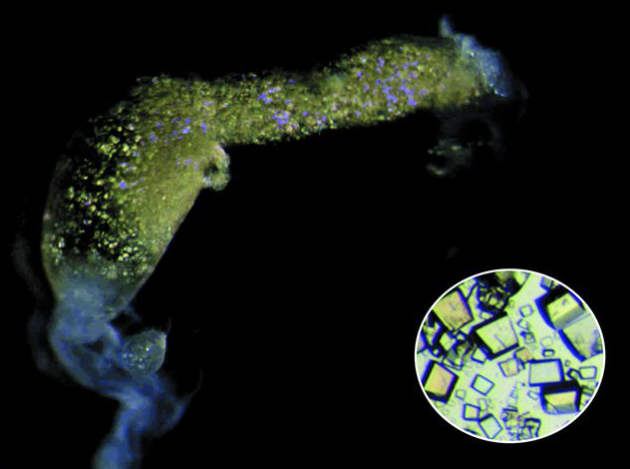
This high energy “cockroach milk” has led some researchers and news sources to call it a possible “superfood” (Niaz, Zaplatic, and Spoor 2018). More generally, because many insect species require less space, water, and food than traditional cattle, they are being studied as potential food sources (van Huis et al. 2013). This presents an interesting possibility, instead of collecting crystals from individual cockroaches, researchers may someday examine their structure to use biotechnology to create similar nutrient storage systems.
However, something is not a useful food just because of its energy density. Cockroach milk has not yet been proven safe for human consumption by researchers, and it would be challenging to gather enough crystals directly from cockroaches. Concerns including allergies, contamination, regulation, large scale production and the acceptance from consumers may arise from insect-based foods (Kłobukowski, Śmiechowska, and Skotnicka 2025). Additionally, the environmental advantages found for commonly farmed insects also cannot automatically be applied to cockroach milk.
Even while cockroach milk won’t be found in supermarkets anytime soon, its structure may still be valuable to future food research. Studying this unique nutritional system may lead to new methods of food production and effective distribution, as hunger and food shortages continue to be major global issues (van Huis et al. 2013). Cockroach milk itself may not feed the futures,but the underlying technology behind it might.
References
Banerjee, Sanchari, Nathan P. Coussens, François-Xavier Gallat, Nitish Sathyanarayanan, Jandhyam Srikanth, Koichiro J. Yagi, James S. S. Gray, et al. 2016. “Structure of a Heterogeneous, Glycosylated, Lipid-Bound, In Vivo-Grown Protein Crystal at Atomic Resolution from the Viviparous Cockroach Diploptera punctata.” IUCrJ 3 (4): 282–293. https://doi.org/10.1107/S2052252516008903.
Jennings, Emily C., Matthew W. Korthauer, Jacob M. Hendershot, Samuel T. Bailey, Matthew T. Weirauch, José M. C. Ribeiro, and Joshua B. Benoit. 2020. “Molecular Mechanisms Underlying Milk Production and Viviparity in the Cockroach, Diploptera punctata.” Insect Biochemistry and Molecular Biology 120: 103333. https://doi.org/10.1016/j.ibmb.2020.103333.
Kłobukowski, Filip, Maria Śmiechowska, and Magdalena Skotnicka. 2025. “Edible Insects from the Perspective of Sustainability: A Review of the Hazards and Benefits.” Foods 14 (8): 1382. https://doi.org/10.3390/foods14081382.
Niaz, Kamal, Elizabeta Zaplatic, and Jonathan Spoor. 2018. “Highlight Report: Diploptera functata (Cockroach) Milk as Next Superfood.” EXCLI Journal 17: 721–723. https://doi.org/10.17179/excli2018-1437.
van Huis, Arnold, Joost Van Itterbeeck, Harmke Klunder, Esther Mertens, Afton Halloran, Giulia Muir, and Paul Vantomme. 2013. Edible Insects: Future Prospects for Food and Feed Security. FAO Forestry Paper 171. Rome: Food and Agriculture Organization of the United Nations. https://www.fao.org/4/i3253e/i3253e.pdf.


Leave a Reply
You must be logged in to post a comment.