Canada is the biggest global producer of Icewine, surpassing traditional producers such as Germany and Austria, with the Niagara Region serving as the primary producer (Musabelliu 2012; Government of Ontario, 2026). However, as climate change drives warmer winter temperatures, more unpredictable and extreme climate conditions, the future of Canadian Icewine is becoming increasingly uncertain.
Icewine is a specific type of rare dessert wine which is known for its sweet taste and high acidity (Musabelliu 2012). Icewines can have this specific flavour profile due to the freeze-thaw cycle, dehydration process, and the methods in which they are picked (Ma et al. 2021). The first step in the production of Icewine is choosing a grape that can tolerate colder temperatures, called “cold-hardy grapes”. These grapes ripen late, can tolerate high amounts of dehydration, and can be harvested long after reaching maturity without a reduction in quality (Jing et al. 2018). During the winter months, the grapes undergo dehydration, as cold winds slowly remove water from the grapes. Once temperatures reach below – 8 ℃, the grapes go through the freeze thaw process. The water inside the grapes freezes into ice crystals, while the sugar, acid, and other flavour components stay liquid. This freezing is what causes the high sweetness and acidity associated with ice wine (Ma et al. 2021). The grapes must be harvested before the temperatures rise above – 8 ℃, as if they do, they will thaw and cause the fruit to spoil. Afterwards, the grapes need to be immediately pressed while the temperature remains under – 8 ℃, to keep the highly concentrated syrup (VQA, 1999; Ma et al. 2021). After pressing, the grapes are checked for their sugar level, yeast is added, and the ga[e juice is fermented, aged, clarified, and bottled, ready to be sold (Figure 1).
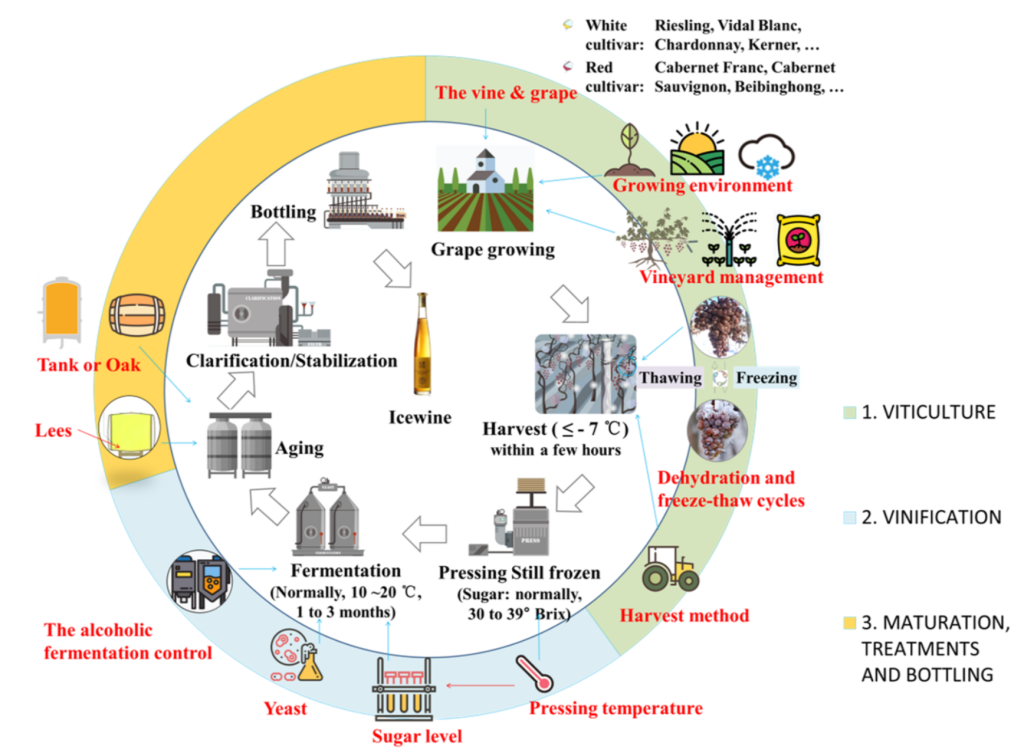
Figure 1: The process of making Icewine from Viticulture (green), Vinification (blue), and Maturation, Treatments and Bottling (yellow). Each step (red text) has a contextual explanation (black), showing the various methods through which Icewine is produced, as well as the requirements (Ma et al. 2021).
Because of the particularities of Icewine, especially the cold temperatures that are needed to ensure a proper harvest, climate change is increasingly becoming a more daunting threat. It has been shown that global warming, by increasing the temperature within the region, also leaves a smaller time window in which farmers can both extract and press the grapes (Figure 2) (Cyr and Shaw 2021). Additionally, it has been suggested that temperatures after the 1990s in the Niagara Region have become more volatile and less predictable, meaning that there is an increased risk every year that the Niagara Region may not be able to produce any Icewine during certain vintages (Cyr and Shaw 2021).
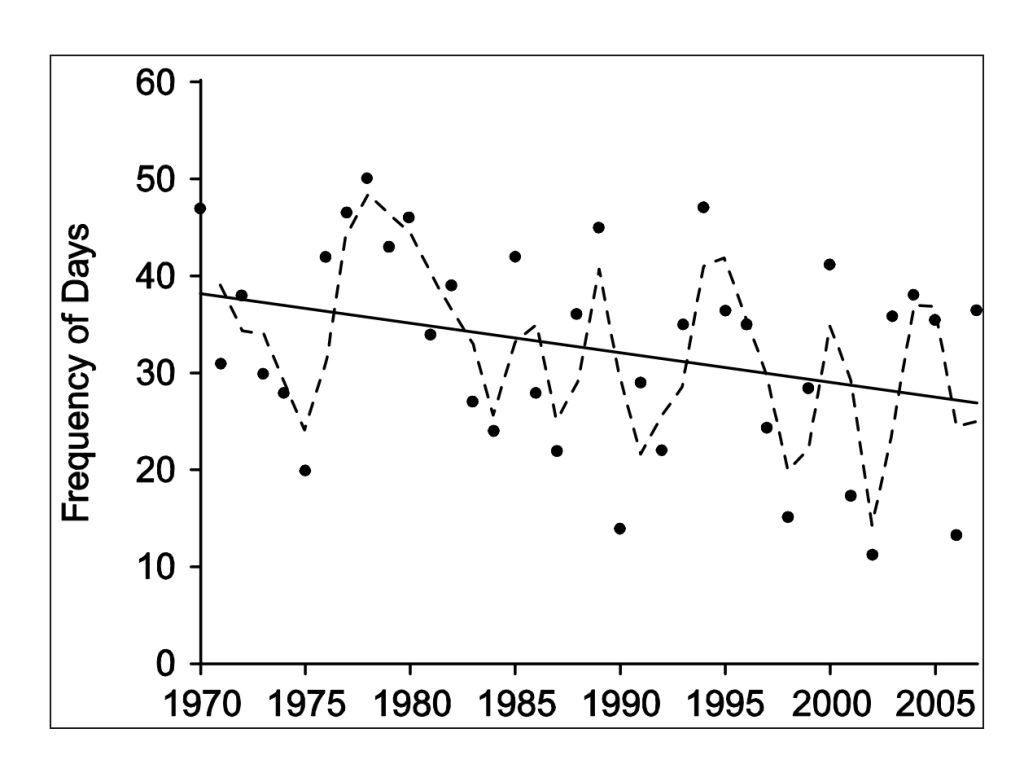
Figure 2: The frequency of days with below -8 ℃ between December and February in Niagara from 1970 to 2007 (Cyr and Shaw 2021).
Taken together, both the particularities associated with the production of Icewine, and the increase and unpredictability of temperatures in the Niagara Region point to a future where the production of Icewine is no longer possible or is too risky to do. For a product whose identity depends on the natural freeze that comes every year, this isn’t a problem that alterations in winemaking can solve. If climate change continues, Niagara’s position as one of the world’s greatest producers of icewine might be lost along with the cold winters that made it possible.
References
Cyr D., Shaw T.B.. “The impact of global warming on Ontario’s icewine industry.” IVES Conference Series Terroir 2010 (2010):
‘E-Laws | Ontario.Ca’. Accessed 20 October 2026. https://www.ontario.ca/laws/regulation/r17060?utm.
Icewine, Canada is the world’s largest producer of award-winning, and with the Niagara Peninsula as the primary production region Taste some of the world’s finest Icewine in Ontario. ‘Icewine Tastings and Events | Destination Ontario’. Website. Accessed 20 October 2026. https://www.destinationontario.com/en-ca/articles/guide-ontarios-icewine.
Jing, Wang, Li Min, Li Jixin, et al. ‘Biotechnology of Ice Wine Production’. In Advances in Biotechnology for Food Industry. Elsevier, 2018. https://doi.org/10.1016/B978-0-12-811443-8.00010-4.
Ma, Yue, Yan Xu, and Ke Tang. ‘Aroma of Icewine: A Review on How Environmental, Viticultural, and Oenological Factors Affect the Aroma of Icewine’. Journal of Agricultural and Food Chemistry 69, no. 25 (2021): 6943–57. https://doi.org/10.1021/acs.jafc.1c01958.
Musabelliu, Nikolin. ‘Ice Wine’. In Sweet, Reinforced and Fortified Wines, 1st edn, edited by Fabio Mencarelli and Pietro Tonutti. Wiley, 2013. https://doi.org/10.1002/9781118569184.ch20.

Leave a Reply
You must be logged in to post a comment.