Canada is the biggest global producer of Icewine, surpassing traditional producers such as Germany and Austria, with the Niagara Region serving as the primary producer (Musabelliu 2012; Government of Ontario, 2026). However, as climate change drives warmer winter temperatures, more unpredictable and extreme climate conditions, the future of Canadian Icewine is becoming increasingly uncertain.
Icewine is a specific type of rare dessert wine which is known for its sweet taste and high acidity (Musabelliu 2012). Icewines can have this specific flavour profile due to the freeze-thaw cycle, dehydration process, and the methods in which they are picked (Ma et al. 2021). The first step in the production of Icewine is choosing a grape that can tolerate colder temperatures, called “cold-hardy grapes”. These grapes ripen late, can tolerate high amounts of dehydration, and can be harvested long after reaching maturity without a reduction in quality (Jing et al. 2018). During the winter months, the grapes undergo dehydration, as cold winds slowly remove water from the grapes. Once temperatures reach below – 8 ℃, the grapes go through the freeze thaw process. The water inside the grapes freezes into ice crystals, while the sugar, acid, and other flavour components stay liquid. This freezing is what causes the high sweetness and acidity associated with ice wine (Ma et al. 2021). The grapes must be harvested before the temperatures rise above – 8 ℃, as if they do, they will thaw and cause the fruit to spoil. Afterwards, the grapes need to be immediately pressed while the temperature remains under – 8 ℃, to keep the highly concentrated syrup (VQA, 1999; Ma et al. 2021). After pressing, the grapes are checked for their sugar level, yeast is added, and the ga[e juice is fermented, aged, clarified, and bottled, ready to be sold (Figure 1).
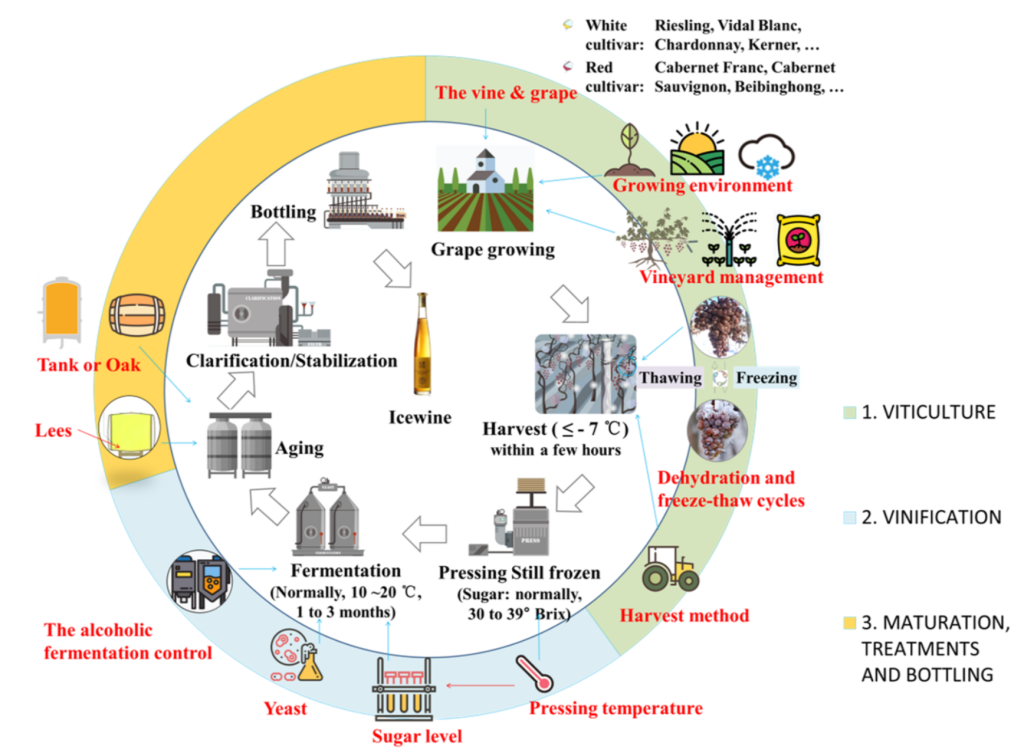
Figure 1: The process of making Icewine from Viticulture (green), Vinification (blue), and Maturation, Treatments and Bottling (yellow). Each step (red text) has a contextual explanation (black), showing the various methods through which Icewine is produced, as well as the requirements (Ma et al. 2021).
Because of the particularities of Icewine, especially the cold temperatures that are needed to ensure a proper harvest, climate change is increasingly becoming a more daunting threat. It has been shown that global warming, by increasing the temperature within the region, also leaves a smaller time window in which farmers can both extract and press the grapes (Figure 2) (Cyr and Shaw 2021). Additionally, it has been suggested that temperatures after the 1990s in the Niagara Region have become more volatile and less predictable, meaning that there is an increased risk every year that the Niagara Region may not be able to produce any Icewine during certain vintages (Cyr and Shaw 2021).
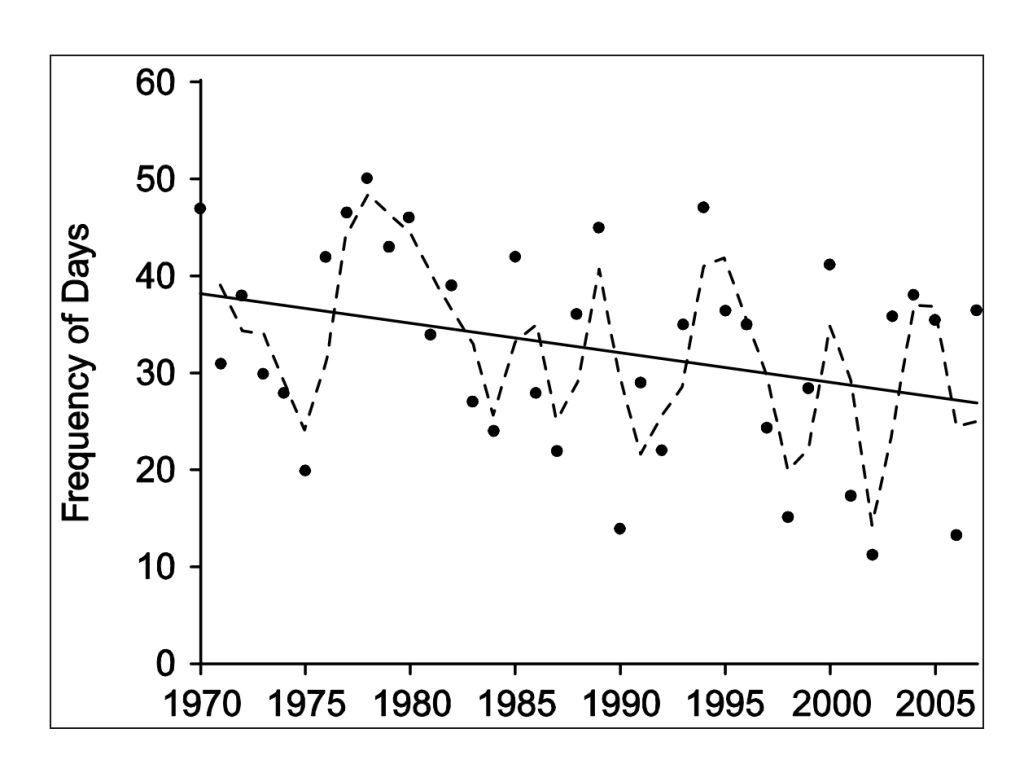
Figure 2: The frequency of days with below -8 ℃ between December and February in Niagara from 1970 to 2007 (Cyr and Shaw 2021).
Taken together, both the particularities associated with the production of Icewine, and the increase and unpredictability of temperatures in the Niagara Region point to a future where the production of Icewine is no longer possible or is too risky to do. For a product whose identity depends on the natural freeze that comes every year, this isn’t a problem that alterations in winemaking can solve. If climate change continues, Niagara’s position as one of the world’s greatest producers of icewine might be lost along with the cold winters that made it possible.
References
Cyr D., Shaw T.B.. “The impact of global warming on Ontario’s icewine industry.” IVES Conference Series Terroir 2010 (2010):
‘E-Laws | Ontario.Ca’. Accessed 20 October 2026. https://www.ontario.ca/laws/regulation/r17060?utm.
Icewine, Canada is the world’s largest producer of award-winning, and with the Niagara Peninsula as the primary production region Taste some of the world’s finest Icewine in Ontario. ‘Icewine Tastings and Events | Destination Ontario’. Website. Accessed 20 October 2026. https://www.destinationontario.com/en-ca/articles/guide-ontarios-icewine.
Jing, Wang, Li Min, Li Jixin, et al. ‘Biotechnology of Ice Wine Production’. In Advances in Biotechnology for Food Industry. Elsevier, 2018. https://doi.org/10.1016/B978-0-12-811443-8.00010-4.
Ma, Yue, Yan Xu, and Ke Tang. ‘Aroma of Icewine: A Review on How Environmental, Viticultural, and Oenological Factors Affect the Aroma of Icewine’. Journal of Agricultural and Food Chemistry 69, no. 25 (2021): 6943–57. https://doi.org/10.1021/acs.jafc.1c01958.
Musabelliu, Nikolin. ‘Ice Wine’. In Sweet, Reinforced and Fortified Wines, 1st edn, edited by Fabio Mencarelli and Pietro Tonutti. Wiley, 2013. https://doi.org/10.1002/9781118569184.ch20.
Comments
7 Responses to “Is Niagara Losing its Cool? Looking at the Precarious Future of Icewine”
Hello iSci,
Combining both what we are learning in Climate Change and Wine Science, I decided to look more into how climate change might affect Niagara’s world-renowned Icewine. Please let me know if you have any comments or suggestions. Hopefully you enjoy the read!
Griffin Suk
Hi Griffin,
This was a super cool and well-written blog post! Here are a few suggestions:
Last sentence in P2: I think you may have accidentally typed “ga[e” instead of “grape”!
-If word count permits, I think it would be really interesting to discuss if there are economic losses that have arisen from this issue, or any reforms or strategies (if there are any) that vineyards are taking up in their process to try and reduce the effect of climate change.
-It may be beneficial to some readers if you include a definition of the term dessert wine.
P2: “Afterwards, the grapes need to be immediately pressed while the temperature remains under – 8 ℃, to keep the highly concentrated syrup”. This sentence was slightly unclear for me. Why do they need to be pressed at that temperature to keep the highly concentrated syrup? Keep it from spoiling?
-Not a suggestion, but you did a really good job at keeping your writing very concise and simple when explaining the complex process of how ice wine is produced! It made it very easy to read and follow as a reader.
Overall, fantastic job, and I cannot wait to read your final copy!
Happy editing,
Via
Hello Via,
Thank you very much for your comment! I have implemented all suggestions.
Take care,
Griffin Suk 🙂
Hi Griffin,
I really enjoyed reading through your blog post, everything was very clear and understandable. However, while reading through your blog post I’ve noticed some suggestions you could make to improve it further.
– There is a type in the sentence where you mention your figure one. You wrote “ga[e juice”, but I’m pretty you meant to write “grape juice”
– Some of your intext citations don’t match your citation in your reference list. For example you wrote (Musabelliu 2012), but in your reference you said it was from 2013.
– I think you should also write a short hook sentence so you can engage the readers better
Overall I really enjoyed reading through your post, it was very clear and easy to understand. Looking forward to reading your final draft,
Troy Lin
Hello Troy,
Thank you for your comment! I have implemented your suggestions.
Take care,
Griffin Suk
Hi Griffin, I found your post interesting! Here’s some feedback on how I think you could improve it:
P1S2: to make it a little clearer, you could say “temperatures, increasing unpredictable and extreme climate conditions…”
P2S11: I believe ‘ga[e’ in: “and the ga[e juice…” is a typo
P3S1: I believe slightly switching the wording here from “is increasingly becoming a more daunting threat” to “is becoming an increasingly daunting threat” improves the word flow
P4S1: I would suggest switching the wording from “or is too risky to do” to “or becomes too risky” to improve word flow
Hello Hafsah,
Thank you for your comment! I have implemented all of your suggestions except the first one. This is because if I change P1S2, it makes it seem as if the increase in winter temperatures is the cause of unpredictable and extreme climate conditions, when it is not.
Thank you for your comment! It helped me a lot during the editing process.
Take care,
Griffin Suk