Are women worse at math than men? On average, why do less women go into STEM degrees, particularly those heavily focused on math?
Historically, women were prohibited from getting a higher education, even as little as a high school degree. Although much has progressed in order to give women the same rights to pursue a higher education, there continues to be a gap in the amount of women who choose STEM pathways (Government of Canada 2021).
In order to determine the deeper context as to why women pursue less math-related degrees, we have to discuss the biological differences between men and women. A plethora of research has been conducted to discover what makes men’s and women’s brains different. There are some structural morphologies that do have a considerable difference between men and women (Xin et al. 2019). However, the functions of these different parts of the brain vary: differences in sensory processes, emotional regulation, and motor abilities (Ingalhalikar et al. 2014). Despite these differences, there has been very little linkage between brain structure and difference in learning when comparing women and men as a whole.
If not for physical differences, then the social conditioning of women from a young age needs to be considered instead. In 1980, a study was conducted to ask young girls about their attitudes towards math courses. They found that not only did girls have personal negative feelings towards math from fear of social ostracization, but also 42% of girls who were interested in math related careers were discouraged from taking higher level math courses by counselors (Beckwith & Durkin 1981). Although this study is considered far from present day, the precedent of girls being discouraged from pursuing careers in pure math or heavy math related sciences still exists. Surveys from 2003-2011 showed that stereotypes such as a greater nurturing ability for women and men being more analytical were upheld in 53 countries (Charles et al. 2014). Figure 1 shows how negative perceptions of STEM courses, specifically among girls, correlates to less enrollment for more math-related postsecondary studies.
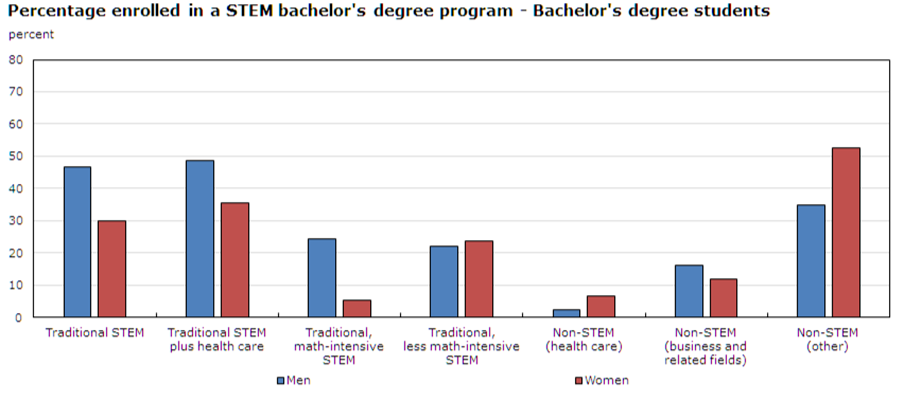
Figure 1 – Statistics Canada 2021 data on percentage of enrollment in a STEM bachelor’s program for British Columbia students for men and women. STEM stands for science, technology, engineering, and mathematics which is what is included for the traditional STEM definition. The math-intensive STEM is defined as computer science, engineering, mathematics, physics, chemistry, and related fields. Comparing the traditional STEM program percentage enrollment of 29.76 % for women with men 46.78%, there is a clear gap. There is an even larger gap between the percent enrollment in math-intensive STEM programs of 5.41% and 24.19% respectively (Government of Canada 2021).
Furthermore, young girls often have more social pressure to reject a career path and follow a more “traditional” lifestyle as a mother. Thus for women, studying math is more defying and a rejection of traditional norms than it is for men (Charles et al. 2014).
The discriminatory ideation forced upon young girls not only impacts their life choices, but has a greater effect on how society treats women in the workplace. The pay wage gap between men and women is still an ongoing issue in Canada, as well as throughout the world. As of 2025, women still get paid 89 for every dollar men earn in Canada (Government of Canada 2026).
Careers in STEM have been integral to the advancements in technology and are subsequently paid on average more than their non-STEM counter parts (Government of Canada 2021). Due to STEM careers being traditionally dominated by men, this creates a clear discrepancy in the average income men earn compared to women.
By continuing to encourage women and girls to further their education in heavily math-focused STEM fields, there is hope that the wage gap can be diminished, and eventually cease to exist.
References
Beckwith, Jon and Durkin John. 1981. “Science and the Attack on Women:Girls, Boys and Math.” Science for the People. Vol 13 No. 5. Science for the People Magazine Vol. 13, No. 5.
Charles, Maria, Bridget Harr, Erin Cech, and Alexandra Hendley. 2014. “Who Likes Math Where? Gender Differences in Eighth-Graders’ Attitudes around the World.” International Studies in Sociology of Education 24 (1): 85–112. https://doi.org/10.1080/09620214.2014.895140.
Government of Canada, Statistics Canada. 2021. “Gender Differences in STEM Enrolment and Graduation: What Are the Roles of Academic Performance and Preparation?” November 24. https://www150.statcan.gc.ca/n1/pub/36-28-0001/2021011/article/00004-eng.htm.
Government of Canada, Statistics Canada. 2026. “Women’s History Month… By the Numbers.” September 10. https://www.statcan.gc.ca/en/daily/by-the-numbers/womens-history-month.
Ingalhalikar, Madhura, Alex Smith, Drew Parker, et al. 2014. “Sex Differences in the Structural Connectome of the Human Brain.” Proceedings of the National Academy of Sciences of the United States of America 111 (2): 823–28. https://doi.org/10.1073/pnas.1316909110.
Xin, Jiang, Yaoxue Zhang, Yan Tang, and Yuan Yang. 2019. “Brain Differences Between Men and Women: Evidence From Deep Learning.” Frontiers in Neuroscience 13 (March). https://doi.org/10.3389/fnins.2019.00185.
Comments
19 Responses to “Men are Smarter than Women! Oh Wait—That’s a Myth”
Hi iSci!
I decided to this post since we have been learning more neuroscience and I wanted to look at the social aspects of why less women choose math or math-focused degrees!
-Brooklyn
Hi Brooklyn!
This was a super interesting blog post to read!! The point about young girls historically being actively steered away from higher-level math by counsellors was eye-opening. You did a great job shedding light on this topic!
– Sanay 🙂
Hi Sanay!
I am glad you enjoyed my blog, I’ll keep an eye out for yours!
-Brooklyn
Hello Brooklyn!
Amazing blog post, it was genuinely eye opening to read! Although it was a little hard to read (the statistics were disheartening), it was nonetheless such an important topic. A statistic that really shocked me was that the “Traditional STEM plus healthcare” is still dominated by men. I had always been taught the rhetoric that biology and healthcare were more ‘feminine sciences’, and this bias influenced my own perception of the gender split; however, it was crazy to learn that despite this common stereotype men are still over-represented.
Once again, amazing blog post! This is a topic that was really important to write about!
Best,
Farwa 🙂
Hi Farwa!
Thank you, I am so glad you liked it! It was very surprising for me to read as well since I have been told those same stereotypes before!
-Brooklyn
Hi Brooklyn!
This is a really interesting and informative blog post! A couple suggestions to keep in mind while editing:
– P4S4: I think you may have a few typos. Did you mean to say ‘present’ day instead of ‘president’ day? And, the ‘precedent’ of girls being discouraged.
– P4S5: For clarity, you could adjust the sentence to say:
Various stereotypes, such as a ‘women are more nurturing’ and ‘men are more analytical’, reinforce the idea that men belong in math-related fields of study and women do not. Surveys from 2003-2011 showed that these stereotypes reinforcing such as a greater were upheld in 53 countries (Charles et al. 2014)
– In paragraph 3, you could mention specifically what morphological structures differ in women’s and men’s brains, if your word count allows it
Happy editing!
Maegan
Hi Maegan!
Thank you for the feedback! I will definitely correct my grammar and look at the sentence you described. I did look into the morphological structures, but since they are very specific I thought it was too complicated for this blog, but I will consider added some more detail on it!
-Brooklyn
Hi Brooklyn,
Great blog post! I thought this was a really interesting way to integrate what we’re learning in neuroscience into social science issues! A few suggestions:
– P4S4: for clarity, consider writing “…42% of girls…”
– P4S9-11: consider being more specific about the surveys that were conducted. How many surveys were there? What type of surveys?
– P4S9: to be more specific, consider writing “…gender stereotypes, such as….”
– In P4, Figure 1 doesn’t directly include women’s negative perceptions of STEM courses as a factor. Consider rephrasing the sentence to write that from the data shown along with your research above, the figure suggests a correlation between negative perceptions of STEM courses and lower enrollment.
– Figure Caption S3: missing a comma, “…with 46.78% for men, there is a clear gap.”
– Figure Caption S4: include the word “programs” after STEM
– P5: to complete the sentence, consider rephrasing it as “Thus for women, studying math is more defiant and a greater rejection of traditional norms than it is for men.”
Overall amazing work and I look forward to reading your edits!
Kirpa
Hi Kirpa!
Thank you for the suggestions! I will for sure try to incorporate most of these!
-Brooklyn
Hi Brooklyn!
I thought this was an amazing blog post! This is a topic that’s really important to me, especially as a woman in STEM. My only suggestion is stylistic: maybe consider combining your first two paragraphs to improve the flow of your introduction.
Great job!
Grace
Hi Grace!
I am so glad you liked it! I do like the separation between the paragraphs, but I will look at it with and without to reconsider.
Thank you!
-Brooklyn
Hi Brooklyn,
This was a great blog post to read and so relevant in today’s society! Here are a few suggestions to keep in mind while you edit:
– The Beckwith and Durkin in-text citation is missing the date.
– I think it would be really interesting, if word count permits, if you could provide some quantitative evidence of the present wage gap between men and women in Canada.
– Also, if you’re able to, include some additional information about the differences in brain structures in men and women.
Overall, it was an interesting read!
Happy editing,
Tessa
Hi Tessa!
I am glad you liked my post! I agree that a statistic on the wage gap would be helpful! I also think the structures would provide more detail to this post however they can sometimes get very complicated very quickly which is why they were omitted, but I will look into added something in a simple way if possible.
Thank you for the suggestions!
-Brooklyn
Hi Brooklyn,
I loved your topic! It’s not only an meaningful discussion, but it also stretches interdisciplinary sciences into a historical context too, which I think is really cool.
I have a few suggestions:
– Be mindful of capitalizing the words in your title. Also, add punctuation after “oh wait” to emphasize the myth. For example: “Men are Smarter than Women! Oh Wait—That’s a Myth”. I think the em dash is a great style choice, but a comma would also do!
– Consider elaborating on the differences of men and women’s brains and possibly include a figure showing them side by side. Also, try to clearly connect the concept of psychological conditioning to why women or younger girls face feel the pressure to be mothers. Perhaps you can explicitly state whether it is classical or operant conditioning at play, and how. I think this would help your scientific connections stand out better.
I know that my second suggestion might be difficult to carry out due to your word count. If that’s the case, try to cut down paragraph six when you begin to talk about pay gaps in the workplace, as this steers a little bit away from the topic of why its a myth that men are better at math than women.
Overall, good job! It’s great how you took the opportunity to address social issues in relation to science.
Happy editing!
Zara
Hi Zara!
Thank you for reading my blog and for the suggestions! I had some other comments on the structures and agree that adding them could help with detail, but word count makes it difficult so a figure is a great alternative! Getting into detail about the conditioning is something I originally planned on, however again word count is strict. Perhaps it can be expanded on in other blog!
Thanks again
-Brooklyn
Hi Brooklyn, this is such an interesting blog post. Below are some suggestions that you could implement:
-P1S1: I would change to “On average, why do less women go into STEM degrees, particularly those heavily focusing on math?” for better flow
-P2S2: I would change this sentence to “Although social systems have significantly improved in giving women the same rights to pursue a higher education, there continues to be a gap in the amount of women who choose STEM pathways (Government of Canada 2021).” as “much has progressed” can sound awkward
-P3S1: I would remove “deeper context” and just use “reason” or “cause”
-I would crop out the figure caption included in the figure of Figure 1 (anything super important you can add to your own figure caption 🙂
-I would change the size of the references title to distinguish it from normal text
Overall, very well done and really interesting topic.
Celine
Hi Celine!
I am glad you enjoyed my blog! Thank you for all the great suggestions!
-Brooklyn
Hi Brooklyn,
I really like your blog post, this is such an important topic that definitely needs to be discussed more!
I just had something for you to consider about the point you make in your second last paragraph about the gender pay gap. Specifically the idea that STEM jobs make more than non-STEM jobs, and given that there are more men in STEM, there exists a pay gap. I wonder (if you had the word count) could you elaborate on this a bit? Reading it made me pause, and I wonder if the logic goes the other way around – are STEM careers paid more than non-STEM careers because they are male dominated? If we were to have more women in these fields, would that make our society devalue them, and thus pay those jobs less? I first thought about Nursing, which is a STEM career often underpaid and devalued, particularly because nurses are predominantly women. For a more math related example, I was thinking about human computers in NASA for early space exploration. Many of them were skilled mathematicians, but were often devalued and underpaid as they were majority women. I think this could be something interesting to talk about, as it shows that this issue is more complex.
If you don’t have time to discuss this specifically, I do think a strong statistic about the gender pay gap would be also valuable.
I look forward to reading your final draft, and I’m really glad that you chose this as your topic!
Alice
Hi Alice!
I am glad you liked my blog!
I had this thought while researching too, the main source in that section is from Statistics Canada where they state that STEM jobs were valued more than non-STEM due to their value to advancing technology (say the push for industrialization) and at this time men dominated both fields (the comparison being that men being in STEM didn’t necessarily make them be paid more from what I interpreted). It is a complex issue and it is true that there begins to be a shift in perception when women dominate a specific field, therefore “devaluing” it as a career. I think this is a real issue to bring up, but for the context of this blog I am not sure how it would fit in with word count.
Thank you for your insight on this, it’s a great expansion on this topic that I unfortunately don’t think I can get into, but a great jumping point for another blog!
-Brooklyn