What if the next package delivered to your doorstep wasn’t made in a factory, but grown by a fungus in mere days? It might sound strange to imagine something as delicate as fungi protecting your fragile delivery. Yet remarkably, the same organisms that decompose dead organic matter can also bind agricultural waste into protective packaging. Could this unusual process also help us combat one of plastic’s biggest environmental problems?
To understand how this works, we need to look at a specific part of fungi, mycelium, a network of fine fungal filaments that can spread through organic matter. As it grows, each of these threads, called hyphae, weave through any tiny gaps between materials and grip the surroundings, which binds particles together surprisingly firmly. As this mycelium network expands, it produces an interlocked porous structure that holds organic material together (Jones et al. 2020).
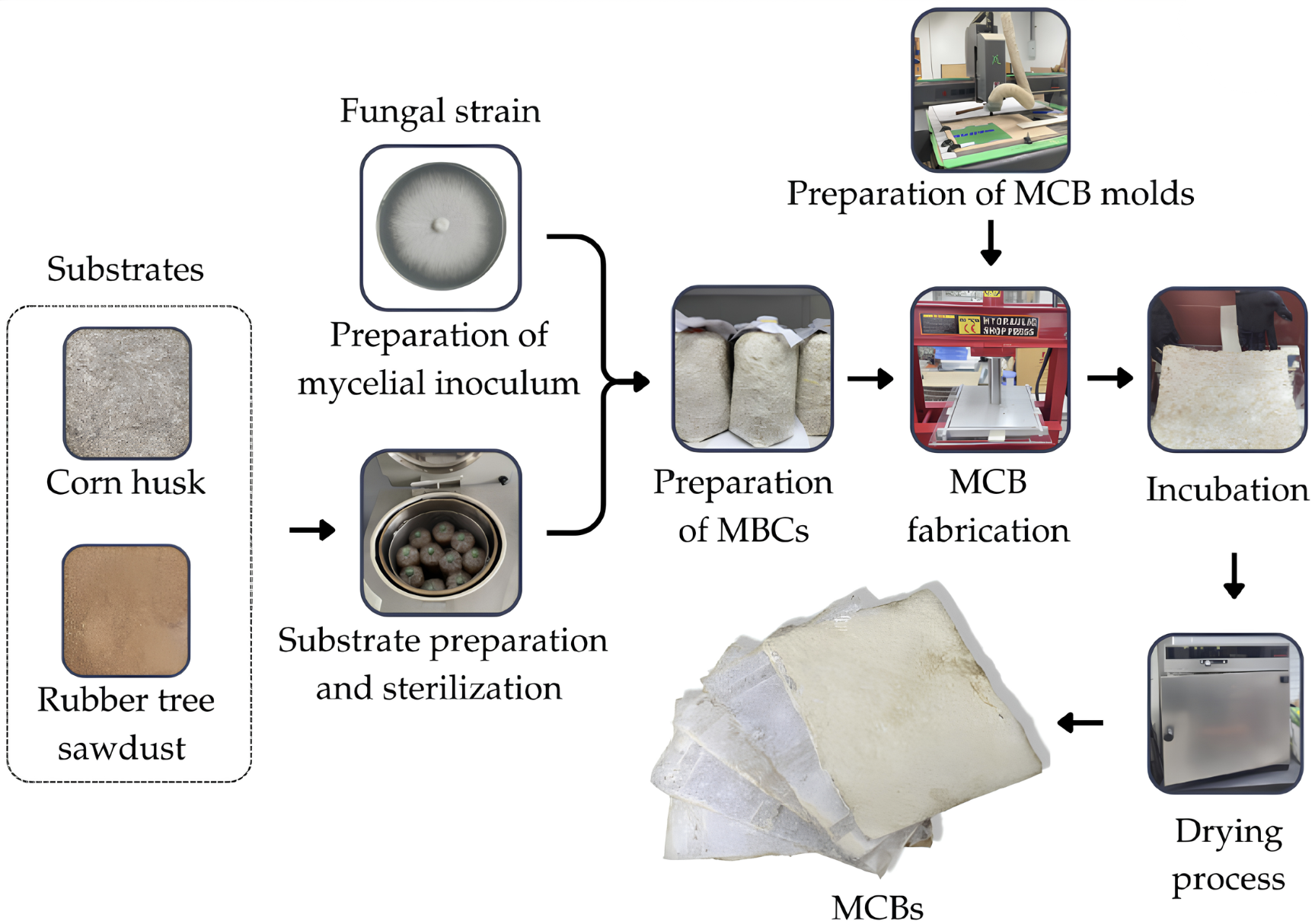
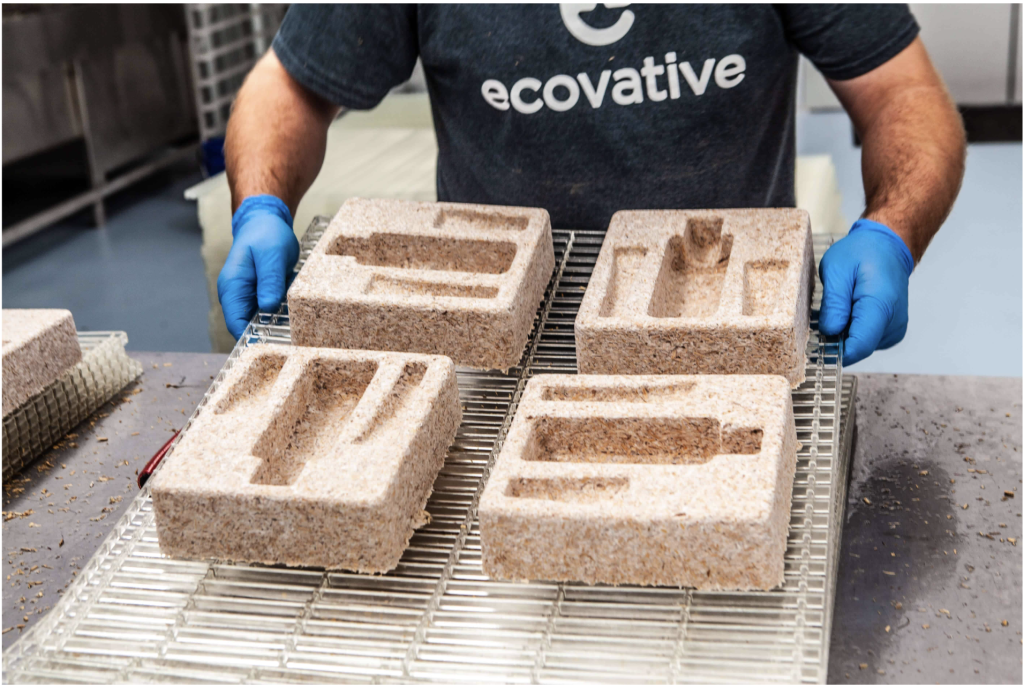
As seen in Figure 1, to produce a mycelium product, researchers have to prepare and sterilize agricultural waste, and add a fungal inoculum, which introduces the fungus into the substrate materials to grow (Jinanukul et al. 2024). The mixture is shaped in a mould and incubated, which allows the mycelium to grow throughout the material. Finally, the shaped composite material is dried to stop further fungal growth and stabilize the final product. Even better yet, commercial production is already possible. As seen in Figure 2, the company Ecovative had launched its Mushroom Packaging in 2010 and has reported that the material can be grown in a single week, and is easily compostable.
While packaging is one of the most well-known uses, mycelium composites have potential uses beyond shipping materials (Jones. et al. 2025). Researchers have explored possible uses in insulation panels, flame resistant utilities, furniture, and even alternatives to certain construction materials.
Does being bio-based automatically make a material more environmentally friendly? Not necessarily. Growing fungi, preparing substrates, and drying the finished product all require resources, while packaging must still protect goods during transport. (Zoungrana et al. 2025) Additionally, mycelium packaging faces practical challenges in integration, such as higher production costs than currently used plastics and competition with this already highly standardized manufacturing industry.
Despite these limitations, a life-cycle assessment comparing mycelium packaging with expanded polystyrene found that mycelium could potentially have a lower environmental impact in commercial settings (Zoungrana et al. 2025). Although the results had depended on factors such as material density and production methods, and heavier packaging could increase transportation impacts, the findings suggest that mycelium packaging can remain an environmentally competitive alternative to conventional materials such as plastic.
While fungi are unlikely to solve the plastic crisis on their own, mycelium packaging is yet another example of how biological systems can inspire innovative materials able to reshape the way products are manufactured and discarded.
References
Ecovative. “Mushroom® Packaging Is Back, and Growing.” Ecovative, May 1, 2023. https://medium.com/@ecovative_design/mushroom-packaging-is-back-and-growing-c8863ddfe5b
Jinanukul, Praween, Jaturong Kumla, Worawoot Aiduang, et al. 2024. “Comparative Evaluation of Mechanical and Physical Properties of Mycelium Composite Boards Made From Lentinus Sajor-Caju With Various Ratios of Corn Husk and Sawdust.” Journal of Fungi (Basel, Switzerland) (Switzerland) 10 (9): 634. PubMed Central. https://doi.org/10.3390/jof10090634.
Jones, Mitchell, Andreas Mautner, Stefano Luenco, Alexander Bismarck, and Sabu John. 2020. “Engineered Mycelium Composite Construction Materials From Fungal Biorefineries: A Critical Review.” Materials & Design 187 (108397): 108397. Science Direct. https://doi.org/10.1016/j.matdes.2019.108397.
Zoungrana, Ali, Georg Hausner, and Qiuyan Yuan. 2025. “Sustainability Assessment of Mycelium Bio-Foam Packaging Compared to Expanded Polystyrene Through Environmental Impact Assessment.” Discover Sustainability 6 (1). https://doi.org/10.1007/s43621-025-02025-8.

Leave a Reply
You must be logged in to post a comment.