A physics degree is expensive, both financially and emotionally. In return, graduates leave with a brain packed full of abstract math, sharp logical thinking, years of sleep debt, and, if lucky, only a few grey hairs. But outside research, where are those skills actually worth something? One answer is quantitative finance: using mathematical models, statistics, and computer programming to analyze markets and price assets (Cesa 2017). This work often relies on probability, differential equations, and stochastic calculus: the same mathematical toolkit physicists use to model physical phenomena.
In the 1990s, economists began describing financial markets with physical models, an approach that gave rise to the field of econophysics. (Mantegna and Stanley 1999). While these often came from thermodynamics and statistical physics, quantum physics slowly found a spot too. One simple example is Zhang and Huang’s (2010) model, which treats a stock’s price in the Chinese market like a quantum particle trapped in a box.
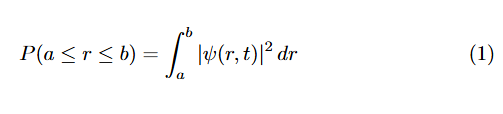
In quantum mechanics, a particle doesn’t have one definite position until it’s measured. Instead, it’s described by a wave function (ψ), which spreads across all the places the particle could be. The Born rule tells us that taking its modulus squared and integrating over some regions of space gives the probability of finding the particle within that region. Upon conducting a measurement on the particle, the spread-out wavefunction “collapses” to one definite value. Before a trade, a stock’s price, and hence rate of return (ROR), is a spread of possible values, and the trade itself is the measurement that collapses it to one value. Zhang and Huang treat a stock as a particle and its position as its ROR as shown in Equation 1.
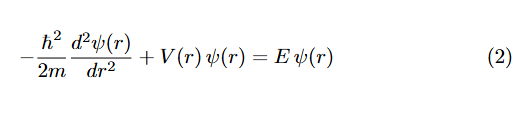
The time-independent Schrodinger equation determines the shape of the wavefunction for a given potential energy function. Zhang and Huang adapt it as shown in Equation 2, where m is the, stock inertia a measure of how readily the price of the stock moves (Zhang and Huang 2010). Solving this equation gives the form of the wavefunction for that specific potential.
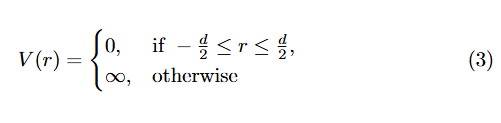
The Chinese stock market imposes a price limit rule, capping daily ROR at ±10%. To model this, the potential is set to be zero between two walls; set to be ±10% away from the origin and infinity outside. The expression for the potential is shown in Equation 3.
Within these walls, Equation 2 reads as shown below.
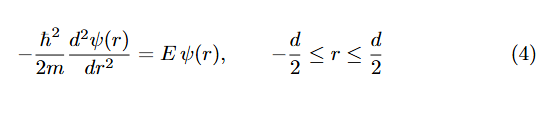
Solving Equation 4 yields the wavefunction in the form:
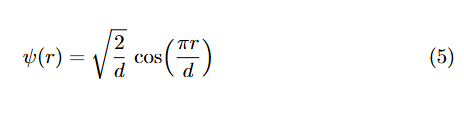
With the equation for the wavefunction, Equation 1 can be used to find the probability of getting a specific ROR within the confines of the “price well”.
It is important to note that ℏ is fine-tuned for quantum systems, not financial markets, so it would have to be derived from market data. Similarly, the stock inertia is not well defined and would also have to come from market data. Additionally, the time-dependent part was omitted here due to its length and complexity, but the authors use it to incorporate periodic fluctuations in ROR due to the news.
Using the three-dimensional version of the Schrodinger equation and changing the form of the potential are just a few of the many ways to improve this kind of model and adapt it to all kinds of stocks and markets. While this is far from a get-rich-quick model, it serves as a clear example of how quantum models can capture aspects of financial market behaviour.
References
Cesa, Mauro. 2017. “A Brief History of Quantitative Finance.” Probability, Uncertainty and Quantitative Risk 2 (1): 6. https://doi.org/10.1186/s41546-017-0018-3.
Mantegna, Rosario N., and H. Eugene Stanley. 1999. Introduction to Econophysics: Correlations and Complexity in Finance. Cambridge University Press. https://doi.org/10.1017/CBO9780511755767.
Zhang, Chao, and Lu Huang. 2010. “A Quantum Model for the Stock Market.” Physica A: Statistical Mechanics and Its Applications 389 (24): 5769–75. https://doi.org/10.1016/j.physa.2010.09.008.
Comments
3 Responses to “A Quantum Introduction to Quantitative Finance”
Hi iSci,
Recently we’ve been studying solutions to the Schrodinger equation with various different potentials in my quantum mechanics class; one of which being the infinite potential well. I happened to stumble along this article that walks through almost exactly what we did in class but interpreted in a different way which I found very interesting. Hope you enjoy the post!
Nam
Hi Nam!
I found it really interesting how concepts from quantum mechanics can be applied to something as seemingly unrelated as the stock market! I also appreciate how unfamiliar terms were explained for the reader to understand. Here are a few comments:
– P3S3: “Upon particle, the spread-out wavefunction “collapses” to one definite value”. I had a bit of trouble understanding this sentence. Should it be “Upon finding the particle”?
– For the figure captions, I noticed you switch between italics and normal case. I would keep a consistent format for better clarity!
– P4S2: I noticed there was a quotation mark before stock inertia. If this is a direct quote be sure to finish it and add the appropriate in text citation! If not, I would rearrange since “is the stock inertia a measure” is a little confusing.
Happy editing!
Nica
Hi Nam!
Great blog post. I really like your intro and the overall theme. I have a few suggestions for you during your editing process:
– P2S1: This sentence is a bit awkward. Might be better to reword it as “In the 1990s, economists began describing financial markets with physical models, an approach that gave rise to the field of econophysics.” or something similar.
– Typically, equations do not have figure captions. If you want/need captions, make these figures rather than equations. Otherwise, integrate (haha) the captions into the text and remove them from beneath the equations.
Overall, great work. I look forward to reading your final draft!
– Keira