What if the next package delivered to your doorstep wasn’t made in a factory, but grown by a fungus in mere days? It might sound strange to imagine something as delicate as fungi protecting your fragile delivery. Yet remarkably, the same organisms that decompose dead organic matter can also bind agricultural waste into protective packaging. Could this unusual process help us combat one of plastic’s biggest environmental problems?
To understand how this works, we need to look at a specific part of fungi, mycelium, a network of fine fungal filaments that can spread through organic matter. As it grows, each of these threads, called hyphae, weave through any tiny gaps between materials and grip the surroundings, which binds particles together surprisingly firmly (Jones et al. 2020). As this mycelium network expands, it produces an interlocked porous structure that holds organic material together .
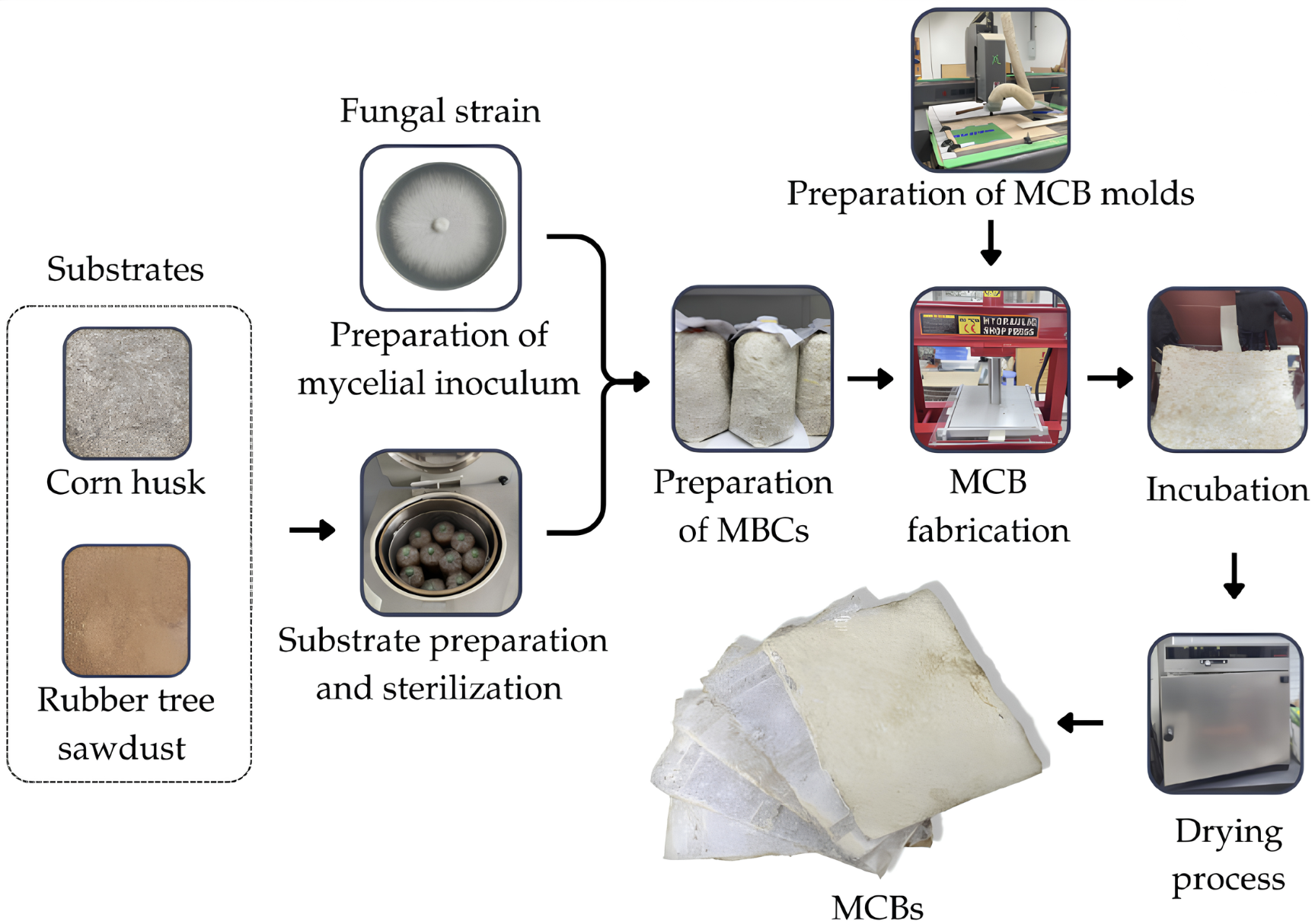
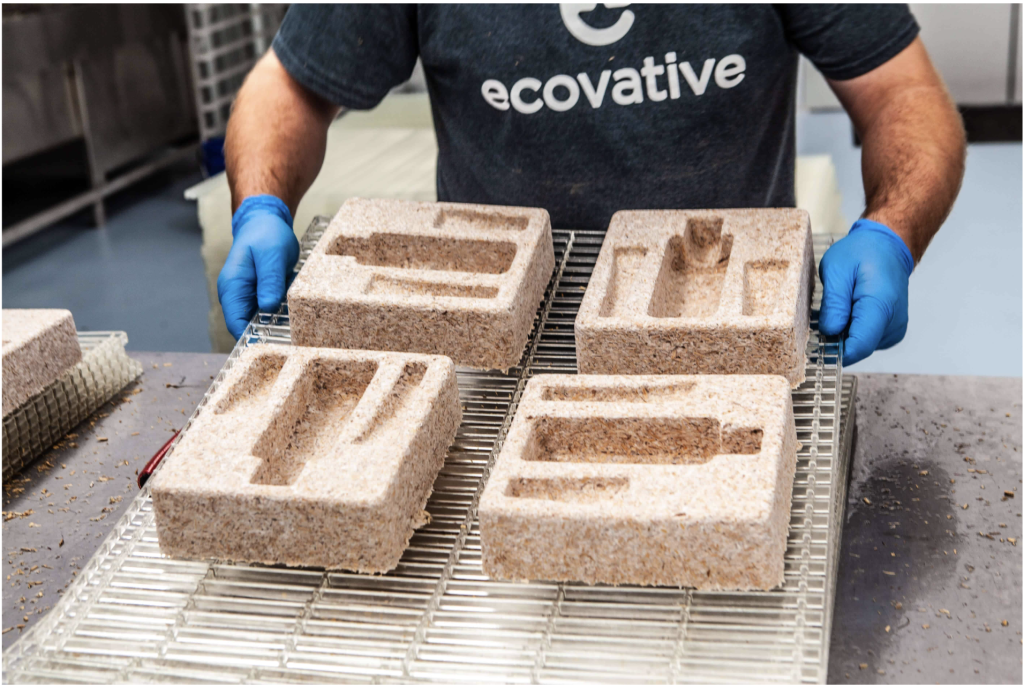
As seen in Figure 1, to produce a mycelium product, researchers have to prepare and sterilize agricultural waste, and add a fungal inoculum, which introduces the fungus into the substrate materials to grow (Jinanukul et al. 2024). The mixture is shaped in a mould and incubated, which allows the mycelium to grow throughout the material. Finally, the shaped composite material is dried to stop further fungal growth and stabilize the final product. Notably, commercial production is already possible; As seen in Figure 2, the company Ecovative had launched its Mushroom Packaging in 2010 and has reported that the material can be grown in a single week, and is easily compostable.
While packaging is one of the most well-known uses, mycelium composites have potential uses beyond shipping materials (Jones et al. 2025). Researchers have explored possible uses in insulation panels, flame-resistant materials, furniture, and even alternatives to certain construction materials.
Does being bio-based automatically make a material more environmentally friendly? Not necessarily. Growing fungi, preparing substrates, and drying the finished product all require resources, while packaging must still protect goods during transport. (Zoungrana et al. 2025) Additionally, mycelium packaging faces practical challenges in integration, such as higher production costs than currently used plastics and competition with the highly standardized manufacturing industry.
Despite these limitations, a life-cycle assessment comparing mycelium packaging with expanded polystyrene found that mycelium could potentially have a lower environmental impact in commercial settings (Zoungrana et al. 2025). Although the results had depended on factors such as material density and production methods, and heavier packaging could increase transportation impacts, the findings suggest that mycelium packaging can remain an environmentally competitive alternative to conventional materials such as plastic.
While fungi are unlikely to solve the plastic crisis on their own, mycelium packaging is yet another example of how biological systems can inspire more innovative materials that can reshape the way products are manufactured and discarded.
References
Ecovative. “Mushroom® Packaging Is Back, and Growing.” Ecovative, May 1, 2023. https://medium.com/@ecovative_design/mushroom-packaging-is-back-and-growing-c8863ddfe5b
Jinanukul, Praween, Jaturong Kumla, Worawoot Aiduang, et al. 2024. “Comparative Evaluation of Mechanical and Physical Properties of Mycelium Composite Boards Made From Lentinus Sajor-Caju With Various Ratios of Corn Husk and Sawdust.” Journal of Fungi (Basel, Switzerland) (Switzerland) 10 (9): 634. PubMed Central. https://doi.org/10.3390/jof10090634.
Jones, Mitchell, Andreas Mautner, Stefano Luenco, Alexander Bismarck, and Sabu John. 2020. “Engineered Mycelium Composite Construction Materials From Fungal Biorefineries: A Critical Review.” Materials & Design 187 (108397): 108397. Science Direct. https://doi.org/10.1016/j.matdes.2019.108397.
Zoungrana, Ali, Georg Hausner, and Qiuyan Yuan. 2025. “Sustainability Assessment of Mycelium Bio-Foam Packaging Compared to Expanded Polystyrene Through Environmental Impact Assessment.” Discover Sustainability 6 (1). https://doi.org/10.1007/s43621-025-02025-8.
Comments
7 Responses to “Transforming Mushrooms into Boxes: Is Fungi a Superior Package?”
Hi Teddy,
This is such a cool topic! You also did a wonderful job making your writing very entertaining and easy to follow. Here are a few suggestions:
-Make sure that you add a comment explaining why you chose to write about this topic!
P2S2: I found this sentence slightly difficult to read. I would suggest rewording it to: “As the fungus grows, its individual threads, called hyphae, weave through tiny gaps in the material and grip the surroundings, binding the particles together surprisingly firmly”.
P3: the term “Even better yet” might be too informal. I would suggest changing it to “notably” and also connecting with with the last sentence using a semi colon.
-Remove the period after “Jones” in your in-text citation for “(Jones. et al. 2025)”.
Overall, you did an amazing job, and I cannot wait to read your final copy!
Happy editing,
Via
Hi Via,
Thanks for the reminder to post a comment! I’ve applied the rest of your formatting suggestions.
Happy reading!
Teddy
Hi Teddy,
Great job! This was an interesting topic and I had fun reading it. Here are some points of feedback:
P4S2: Change “flame resistant utilities” to “flame-resistant materials” for better readability and flow.
P5S4: Change “this already highly standardized manufacturing industry” → “the already highly standardized plastics industry” for better readability and flow.
P6S2: Change “had depended” to “depended” for better readability and flow..
Overall, great job! Looking forward to reading the final draft.
Nam
Hi Nam,
Thanks for your recommendations! I’ve applied your changes.
Happy reading,
Teddy
Hi iSci,
Hope you enjoyed reading my post! I chose mycelium packaging as it connects to several areas of iSci that we’ve explored in class so far, and also because its particularly interesting to find uses in materials we usually don’t use in commercial settings. Topics such as ecology and biological systems were connected from our Life Sci lectures, while the use of agricultural waste to create packaging relates to our previous topics of life cycle assessments and green chemistry.
Any feedback would be appreciated,
Teddy
Hi Teddy,
This is a great link to the life-cycle assessment we’ve learned in chemistry! Mycelium as a packaging material is certainly an intriguing concept and I wonder whether or not this practice will become more standardized in the future. That said, heres some feedback for the blog.
– The title “fungi” is plural, use either “Are fungi” or “is fungus” to ensure agreement
– The title also asks if fungi is superior, but I feel there lacks explicit comparison of durability and practicality of mycelium with standard materials. While I’m aware you’ve brushed over this in certain parts I feel this section could be structured more clearly
– P1S4: delete “also”, it is redundant.
– P2S1: remember to cite right after your sentence whenever the information comes from another source and is not common knowledge
– P6S2: this sentence is quite long, consider splitting it into two for structural balance
– P7S1: the word “able” is redundant here
Overall, nicely done! Looking forward to seeing the final draft! (Everyone says this after their feedback but I couldn’t care enough to say something more original)
Regards,
Brand
Hi Brand,
Thanks for the quick advice, everything’s implemented now!
Have fun reading the final draft!
Teddy