The plastic water bottle you drank from years ago will exist in some form long after you, your children, and your grandchildren are gone. These plastic bottles are made from PET (polyethylene terephthalate), which takes an awfully long time to decompose. At first, breaking down PET with microbes didn’t seem practical because scientists thought only a few fungal species could do so. Then, a team set out to find a microbe that could. By screening multiple microbial communities living around PET waste, they discovered Ideonella sakaiensis. I. sakaiensis was able to almost completely break down a thin film of PET after six weeks at 30°C, which was only possible because of the two enzymes, namely PETase and MHETase. PETase hydrolyzes PET into smaller molecules, including MHET. MHETase then breaks MHET into terephthalic acid and ethylene glycol (Yoshida et al. 2016). Figure 1 shows the PET breakdown process.
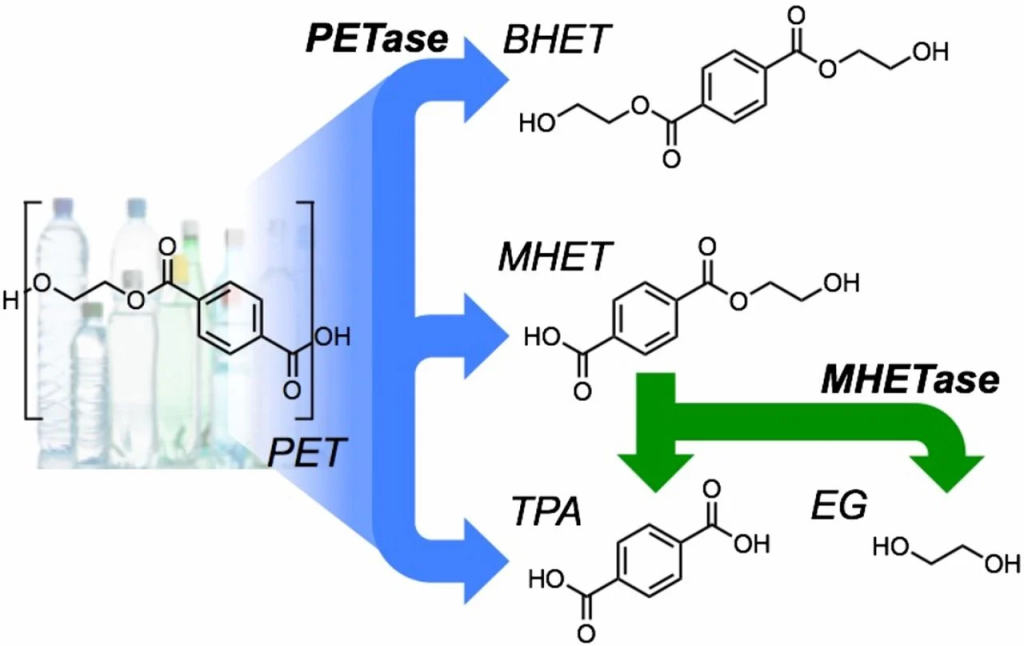
Figure 1. PETase breaks PET down into BHET, MHET, and terephthalic acid (TPA), and MHETase then breaks MHET into the building blocks TPA and ethylene glycol (EG). From Austin et al. (2018).
To understand how PETase works, scientists determined the enzyme’s structure, which shared similar features with cutinases and lipases. To test whether PETase evolved specifically to break down PET, scientists mutated two amino acids in the active site to make it more like cutinase. From this they found that PETase isn’t fully optimized to break down PET since the mutated enzyme actually broke down PET better (Austin et al. 2018). Its structural resemblance to cutinases and lipases may explain why it isn’t fully optimized, and finding a structure that breaks down PET more effectively could make a real difference in addressing the ever-increasing plastic waste.
However, PETase isn’t the only enzyme in the process. MHETase, which is the other enzyme involved, is structurally similar to PETase, but has an additional lid that’s crucial for breaking down MHET. Since MHETase breaks down PETase’s main product, researchers wondered what would happen if they physically linked PETase and MHETase into a chimeric protein. The chimeric protein showed improved breakdown of both PET and MHET compared to when the enzymes were separated (Knott et al. 2020).
Other researchers took a different route. Instead of pairing PETase with a partner, they redesigned the enzyme itself. They found that PETase works well under moderate conditions but is unstable in harsher conditions making it limited in its practical use. The challenge in improving an enzyme is finding a correct pathway through countless possible mutations. The researchers devised a computational strategy called GRAPE (greedy accumulated strategy for protein engineering), which groups predicted mutations into clusters and then stacks beneficial ones step by step. The redesigned enzyme, DuraPETase, had a melting point 31°C higher than the original and broke down a semicrystalline PET film 300 times better at mild temperatures. Crystallinity measures how tightly packed a plastic’s molecular chains are. The natural enzyme handles low-crystallinity PET well, but more crystalline PET is harder for the enzyme to break down, which is why DuraPETase’s improvement on semicrystalline film matters (Cui et al. 2021). In comparison, the film I. sakaiensis broke down was only 1.9% crystalline (Yoshida et al. 2016). DuraPETase’s ability to break down 30% crystalline PET could signal future improvements that allow the enzyme to break down more crystalline plastics.
The bottle you drank from years ago was supposed to outlast your grandchildren, but thanks to I. sakaiensis and its enzymes, it might not even outlast you.
References:
Austin, Harry P., Mark D. Allen, Bryon S. Donohoe, Nicholas A. Rorrer, Fiona L. Kearns, Rodrigo L. Silveira, Benjamin C. Pollard, et al. 2018. “Characterization and Engineering of a Plastic-degrading Aromatic Polyesterase.” Proceedings of the National Academy of Sciences 115 (19): E4350–57. https://doi.org/10.1073/pnas.1718804115.
Cui, Yinglu, Yanchun Chen, Xinyue Liu, Saijun Dong, Yu’e Tian, Yuxin Qiao, Ruchira Mitra, et al. 2021. “Computational Redesign of a PETase for Plastic Biodegradation Under Ambient Condition by the GRAPE Strategy.” ACS Catalysis 11 (3): 1340–50. https://doi.org/10.1021/acscatal.0c05126.
Knott, Brandon C., Erika Erickson, Mark D. Allen, Japheth E. Gado, Rosie Graham, Fiona L. Kearns, Isabel Pardo, et al. 2020. “Characterization and Engineering of a Two-enzyme System for Plastics Depolymerization.” Proceedings of the National Academy of Sciences 117 (41): 25476–85. https://doi.org/10.1073/pnas.2006753117.
Yoshida, Shosuke, Kazumi Hiraga, Toshihiko Takehana, Ikuo Taniguchi, Hironao Yamaji, Yasuhito Maeda, Kiyotsuna Toyohara, Kenji Miyamoto, Yoshiharu Kimura, and Kohei Oda. 2016. “A Bacterium That Degrades and Assimilates Poly(Ethylene Terephthalate).” Science 351 (6278): 1196–99. https://doi.org/10.1126/science.aad6359.
Comments
7 Responses to “The Amazing Microbe Secretly Devouring Our Plastic Waste”
Hi isci,
I first came across Ideonella sakaiensis while browsing online and learned that it can break down plastic. It made me wonder what chemical processes let a bacterium do this, and whether humans could improve it to break down plastic faster. In this post, In this blog post, I cover how I. sakaiensis uses two enzymes, PETase and MHETase, to hydrolyze the ester bonds that hold PET together. I also look at how scientists have engineered these enzymes to break down PET more efficiently.
Thank you for reading and I appreciate any feedback you have!
Hi Troy,
Awesome blog post! This blog post was pretty reassuring given all of the terrible stuff we see about plastic on social media. Here are some points of feedback.
P1S2: Change “-made from PET (polyethylene terephthalate), which take an awfully long time…” to “-made from PET (polyethylene terephthalate), which takes an awfully…” as which refers to PET as a singular noun.
P1S5: Change “-sakaiensis was almost able to completely…” to “sakaiensis was able to almost completely” for improved readability.
P1S6: Your citation (Yoshida et al. 2016) belongs inside the sentence. Remove the period right before the citation.
Overall, great job! Looking forward to reading the final draft!
Nam
Thank you for your suggestion, I have incorporated what you’ve suggested.
Hey Troy,
Great blog post! I found the subject highly insightful and relevant to our ever growing world. I also felt that the blog post had a pretty good integration of biology and chemistry in conveying its message. My one critique is that your personal voice should come through more in the text. Adding some more analysis of how these findings could impact our world, or why it is an important discovery for science right now would make your post more personalized and strengthen the blog.
– Winning
Thank you for your suggestion, incorporating my voice might be difficult cause I am a little over 500 words currently. I will find sentences that I can shorten so I can incorporate more of my personal voice.
Hi Troy,
Great blog post! I really enjoyed learning about how Ideonella sakaiensis uses PETase and MHETase to break down plastic. Here are three points of feedback:
1. Consider adding a brief explanation of why PET is so difficult to break down naturally. This would help readers understand why discovering a bacterium capable of degrading it is so significant.
2. The explanation of the GRAPE strategy and DuraPETase is interesting, but it could be helpful to briefly explain how computational modelling helps scientists identify beneficial mutations. This would make the connection between computational biology and enzyme engineering clearer to readers without a strong background in the field.
3. I think the post could be strengthened by discussing the real-world implications of these discoveries. For example, what challenges must scientists overcome before engineered enzymes can be used on a large scale to recycle plastic waste? This would help readers appreciate both the potential and the limitations of this technology.
Overall, great work connecting microbiology, chemistry, and protein engineering to an important environmental issue!
Sorry Tvara, I would love to take your suggestion into account, but I really don’t have the word count to do so.